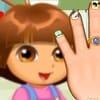
The whole mess in Dora Hand Doctor Caring starts with something muy típico of Dora and Boots: they go happily into the woods, chasing butterflies and singing… and then reality says “careful there” 🌳🫣 One bad step, a root hidden under the grass, Dora trips and lands hands first on rocks, branches and who knows what else. It is not a huge drama, but when she lifts her palms you can see scratches, little cuts and a couple of nasty splinters that clearly hurt. For once, the brave explorer needs someone else to help her instead of being the one who saves the day.
That “someone” is you. The screen zooms in and suddenly Dora’s hands are right in front of you, resting on the exam table. They look a bit dirty, a bit red, with small bruises on the knuckles. It feels almost like she is sitting there in a tiny clinic, waiting and trusting you to fix things. On the side, there is a tray full of tools: tweezers, cotton, disinfectant, bandages, cream, little scissors, even a funny machine or two. Nothing is super realistic or scary, but it all looks important enough that you pause a second and think “okay, let’s take this seriously.” 🩹
The game doesn’t rush you. You start by cleaning her hands, because that is always the first step in real life. A bit of water, some foam, soft circular movements to take out the mud and dust from the fall. While you do it, you watch how the skin color changes from greyish to normal again. On a kid’s level, it is an easy way to show that “dirty wound = bad idea, clean wound = good start.” You wipe, rinse, dry, and Dora already seems a little less worried.
Then comes the part that always makes children hold their breath: the splinters and the tiny stuck things. You take the tweezers and zoom into the spots where you see dark little fragments. If you just tap randomly, nothing happens. You have to aim, grab, pull, and see the splinter come out slowly. It is oddly satisfying when it finally slides out and disappears. Dora might react with a small flinch, but she never screams or cries in a dramatic way. The message is simple: yes, it hurts a bit, but it is manageable, and when it is done, you feel better. Kids watching that process usually relax after the first one. They realize it is not a horror show, it is just a careful fix.
Once the foreign objects are gone, it is time to disinfect everything. That is where ointments and colorful bottles appear on screen. You pick one up, dab small amounts on each cut, maybe see tiny germs “running away” in a cartoony style. In real life nobody loves the sting of antiseptic, but here it is more like a magic liquid that erases danger. Dora’s hands start to look calmer, less red, less messy. It is a nice way to show that medicine is not something to be scared of, but something that helps 💊✨
Bandages arrive right after that. And if you know kids, you know bandages might be their favorite part. They are not boring white strips: they can be colorful, patterned, cute. You decide which finger needs extra protection, which part of the palm should be covered, and how many you actually want to use. Some players wrap her like a mummy, others try to be more “doctor like” and only cover the worst parts. Either way, each bandage that appears feels like closing a chapter. “This spot is safe now. Next.”
Little by little, the energy in the room changes. At the beginning Dora’s hands looked fragile and sad. After each step, they look a bit more “hers” again. Clean, protected, treated. And when the last bandage is in place, the game does something clever: it doesn’t just say “done, bye.” Instead, it shifts from emergency mode to pampering mode. The work as a doctor is over. Now it is time to be a stylist.
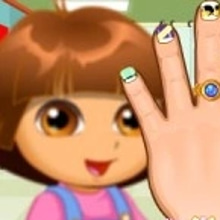
This is where the manicure part kicks in 💅🌈 The tone flips completely. The tools on the table switch from medical to decorative: nail polishes in different colors, small stickers, maybe some sparkly effects. You are no longer fixing a problem, you are celebrating that she is okay. Even with a couple of bandages still on, Dora is smiling again, ready to let you choose how her nails will look after such a rough adventure.
Maybe you go classic and pick pink or purple. Maybe you mix colors on each finger. Maybe you go full chaos and pick green, blue and yellow with tiny hearts or stars. There is no “right” choice, and that is the whole point. Dora lets kids express taste and mood: “today I want bright colors,” “today I want something soft,” “today I want all the colors at once because why not.” It is a small but powerful way of telling them that being healed is not only about not hurting anymore, but also about feeling confident and cheerful again.
The controls keep everything reachable for small hands. On PC, you move the mouse, click on a tool, drag it toward the right spot and follow simple visual hints. On mobile or tablet, everything becomes tap and swipe, which feels almost like really touching Dora’s hand and the instruments. There are no complicated combos, no strict timers ticking down. If a child needs a second to think, the game waits. If they place something in the wrong place, they can try again until it feels right. That forgiving design makes it very easy for parents to leave kids alone with the game for a few minutes without worrying about frustration or jump scares.
What makes Dora Hand Doctor Caring surprisingly nice is the quiet little lesson underneath the bright colors. The game shows that accidents happen even to brave explorers, and that asking for help is normal. It also shows that helping someone is not just one single gesture. you clean, you check, you treat, you protect, and then, if you want, you add a bit of beauty and fun on top. Kids see that sequence and, without any long explanation, they start to understand basic care routines and empathy. “If someone gets hurt, we clean the wound, we take out what is stuck, we put medicine, and then we try to make them smile again.”
It is also a neat bridge between fantasy and reality. Kids who are nervous about doctors sometimes feel less scared after “being” the doctor in a safe game like this. The tools are familiar, the process feels less mysterious, and Dora’s calm attitude gives them a friendly example. Next time they have a real scratch on their own hand, maybe they will remember the game and think “okay, first we wash it,” instead of panicking.
And then there is the simple fact that many children adore Dora. Seeing her vulnerable for a moment, trusting them, thanking them with a smile after the treatment, makes them feel genuinely useful. It is not just a high score or a level cleared. It is “I helped Dora,” which is on a completely different emotional level 🧡
So, in the end, Dora Hand Doctor Caring is not trying to be a huge, complex simulator. It is a small, cozy story told through hands and tools: a fall in the forest, a careful little appointment in a friendly clinic, and a colorful manicure to close the day. You open the game, fix what needs to be fixed, play with colors for a while, and when you exit, it feels like you just spent a quiet moment taking care of someone who is always taking care of others. For a short browser game, that is a pretty nice feeling to leave behind.
















 2.5 (23 votes)
 Share
Share
 Embed
Embed