🐭🔬 PROFESSOR RAT HAS A PLAN AND IT IS PROBABLY ILLEGAL
Heart Box drops you into a world where a brilliant little troublemaker called Professor Rat treats physics like a toy box and treats you like the assistant who has to clean up the mess. The rooms look like puzzle labs, neat and colorful, but the vibe is always the same: something is going to move, something is going to fall, and you are going to stare at it for a second thinking, wait, that can work, right.
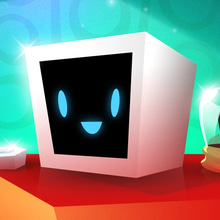
The story is simple in the best way. The professor built a robot named Robby, then decided to give him a weak battery, which is both tragic and suspiciously convenient for experiments. So Robby keeps ending up stuck to a charger like a dog on a leash, and every puzzle room is basically a setup designed to force him to escape. It is cute, it is chaotic, and it is surprisingly smart because the real narrative is not text on the screen, it is the way each room teaches you how to think with gravity instead of against it.
🔋🤖 ROBBY IS TINY, BRAVE, AND ALWAYS ONE BAR FROM DISASTER
Robby is not a superhero robot. He is more like a determined little toaster with legs. He wants freedom, but freedom requires movement, and movement requires energy, and energy requires getting off the charger. That is the whole emotional engine of Heart Box. You are not saving the world. You are saving one small robot from an extension cord life.
The game makes you care because the goal is clear every time. Free Robby from the charging point, guide him to the exit, and do it by interacting with objects in the room. You push, pull, drop, trigger, block, and occasionally you watch Robby bounce in a way that feels like the room just clapped back at your plan. When it works, it feels clean and clever. When it fails, it is rarely unfair. It is usually you being a little too confident, or a little too impatient, or a little too willing to press buttons without thinking what the button is connected to.
🧲🧱 THE ROOM IS A PUZZLE BOX FULL OF TOOLS WITH PERSONALITY
Heart Box is the kind of physics puzzle game where the objects are not decoration, they are the language. Boxes are not just boxes, they are weight, shields, bridges, and chaos grenades if you drop them wrong. Platforms are not just platforms, they are timing gates. Switches and triggers are not just clicks, they are promises.
You start learning to look at a room like a blueprint. Where can Robby roll if the floor tilts. What happens if you remove a support. Which object can stop a fall without blocking the path later. Some levels are about making a safe route, others are about making an escape route, and some are about making a ridiculous chain reaction that looks accidental but is actually the only way forward.
There is also that satisfying feeling of interaction. You tap or click something and the physics responds immediately. No long animations begging for patience. You do a thing, the room reacts, and your brain gets instant feedback. That is why it is so easy to fall into the loop.
😵💫🌀 WHEN PHYSICS STARTS LAUGHING, DO NOT TAKE IT PERSONALLY
There is a specific kind of failure in physics based puzzle games that feels almost funny. You set up what you think is a perfect plan. You move a box into position, you trigger a mechanism, and then one tiny bump sends Robby rolling in the wrong direction like he just remembered an appointment somewhere else. You sit there for a second in silence. Then you try again, but this time you add one small adjustment, and suddenly the whole thing behaves.
That is what Heart Box does well. It makes physics feel playful. Gravity is not an enemy, it is a partner that sometimes forgets the choreography. Momentum matters. Angles matter. Timing matters. Sometimes waiting half a second is the difference between a clean landing and Robby getting politely launched into a corner.
And the game encourages experimentation. You can solve many rooms in more than one way. Not infinite sandbox freedom, but enough freedom that you can feel clever. You can take the safe route, or the fast route, or the route that looks like nonsense until it works. The best moments are the ones where you solve a level and think, I should not be proud of this, but I am.
🎮⚙️ THE GAMER MOMENT WHEN YOU STOP GUESSING AND START READING
At first, you play like a tourist. You click objects to see what they do. You move things around like you are testing a new remote control. Then something shifts. You begin to predict outcomes. You see a lever and you already know it is going to drop a platform or swing a beam. You see a box and you know it is not meant to be moved randomly, it is meant to be placed exactly where the force will matter.
This is the moment the game becomes addictive. Because now you are not just solving puzzles, you are improving at a skill. You are learning to read physics puzzles. You are learning to build solutions in your head before you touch anything. You are learning to recover when your plan goes sideways.
The rooms get trickier and you start doing tiny mental checks. If Robby rolls there, can I stop him before the edge. If I break the support, will the object land in a useful spot or block the door. If I trigger this too early, does it waste the timing window. It is not complicated like a textbook. It is complicated like a good prank. It teaches you through consequences, and the consequences happen fast.
🛠️🎛️ THE LEVEL EDITOR IS WHERE YOUR INNER PROFESSOR RAT WAKES UP
Then Heart Box offers something that changes everything: the Level Editor. If you ever played a puzzle game and thought, I want to build something mean for someone else, this is your moment. The editor turns you from solver into designer, and it feels like a whole second game living inside the first.
Creating levels is its own kind of joy. You place objects, you design traps, you decide how Robby starts and how he can escape. You can make elegant rooms with one clever solution, or you can make chaotic rooms that require experimentation and a bit of luck. You learn quickly that building a good physics puzzle is not about stuffing the room with stuff. It is about making the room readable, then making the solution surprising.
And the funniest part is how it changes the way you play the normal levels. After you try designing your own rooms, you start noticing how carefully the official puzzles are built. You see why a box is placed exactly there. You understand why a platform is just slightly off center. You feel the design choices. It makes you respect the game more, and it makes you want to solve levels cleaner, because now you recognize the intention behind the chaos.
✨🏁 WHY THIS PUZZLE GAME FEELS SO GOOD ON Kiz10
Heart Box is a physics puzzle game that hits a sweet spot. It is approachable, because the controls are simple and the goal is clear. But it stays interesting because the solutions are about thinking, not memorizing. It also has a warm personality. The professor is ridiculous, Robby is lovable, and the rooms feel like playful challenges instead of cold logic tests.
If you like robot puzzle games, interactive physics rooms, logic challenges, and creative experimentation, this one is easy to recommend. You will solve a level, feel smart, then immediately get humbled by the next room and laugh about it. That loop is honest. It is the kind of challenge that makes you want to improve rather than quit.
Play Heart Box on Kiz10, free Robby from the charger, and embrace the truth every physics fan learns eventually: sometimes the best plan is the one that looks slightly insane until the moment it works 🔋🤖🧩





 3.5 (158 votes)
 Share
Share
 Embed
Embed