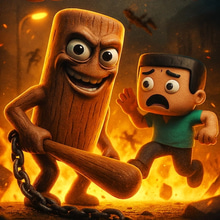
The bell dings like a frying pan and Sahur wobbles into frame with a grin that says trust me, I’ve got this. A split second later a hammer twice his size yanks him sideways, a bot tumbles through a table, and the crowd goes feral. Hero Ragdoll Fighting isn’t about spotless form—it’s about glorious physics, desperate recoveries, and the kind of slapstick mastery that makes you laugh even while you’re lining up the next knockout. You are Tung Tung Tung Sahur, one legend and many bruises, and the arena is your toy box.
🥊 Elastic mayhem, honest physics
Every swing has weight, every stumble has momentum, and every impact tells a tiny story. You don’t just press attack—you commit your whole goofy center of mass to a haymaker and ride the consequences. Clip a foe with the edge of a bat and watch them pinwheel into a hazard; overextend on a jump-kick and learn humility as you helicopter into a lamp. The controls are simple—WASD or a comfy virtual joystick—but the feel is rich: timing a lunge to catch the perfect rebound becomes a skill you can feel in your shoulders.
🧰 Sahur’s arsenal, equal parts genius and menace
Sahur doesn’t collect weapons so much as adopt personalities. A steel pipe is quick and petty; it loves interrupts and trip hits. The sledge is comedy until it lands, then it’s punctuation. Twin knives turn stumbles into lucky flurries that feel planned even when they weren’t. A chain—oh, the chain—draws elegant arcs that punish anyone who forgets geometry. Ranged toys pop up too: a springy blaster that knocks both of you back (use the recoil as mobility), a sticky grenade that’s half threat, half prank, and a boomerang that returns on its own peculiar schedule to bonk the guilty or the unlucky. None of it requires manuals. All of it rewards practice until “ragdoll chaos” starts looking suspiciously like choreography.
🎮 Survival mode: waves that learn your name
It begins with clumsy bots who windmill like noodles and ends with elites that bait your swings and chase angles. Between those bookends: escalating modifiers, tighter arenas, surprise weapon drops, and that delicious scoreboard pressure. Survive long enough and the arena itself turns into a partner—walls to bank throws, ramps to slide-kick, fans that gift an accidental lift into a heroic uppercut. A good wave feels like jazz: you parry with a shoulder, rebound off a crate, snag a midair hammer and drop a finisher that looks scripted but was pure instinct. The timer doesn’t care how pretty it looked. The combo counter does.
📜 Campaign mode: levels with opinions
Each stage is a tiny thesis. A construction site where swinging girders punish tunnel vision. A temple courtyard with wind bursts that reroute jumps at the last possible frame. A neon diner whose slick floor makes footing an active verb. Levels layer gimmicks without cluttering the read: you see the hazard, you grin, you decide whether you’ll use it like a pro or fly into it like an educational example. Boss encounters trade raw HP for personality—a shielded bruiser who only opens after a whiffed grab, a mirror fighter who copies your last attack type, a trap-setter who fights the room more than you and loses to your patience.
⚡ Movement that turns flailing into flow
Ragdolls love momentum, and you’ll learn to love it back. Short hops turn into hop-cancels that reset stance. Shoulder checks convert defense into offense without a button labeled “parry.” Ground slides steal distance and set angle for a rising strike; time the pop and you’ll surf off a bot’s shin like a smug skateboarder. Recovery matters as much as attack—wiggle mid-air to face the right way on landing, tap forward twice to absorb bounce and avoid the dreaded pratfall. It’s slapstick that rewards intent; the more you mean a move, the more the physics engine says okay, I see you.
🧠 Ragdoll tactics (or, how to look brilliant on purpose)
Anchor your swings to edges. The last 10% of a weapon arc hits hardest; aim for that slice of space and you’ll start seeing knockdowns you can finish clean. Respect stagger—two light taps are often better than one greedy wallop that spins you into trouble. Use the stage like a co-op partner: shove, bank, bounce. When you’re disarmed, don’t panic; Sahur’s hips plus a well-timed jump can body-check a bot into a prop long enough to repossess your favorite toy. The secret sauce is rhythm: attack, micro-stabilize, reposition, attack. Once that cadence lands, the chaos starts behaving.
🗺️ Arenas that clap back (politely)
Props aren’t decoration. Barrels roll. Signs swing. Tables break, altering paths in ways that create new lines the next second. Electric floors cycle; learn the beat and you’ll toss foes into sparks like a magician revealing a trapdoor. Springs on the edges fling anyone foolish enough to pin themselves there—which is why good players “accidentally” back into a spring with a raised weapon and let physics do the rest. Each arena becomes a personality you learn to exploit: the thin bridge where spacing wins, the pit ring where ring-outs are currency, the multi-tier loft that turns vertical control into dominance.
🔧 Perks, styles, and tiny edges
Between bouts, you pick perks that tilt physics in charming ways. A wrist wrap reduces weapon wobble just enough to land edge hits more consistently. Soft-soled boots grip after slides, letting you pop into stance without the extra wobble. A headband widens brief “super armor” during windup—dangerous in the wrong hands, glorious in yours. Cosmetics arrive as jokes you’ll grow fond of: a cape that flutters more as your combo climbs, a frying pan skin for the hammer (the sound is art), gloves that spark on perfect counters. They don’t auto-win fights; they make good habits louder.
🔊 Sound of slapstick glory
Hits land with meat and metal, never mush. A clean edge clack is a higher pitch than a handle thud; your ears start coaching your aim. Springs boing with a smug note right before the launch, telegraphing comedy. Crowd noise swells on streaks, dips when you faceplant, surges when you stand up and do something heroic. The soundtrack is punchy percussion and grinning synths, the kind of beat that makes even a textbook juggle feel like a music video you didn’t budget for.
📱 Simple inputs, real mastery
Keyboard players dance on WASD, feathering momentum instead of wrestling it. Mobile pilots thumb a virtual joystick that appears where it’s comfortable—no camera to babysit, just readable space and a character who respects your intention. Attacks sit on context: proximity chooses shove vs. swing, height nudges strike types, and a quick double-tap turns a panic step into a dodge that looks like swagger. The game meets you where you are and then quietly raises the ceiling.
🏅 Goals that keep the loop spicy
Survival chases wave counts and elegant time-to-clear. Campaign tracks finesse: fewest falls, fastest ring-out, “no weapon” clears that make you a folk hero. Optional dares float in during fights—win without touching the floor for five seconds, land three edge hits in a row, finish a boss with environmental damage—and completing them unlocks goofy banners and serious pride. Leaderboards aren’t just numbers; they’re shorthand stories of players who learned to make physics sing.
🧩 Micro-habits of a master ragdoller
Breathe on windup; held breath equals over-swing. Aim with hips, not arms—the body leads, the weapon follows, and the arc reads cleaner. Reset stance after big contact with the tiniest backward tap. If you’re airborne, decide right now how you’ll land; accidental sits are losses you don’t need. Above all, chase control, not chaos: the funniest KOs usually happen to the player dictating the joke.
🌟 Why Sahur’s legend sticks
Because few things feel better than turning flailing into fluency. Because ragdoll physics can be comedy or craft, and Hero Ragdoll Fighting lets you choose both on the same punch. Because Campaign levels charm, Survival waves demand, and the weapons are equal parts toy and tool. Mostly because there’s a moment in every run when the swing, the bounce, and the room all agree with your plan—and the KO lands with a perfect clonk that makes you laugh out loud. On Kiz10 the restart is instant, the climb is fair, and Sahur is ready to prove (again) that no one does spectacular nonsense quite this well.





 Share
Share
 Embed
Embed


