🕯️🔪 A Quiet Room, A Spinning Horror, And Your Finger Hovering
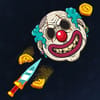
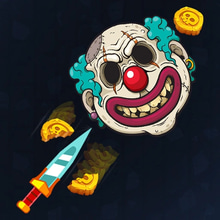
Knife Hit Horror has that deliciously mean setup: one creepy target, one simple rule, and a lot of ways to embarrass yourself in under five seconds. You’re staring at a spinning monster head, the kind that looks like it belongs on an old VHS cover with “DO NOT PLAY AT NIGHT” written in marker. The screen is minimal, the atmosphere is off, and your job is painfully clear: throw knives into the target without hitting any blade already stuck there. It’s a timing game pretending to be simple, but it’s really a tiny horror ritual where every tap feels like a dare. On Kiz10, it’s the perfect “just one try” trap, because the game is quick, the feedback is instant, and your ego will not let you stop after a dumb miss.
The best part is that the fear here isn’t a jump scare, it’s anticipation. You watch the rotation, you spot a gap, your thumb twitches, and suddenly you’re not thinking about “strategy” anymore. You’re thinking, please don’t clip that knife, please don’t clip that knife, PLEASE don’t— and then you clip it. The fail is immediate. The shame is immediate. The restart is also immediate. Dangerous combo.
🧟♂️🌀 The Spin Has Personality, And It’s Not Friendly
The target’s rotation is the entire personality of Knife Hit Horror. Sometimes it spins smooth and predictable, like it’s letting you warm up. Sometimes it speeds up just enough to make you rush. Sometimes it feels like it changes its rhythm at the exact moment you decide to be confident. That’s the mind game. The target doesn’t need complex mechanics to feel threatening, it only needs to keep you slightly unsure. Because uncertainty makes you tap early. Uncertainty makes you tap late. Uncertainty makes you tap twice in panic like a gremlin and then act surprised when the blades collide 😅.
And the more you succeed, the more the board becomes crowded with your own decisions. Every knife you land is now a hazard you created. That’s a sneaky kind of difficulty scaling: you build the trap while trying to escape it. The board is literally your history spinning back at you, faster and faster, like the game is saying, “Remember that confident throw? Cool. Now live with it.”
👁️🩸 The Gap Is a Promise, Not a Guarantee
At first, you see big empty spaces and think you can throw rapidly. That’s how Knife Hit Horror catches people. Because the real skill isn’t throwing fast, it’s throwing clean. The safe gap you see is only safe for a moment, and if you tap with sloppy timing, the rotation carries a knife into your landing point right before impact. That’s when the game feels cruel in the most satisfying way: it’s not random. You can see why you failed. You can replay the moment in your head like a dramatic slow-motion scene. You were impatient. You got greedy. You believed in “close enough.”
Then you learn the good habit: watch a full rotation. Not because the game demands it, but because your brain needs it. A full rotation teaches you rhythm. Rhythm teaches you calm. Calm keeps you alive. It’s weirdly Zen for something that involves throwing knives at a monster face 🤨🔪.
🕷️🎯 Rhythm Beats Reflex, Even When Your Heart Disagrees
Knife Hit Horror is a rhythm game wearing a horror mask. Yes, reflex helps, but reflex alone makes you twitchy. And twitchy players throw at the first gap they see, which is the exact gap they shouldn’t take. The real winners are the ones who settle into a tempo: observe, breathe, throw. Observe, breathe, throw. Not slow. Just steady. The moment you speed up for emotional reasons, the game punishes you. It’s like it can smell adrenaline.
There’s a specific psychological trap the game sets: you get a streak going, you feel powerful, and you decide to “finish the level faster.” That decision is usually fatal. Because your tempo shifts. Your timing window shrinks. Your hand stops listening to your eyes and starts listening to your confidence, which is the least accurate sensor on Earth 😭.
When you stay steady, something cool happens. You start throwing before you consciously think “now.” Your timing becomes muscle memory. The target spins and your hand responds like a metronome. That’s when the game stops feeling scary and starts feeling satisfying, like you’ve tamed the spin.
🪦🔪 When the Board Fills Up, the Air Gets Heavier
The pressure ramps up in a very clean way: with every successful hit, you remove future safety. Early throws feel generous. Mid throws feel focused. Late throws feel like threading a needle while someone whispers in your ear. The gaps are smaller, the stakes are higher, and your brain begins narrating every moment like it’s a horror movie monologue. Okay, there’s the gap. Wait. WAIT. Not yet. Not yet. Now. NOW. And then you miss by a pixel and feel personally attacked by geometry.
What’s fun is that the tension is earned. It’s not loud. It’s not flashy. It’s just the board getting tighter, the spin feeling faster, and your patience being tested like it’s on trial. Every level is basically a test of whether you can keep your cool while the game begs you to panic.
🧛♂️🕯️ The Horror Flavor Is a Little Joke You Keep Falling For
Knife Hit Horror uses the spooky theme like seasoning. The monster target, the eerie vibe, the “don’t let them escape” energy, it all adds flavor to a mechanic that is already addictive on its own. And it works because it changes how you feel while playing. A normal knife target is stressful. A horror target makes it feel like you’re battling something alive. Even if it’s just spinning. Even if it’s just pixels. Your brain still treats it like a rival.
That’s why misses feel dramatic. It’s not just “game over.” It’s “I slipped, and the monster wins.” The game makes tiny failures feel cinematic, which is ridiculous, but also exactly why you keep retrying.
🎮⚡ Why It’s So Addictive on Kiz10
Knife Hit Horror is built for fast sessions and stubborn players. It’s easy to understand instantly, hard to master cleanly, and brutal in the way good arcade games are brutal: you always know what you did wrong. That honesty is addictive. You don’t quit because it feels unfair. You replay because it feels fixable. One better pause. One calmer throw. One less emotional tap. That’s all it takes.
If you love arcade skill games, timing challenges, horror-themed reflex tests, and that sharp “one more try” loop where your improvement is visible minute by minute, Knife Hit Horror is a perfect fit. Play it on Kiz10.com, settle into the spin, respect the gap, and don’t let your confidence throw the knife for you. 🕯️🔪😈






 4.1 (38 votes)
 Share
Share
 Embed
Embed