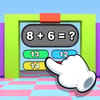
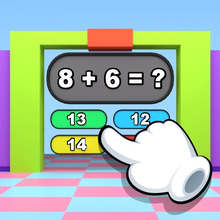
The corridor hums like a starting line, all glow and nerves, and at the far end the first wall wakes with a problem that feels small until your feet start moving. Math Wall Simulator doesn’t hand you a worksheet; it hands you velocity. You sprint, the equation pops, your brain answers faster than your mouth could, and the bricks either blossom into neon shards or stay smugly intact while your momentum scolds you. It’s thinking as a sport—clean, kinetic, a loop that turns arithmetic into door keys and accuracy into speed.
🧠 Numbers that move, not numbers that sit
The early classes are kind on purpose. Addition and subtraction fall like dominoes; 8+7 becomes 15 before you’re halfway to the gate because you quietly stole 2 from the 7 and made a 10. You stop counting, you start shaping. Then multiplication rolls in and the rhythm changes—fours drum, fives clap, nines wink with pattern tricks you suddenly remember because the wall doesn’t wait. Division shows up with a tiny ego and you answer by chunking groups: 36÷4 isn’t a riddle, it’s “halve, then halve again,” and the correct door tilts open like a friend holding it with a foot.
🏃♂️ Decisions that feel like jumps
Every equation is a fork in the lane. Two, sometimes three, answer gates fan across your path, and the right one is a small, honest angle away—reachable if you commit early. Slide left for 42, cut right for 36, hop the center if the difference lands in your bones. The sweet spot is where math shifts from “typing answers” to “reading lines.” You’ll learn to glance ahead, budget brain cycles, and aim for the door before the full result finishes forming. Miss by a digit and the wall says “not today” with a rubbery thud; nail it and coins spray in a happy arc that makes the next sprint braver.
📚 Twenty classes, twenty moods
Progression climbs like a fair staircase. Classes 1–3 are pure arithmetic—great for warming up thumbs and turning sums into reflex. Classes 4–6 start mixing operations and parentheses; order becomes a rhythm you can hum (inside first, then multiply/divide, then add/subtract) and suddenly your hands trust the chant. Classes 7–9 add negatives—less a monster than a compass; flip directions, keep the magnitude tidy, slide through the correct sign like you planned it. Fractions enter around the middle and discover you at sprint pace: reduce when it’s obvious (divide top and bottom by 2 or 5 without blinking), skip when it’s fiddly, because flow is a resource. Late classes drop exponents and square roots as boss walls—short problems with long shadows that reward estimation first, precision on the cut. The capstone sets toss tidy word snippets and pattern checks: “every third tile adds 2” or “double then subtract 5”—tiny stories told at jogging speed.
💡 Shortcuts your brain learns in self-defense
You’ll watch new habits appear like magic tricks you swear you always knew. 27+14 becomes 30+11 because tens are easier on the ankles. 7×8 turns into (7×4)×2—halves and doubles are friendlier than tables under pressure. 45÷5 is just 9 because fives live in your wrist now. For fractions, a denominator of 10 means “move the decimal and smile,” 25 means “twice to 100,” and anything over 1 invites “whole plus remainder,” which is safer at speed. These aren’t tips in a menu. They’re reflexes you earn by bumping into walls until the geometry of good thinking fits your stride.
🎯 Modes that tune your brainstate
Classic is the core: a ladder of classes with a timer that respects calm more than panic. Endless smooths into a trance where difficulty rises like tide—one clean answer at a time, one coin ribbon after another. Time Trial compresses everything into sixty rude seconds; here, estimation rules: round first, correct late, win on rhythm. Daily Challenges break your comfort on purpose—negatives-only sprints, fraction frenzies, double-speed exponents—and you come out the other side a little sharper even if your score looks modest.
🛠️ Coins, upgrades, and style that actually helps
Shattered walls spill coins you funnel into gentle advantages. A focus visor widens the highlight on the correct gate by a whisper—just enough to reward early reading. A momentum band refunds a sliver of speed for three perfects in a row, turning discipline into velocity. A ghost pace outlines your best run so far, a transparent rival you will chase and pass and chase again. Skins are earned swagger: chalk-dust trails, neon grids, comet sparks that flare during streaks. They won’t solve for x, but they’ll make a ten-wall perfect feel like fireworks.
🎛️ Controls that vanish when flow arrives
On desktop, WASD or arrows glide you between answers while a clean tap locks the choice; space can hop tiny gaps when two gates sit rudely apart. On mobile, a thumb swipe steers and a tap confirms—no camera wrangling, no fussy targets, just lanes and decisions. Inputs are forgiving when intention is clear and strict when you waffle, which is precisely the lesson the game wants you to learn: decide, commit, go.
🧩 Gentle scaffolding without babying
If a class keeps tripping you, the simulator responds with tempo and repetition, not lectures. Early walls in a set might glow factors for a single frame or nudge a denominator hint with a soft shimmer. As you succeed, the helpers fade. Failures reset instantly—no loading sighs—so practice feels like play, not penance. You will start a run annoyed and, sixty seconds later, be grinning at the sound of your own improvements.
🎵 Sound that turns thinking into groove
The lane carries a metronome heartbeat; gates line up to the downbeat, and syncing your answers to that pulse feels like cheating even though it’s just good timing. Correct pings are bell-bright; wrong thuds are cushioned so your shoulders don’t climb to your ears. Coin pick-ups gliss in ascending twinkles that make streaks sound like applause. Class promotions drop a warm chord that lands in your chest like permission to be proud. It’s not fluff—it’s feedback, and it makes you faster without ever telling you to hurry.
🧠 Micro-habits of a crisp runner
Anchor your gaze one gate ahead so your hands finish the current answer while your eyes prime the next. Whisper order of operations on mixed sets once at the start, then trust muscle memory. For big multiplications, break into friendlier chunks (12×14 = 12×10 + 12×4) and aim while you add. In fractions, reduce only when the factor is obvious; protect your pace. If your brain fogs, grab one clean correct to reset rhythm; streaks rebuild confidence faster than pep talks. And yes: breathe on the commit. That half-second exhale makes answers land truer than any upgrade.
🏆 Why “one more class” keeps being true
Because the loop is honest: think well, move clean, get rewarded. Because improvement is visible—today you hesitated on negatives, tomorrow you flip signs like a reflex and wonder what changed (you did). Because leaderboards tell little stories—who solved fast, who solved neat, who solved brave—and those stories make you want another lap. Mostly because Math Wall Simulator treats math like motion and motion like joy. On Kiz10, you’re two clicks from flow, ten gates from a grin, and one perfect streak from proving to yourself that clever and fast can be the same thing when the wall is asking nicely for the right answer.
















 2 (158 votes)
 Share
Share
 Embed
Embed