🧩 Tiny pixels big decisions
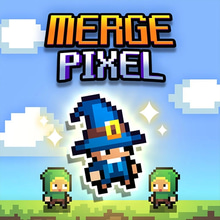
Merge Pixel looks simple at first glance. Cute dot characters drift onto a small board and you slide them around until two identical ones touch and fuse. Then your brain does that click. Every merge frees a tile, every new spawn costs a tile, and the distance between genius and game over is exactly one careless move. It is a merge puzzle that plays fast but rewards patience, a little spatial foresight, and the kind of gentle greed that makes you say okay just one more fusion and then I will clean the board I promise.
🎨 Dot art that feels alive
These are not blank tiles. Each sprite blinks with attitude a cap tilted here a cape flicking there a tiny emote when a merge lands. Color palettes stay crisp so pairs are easy to spot at a glance even when the grid starts to crowd. The higher levels glow with subtle highlights so a fresh legendary reads instantly across the board. That readability is half the pleasure. Your eyes relax. Your hands move. Your plan emerges from the pattern rather than from a menu full of numbers.
🧠 The real game is space management
Merging is easy. Making room for the mergers is the trick. You slide a second level unit toward its twin and suddenly a third piece spawns in exactly the square you needed. Fine. Push two mid tiers together on the opposite side to open a lane, but that makes a new spawn again, so your lane narrows. The habit that saves runs is thinking two merges ahead. Keep a small “garage” corner where you park half-built pairs, then build toward them instead of dragging them across traffic. When the board gets tense, stop moving three things and commit to finishing one chain. Control returns the moment a legendary pops and frees two tiles at once.
⚙️ Combo timing matters more than speed
Rapid swiping looks dramatic, but Merge Pixel pays the player who stacks a little drama before the flourish. Nudge pieces to set up a cascade, then execute in four moves that fuse two pairs and create one high-tier result. The satisfaction is not just visual. Cascades give you a rhythm that prevents panic spawns from blocking key paths. If you feel yourself rushing, anchor one side of the board and work outward like tidy handwriting. This one shift turns “almost there” boards into clean wins.
💡 Power ups as clever punctuation
When available, boosters behave like tools not cheats. A swap lets two tiles trade places and can rescue a doomed lane if you use it early, not late. A hammer clears one nuisance piece, best spent on an orphan with no partner in sight. A magnet pulls nearest matches one tile closer, turning awkward diagonals into clean edges. The rule is simple save tools for position, not for points. Good position makes points inevitable.
🚀 Progression that feels tactile
Evolving to a new tier does more than change the sprite. Hitboxes feel snugger on movement, feedback pings get brighter, and merges release a tiny particle burst that the eyes read as “room created.” It is subtle, but it trains you to chase clarity rather than just level numbers. The moment a new legendary drops, you instinctively tidy the board around it because your senses tell you space just became affordable again.
📍 Micro tactics that quietly win the day
Work the edges first. Corners hold pairs safely while you weave traffic in the center. Keep a “spacer” tile between two parking pairs so new spawns cannot wedge themselves into your perfect plan. When the grid feels jammed, scan for the closest pair that finishes in two moves or fewer. Clearing one quick chain often opens a surprising corridor. If you are one move from a cascade and a spawn threatens your route, make a small stalling merge elsewhere to redirect the next piece away from the lane you need. These are soft habits, but they add up to a board that behaves.
🧭 Modes that change your mindset
A relaxed mode lets you play with coffee, smoothing spawns and encouraging long tidy combos. A challenge mode cranks cadence and throws oddballs that demand creative parking. Time trials reward brisk, deliberate routes and punish indecision. Swapping modes between sessions trains different parts of your brain. After a few fast runs, the normal grid feels luxurious, and you start seeing chains you used to miss.
🔊 Sound that teaches your fingers
Merges chime with a warm upward interval, and failed drags make a soft cloth sound instead of a buzzer, keeping your mood curious rather than cautious. High-tier fusions add a little bass bloom that says space gained without words. With headphones you will start moving to the cadence of your own merges, which weirdly reduces mistakes. It is a private metronome that keeps you from over dragging into a trap.
📱 Controls that disappear
On phone you thumb-slide any tile, with forgiving snap-to-grid that lands where you intended. On desktop a quick click-drag feels precise even when you are threading two units through a narrow channel. Input latency is minimal so the board always feels fair. That fairness matters, because Merge Pixel is a game about discipline; you want every mistake to be yours.
🎯 How to rescue crowded boards
Zoom your attention out and find the most numerous tier. Those are hidden points. Consolidate two of them to free just enough space to finish a higher chain you parked earlier. Avoid dragging through the middle if you can route around a side. Middle traffic creates accidental spawns in the worst places. If no pair is within two moves, deliberately create a pair next to a piece that already has a partner nearby. You are building a zipper. Once the first tooth closes, the rest follows.
🏆 Why you keep saying one more merge
Because every session leaves you with a tiny lesson you can use immediately. Because the sprites are charming without shouting and your best runs look like a neat little city of colors that suddenly lights up. Because failure never feels random; it feels like a story you can tell I split my garage, I dragged through the center, I got greedy one move early and you know exactly how to not repeat it. Merge Pixel turns simple rules into a satisfying routine you can improve daily, and that invisible climb is addictive in the kind way. You arrive for a three-minute brain snack, you leave twenty minutes later with a cleaner grid, a new legendary smiling in the corner, and the quiet confidence that the next run will be the tidy one.



 2.5 (154 votes)
 Share
Share
 Embed
Embed


