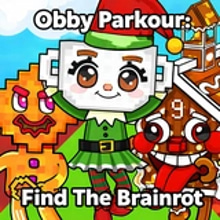
The first thing that hits you in Obby Parkour Find The Brainrot is visual noise in the best possible way. Platforms float at odd angles, colors shout from every corner, random props sit everywhere like someone spilled a toy store across a parkour map. It looks messy on purpose. Somewhere inside that mess the brainrot is hiding and the game quietly asks a simple question. Can you actually see it. 👀
You are not running and jumping like in a classic obby this time. Instead you are doing something almost harder. You are standing still and paying attention. Every level is a busy scene built in that familiar obby style blocks floating in space, quirky decorations, tiny characters but your task is not to reach the finish line. Your task is to find one specific thing hidden among dozens of distractions. A tiny brainrot tucked between props. A shape that looks like it is joking with you.
On the first level you feel confident. The brainrot is visible after a few seconds and you tap it with that smug little smile that says this is easy. Then the game adds more elements. Extra platforms. More props. More small details that look sort of right and sort of wrong at the same time. Suddenly your eyes start sliding over things without really registering them and you realise Obby Parkour Find The Brainrot is not just about what is on the screen. It is about how long your attention can actually stay sharp.
Eyes against visual chaos 👁️🧠
Each stage is built like a visual trap. The designers stack colors, shapes and objects in front of you and wait to see what your brain ignores first. Bright pieces sit next to muted ones. Clean lines blend with weird angles. There might be ten objects that share the same color as the brainrot so you cannot just hunt by shade. You have to look for outlines, small details, maybe a familiar face peeking out from behind something else.
You start scanning the way a detective scans a crime board. Top to bottom. Left to right. Then the opposite when that fails. You zoom in mentally on suspicious clusters of detail. That pile of crates. That crowd of small props in the corner. That area where shadows are thicker. The game does not move anything yet still feels alive because your eyes are constantly traveling and your brain is quietly sorting everything into yes no maybe piles.
There is a strange satisfaction when you finally notice the brainrot in a place you ignored three times already. It feels like catching someone who has been standing behind you silently for minutes. Nothing jumps at you. No cheap fright. Just the sudden click of recognition and a small surge of pride that says there you are I knew you had to be somewhere.
How the brainrot hunt works 🧩🔍
Mechanically the rules are simple. Each level shows you a scene filled with elements and somewhere inside is the correct brainrot item. You tap or click when you think you have found it. Choose correctly and the game rewards you with progress, points and that very addictive feeling of being sharper than the chaos. Miss and you feel the sting of a wasted move.
The challenge is that the target can be anywhere. Sometimes it sits almost in the open waiting for players who rush and get lucky. Other times it hides behind overlapping shapes peeking out with only a small part visible. The more you advance the more the game loves these partial reveals. Maybe you only see a fragment of a face. Or just the edge of a familiar silhouette squeezed between blocks.
You start developing small tricks to handle this. You blur your eyes for a second to see big shapes instead of details. You then focus on fine lines to catch tiny differences in outline. Some players prefer to divide the screen into invisible zones and clear them one by one. Others prefer to scan by color or by the direction of light. None of these methods are official features. They are just signs that the game has wormed its way into your thinking.
The best part is that there is no single right way. Some levels yield quickly to a broad sweep. Others demand that you zoom mentally into a packed corner and really read every detail. That variety keeps you from slipping into autopilot which is exactly what a game about attention is supposed to do.
Obby style worlds without falling off 🧱🏃♂️
Even though you are not jumping, the obby parkour spirit is everywhere. The backgrounds look like they were ripped out of a Roblox course mid run. Floating islands. Skinny platforms suspended over a void. Random props that would make sense as obstacles if you were racing through them instead of studying them.
This gives each level a strange tension. Your eyes expect movement. Your fingers almost want to press jump. Instead you stand still and search, which feels a bit like trying to read a book while sitting on a roller coaster track. The energy of movement is there you just channel it into focus instead of physical reactions.
Sometimes you imagine the route you would take if this was a regular obby. You trace imaginary jumps between platforms while your eyes hunt for the brainrot at the same time. That mental multitasking makes the scenes feel deeper than a flat picture and is one of the reasons the game feels fresh even after many levels.
Speed focus and tiny mistakes ⏱️⚡
Obby Parkour Find The Brainrot is not content with slow careful searching forever. It also nudges you with time and reaction pressure. The faster you find the brainrot the better your standing. Leaderboards do not care that the level was pretty. They care how quickly you spotted the right object.
This turns every second into a small gamble. Do you tap what looks almost right and risk a mistake. Or do you spend three more seconds checking the rest of the scene while the clock silently judges you. Small errors add up. Click on the wrong thing too many times and you feel your confidence wobble. Start doubting your instincts and the hunt becomes even harder.
When it flows though, it feels amazing. There are runs where your eyes lock onto the target almost instantly. You tap, the brainrot reveal animation pops, and you move to the next level with a grin. Then there are runs where you are sure the game is trolling you because nothing looks right. Those are the moments where you have to breathe, slow down and remember that the brainrot is always there. The only question is whether you are actually looking or just rushing.
Competing with friends and the board 🏆😈
Once you get comfortable with the basic gameplay, the leaderboard starts whispering in your ear. It is not enough to complete levels. Now you want to complete them faster than other people. Suddenly your careful methodical scanning turns into a race against ghost scores.
You challenge friends and brag about times. That one level where you found the brainrot in a ridiculous number of seconds becomes your favorite story. Of course they try to beat it. They accuse you of luck. You insist it was pure skill. The game does not take sides. It just records numbers and keeps quietly pushing all of you forward.
The more you climb the ranks, the more you notice how punishing small hesitations can be. A tiny pause here, a false tap there, and a run that felt fast drops several places. That is where the reaction side of the game really shows. Your eyes have to be accurate but your hands cannot lag behind. You learn to trust your first correct impulse more often instead of second guessing forever.
Why this brainrot hunt is so addictive 🤯💜
It would be easy to say that Obby Parkour Find The Brainrot works simply because it is another hidden object title with meme flavor, but that misses the real hook. The game understands modern attention spans. It throws micro challenges at you, one after another, each one packed with detail but short enough that you always feel just one step away from success.
You get that tiny rush of satisfaction every time your brain slices through the noise and lands on the right object. Failures do not feel catastrophic. They feel like quick jabs that make the next victory taste better. The obby themed worlds add a familiar background, especially if you already live in the Roblox universe on Kiz10, while the brainrot target taps straight into the current meme culture. It feels current, fast and a little unhinged in the best way.
Most importantly, the game is incredibly easy to drop into. No long tutorial. No heavy rules. You open a level, see the jumble of platforms and props, and instantly know what you need to do. Find the brainrot. Everything else, the competition, the personal techniques, the quiet pride of spotting things faster than your friends, grows naturally from that one simple task.
If you enjoy games that test внимательность that slow sharp form of attention where you actually look instead of just glancing this one fits right into your Kiz10 routine. It is something you can play for two minutes or for an hour and come away with the same feeling that your eyes were doing tiny push ups the whole time. And the next time you scroll past a crowded meme image full of brainrots you will probably catch yourself thinking I could find the right one faster now because I have been training for this.





 Share
Share
 Embed
Embed


