✈️ Engines humming, nerves evaporating
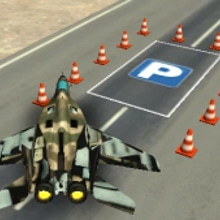
Park it 3D: Fighter Jet takes a very simple idea and makes it instantly more intimidating by replacing a normal vehicle with a military aircraft. Parking a car is one thing. Parking a fighter jet is something else entirely. The moment the game starts, the whole challenge changes shape. You are not squeezing a tiny hatchback into a city slot or guiding a bus through traffic cones. You are handling a fast, expensive-looking machine that feels like it should be roaring into the sky, not creeping through a narrow ground route while you pray you do not clip a barrier with the wing. That contrast is exactly why the game works. Outside references to the game describe it as a 3D parking challenge where you pilot a fighter aircraft and must park it in the correct spot without hitting obstacles, which matches the title perfectly and gives the whole thing a wonderfully tense identity.
And honestly, that identity is strong enough to carry the whole experience.
A fighter jet changes the mood immediately. Even before you move, it feels more serious. More dramatic. More fragile in a very expensive way. A wrong turn in an ordinary parking game is annoying. A wrong turn in a fighter jet parking game feels like the kind of mistake that should come with paperwork. That gives every movement extra weight, and that extra weight is where the fun begins. You are no longer just parking. You are carefully escorting a machine built for speed and chaos through a route that demands patience instead. Great setup. Slightly cruel. Very memorable.
🛬 The sky is not the problem, the ground is
That is the funny part. Fighter jets are supposed to dominate the air. They look powerful when flying, aggressive when accelerating, dramatic when taking off. But on the ground? On the ground they become awkward little monsters. Suddenly everything is about alignment, turning space, and how much room the wings actually need. Park it 3D: Fighter Jet turns that awkwardness into the entire challenge. The game is not asking whether you can be brave at 900 miles per hour. It is asking whether you can stay calm at painfully low speed while guiding a giant aircraft past things that are obviously too close for comfort.
That shift from speed fantasy to precision anxiety is what makes the game unexpectedly addictive. It feels unfamiliar in the best way. Most players can guess how a car parking game works. A fighter jet parking game instantly creates new tension because the vehicle itself changes how you read space. You start noticing width more than speed. You start caring about approach angles, wing clearance, nose position, and whether the turn you are about to make is clever or deeply embarrassing.
Usually it is one of those two.
And this is why the game stops being a gimmick and starts being genuinely satisfying. The concept sounds funny at first. Then you realize it actually works because the vehicle creates real pressure. A jet is long, wide, awkward, and full of presence. Every level becomes a tiny military taxiing nightmare, and somehow that is very entertaining.
🚧 Precision gets meaner when the machine gets larger
A big vehicle always creates good tension in parking games, but a fighter jet adds something extra: vulnerability. Wings change everything. What would be a harmless turn in a truck becomes a disaster in an aircraft. Space that looks safe suddenly feels tight. A cone is not just a cone anymore. It is a personal threat. The game likely builds its difficulty exactly around that sense of false confidence. You think you have enough room, then the wing says absolutely not.
That is a wonderful design trick, because it makes the player slow down mentally. You stop reacting and start planning. You think about the route before taking it. You picture the turn instead of improvising it. Parking games become much stronger when they force that kind of careful mindset, and Park it 3D: Fighter Jet clearly belongs to that family.
It also helps that the vehicle itself has personality. Aircraft in games always feel different from road vehicles. Even when the controls are straightforward, the imagination does a lot of work. You are not only parking an object. You are handling military hardware. That tiny bit of roleplay makes the challenge more flavorful. Suddenly a clean maneuver feels cooler than it probably should. You are still just moving carefully through a course, yes, but the presence of the jet turns the whole thing cinematic. A slow turn can still feel dramatic when the machine doing it looks like it belongs in a movie trailer.
Then, of course, you hit a cone and the fantasy becomes much less heroic.
🧠 Parking games are really puzzle games in disguise
That is especially true here. Park it 3D: Fighter Jet is not only about steering. It is about reading geometry. The path, the corners, the space around the aircraft, the angle of entry into the final slot, all of it turns into a small spatial puzzle. You are not simply moving forward. You are solving shape problems with wheels and patience.
And that is why games like this stay interesting longer than expected. They create a loop of observation, action, and correction that feels satisfying even without speed. One bad turn teaches you something. One clean pass through a narrow section makes the next challenge feel possible. A parking game lives or dies on whether improvement feels tangible, and this concept absolutely supports that. The more you play, the more the jet stops feeling awkward and starts feeling readable. Not easy, never exactly easy, but readable.
That change is important. At first, the aircraft feels oversized, almost ridiculous for a parking challenge. Later, it becomes something you understand. You start respecting the wing span, judging the nose angle better, and approaching turns with less panic. Improvement in a game like this feels real because the challenge is so visible. There is no mystery about success. Either the jet fits cleanly or it does not. Either you parked it or you did not. That clarity is powerful.
❄️ Every slow movement feels louder than it should
What makes this kind of challenge strangely intense is that it happens at low speed. There is no easy way to hide mistakes when everything unfolds slowly. You see the angle getting worse. You know the wing is getting close. You try to correct. Sometimes the correction works. Sometimes it arrives exactly one second too late and the obstacle wins anyway. That sort of drawn-out tension is almost more brutal than crashing at high speed, because you can watch the bad decision happen in real time.
And yes, that makes the successful attempts feel much better.
A clean park in a game like this has a very specific kind of satisfaction. Quiet, precise, deserved. No giant fireworks needed. The reward is the relief. The jet fits, the route is complete, nothing got clipped, and for a brief shining moment you feel like an absurdly competent ground crew legend. Then the next level appears and ruins your peace. Perfect. That is how these games should work.
There is also something charming about how specialized the fantasy is. A lot of browser driving games are broad: cars, trucks, buses, maybe bikes. A fighter jet parking game knows exactly what strange little niche it wants to occupy. That makes it memorable. Even years later, the concept sticks in your head because it is so specific. Not flying a jet. Parking one. That is much funnier and more interesting than it has any right to be.
🎮 Why this fits Kiz10 so well
Kiz10 works especially well with games that are easy to understand instantly and then become harder than expected once you are committed. Park it 3D: Fighter Jet fits that model perfectly. The objective is immediate. Guide the aircraft through the route and park it safely. No giant tutorial needed. The fun starts right away because the vehicle itself creates the hook.
It also sits comfortably beside real Kiz10 games that share its broader mix of aircraft and precision parking or airport control energy. Good nearby matches currently on Kiz10 include Airplane Parking, Airport Rush Hour, TU-95, Flight Simulator Boeing 737-400 Sim, and Aviation Simulator. Some of those are more focused on taxiing and clean parking, others lean into full flight control and aircraft handling, but all of them scratch a similar itch: mastering large aircraft with discipline instead of chaos. Airplane Parking is especially close, since Kiz10 describes it as a precision game about guiding a large plane through airport paths and parking it correctly without collisions. TU-95 adds the broader aircraft-control fantasy with taxiing, takeoff, and landing.
That makes Park it 3D: Fighter Jet a very easy recommendation for players who like unusual parking games, military aircraft themes, and browser challenges where patience matters more than speed. It turns a fighter jet into a puzzle, a taxi route into a threat, and a parking space into a tiny final boss. Which is a ridiculous idea, really. But a very good one.





 Share
Share
 Embed
Embed