🛠️🚚 The first truck rolls in and suddenly you are a plumbing CEO
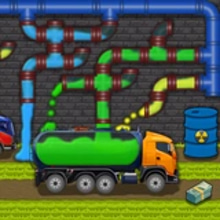
Pipe Flow Empire: Plumber's Tycoon starts with a simple scene that becomes weirdly intense fast. A truck pulls up, a tank needs filling, and you’re staring at a set of pipes like they’re the world’s most stubborn crossword puzzle. It feels calm at first. Place a piece here, connect it there, watch liquid move. Then you realize every decision has a cost. Metal is limited. Liquids are limited. Your reputation is basically a fragile star rating that can rise or collapse depending on how cleanly you deliver the right stuff to the right vehicle. 😅
This is not just a puzzle game, and it’s not just a management game. It’s the satisfying collision of both. You’re building a system, not solving a one time riddle. Every upgrade you buy changes how you play. Every new liquid adds chaos. Every contract brings more pressure, because now multiple trucks are waiting and your pipes are suddenly doing the kind of job that makes you feel like you should wear a hard hat in real life.
🧩🧠 Pipes are logic, but your brain will still try to improvise
At its core, the game is about connecting flow. You place pipes to link sources, reserves, and delivery points. It sounds easy until the map becomes crowded and you’ve got three liquids that should never touch each other. Water wants one route. Fuel wants another. Acid wants its own private lane because mixing anything with acid is how you create regret. 😬
The best part is that the puzzles aren’t “find the only solution.” They’re “build a working system under constraints.” That means you can solve a level in different ways, and some of those ways are smarter, cheaper, cleaner, and faster. You start learning how to plan a backbone pipeline that you can branch from. You start thinking in loops and shortcuts. You start placing pieces with a purpose instead of just hoping the next corner fits.
And when you mess up, the game doesn’t just punish you. It gives you a tool that feels realistic and forgiving. You can tear down old pipelines and recover some metal. That one mechanic changes everything. It means experimentation is encouraged. It means your first design can be ugly and you can improve it. It means the game is not about being perfect on the first try, it’s about learning how to build better infrastructure over time.
⛽💧☣️ Multiple liquids, multiple headaches, one tiny delivery point
Once new liquids arrive, the whole vibe shifts. With one liquid, it’s pure connection. With two, it’s planning. With three, it’s chaos management. Suddenly you are watching colors and routes like a traffic controller. You’re thinking about which reserve is being drained. You’re making sure you don’t accidentally route the wrong fluid to a truck that asked for something else. Because that mistake isn’t just a mistake. It’s lost rating, lost trust, and that annoying feeling of, wow, I really delivered acid to the wrong tank like a villain. 😵💫
But the stress is the fun. When you build a clean network and watch the correct liquid glide through your pipes into the right vehicle, it’s unbelievably satisfying. It’s like watching dominoes fall perfectly, except the dominoes are your own planning and the reward is money, stars, and the smug feeling that your station is finally running like a machine.
📦⭐ Storage upgrades feel like breathing room
Storage is your safety net. Early on, you feel the lack of it constantly. Every fill request drains your reserves and you start reacting instead of planning. You build pipes in a hurry because a truck is waiting. You make messy routes because you don’t have space for a clean layout.
Then you invest. Expand storage. Unlock new capacities. And suddenly the game becomes smoother. You can stock up. You can prepare for multiple vehicles. You can handle surprises without tearing everything down. It feels like you upgraded your brain, honestly. 😌
What’s great is how the tycoon side is tied directly to your puzzle performance. The better you route, the better you fulfill requests, the more money you generate. The more money you generate, the more you can invest. It becomes a cycle of competence. Not grinding. Competence. You get better and the station grows because you earned it.
📜🚛 Contracts turn simple refuels into a real business
The contracts are where the “empire” part kicks in. It’s not just random trucks anymore. It’s agreements, expectations, a growing list of vehicles that want specific liquids on demand. This is where your layout starts mattering long term. A messy network that worked for one or two requests will collapse under contract pressure. You’ll find yourself thinking like a planner.
Where should the main pipes run so they don’t block future expansion
How can I separate liquids cleanly while still keeping the system efficient
Do I need a dedicated lane for each fluid or can I create smart switching points without creating a disaster later
The game pushes you to build something that can scale. And when you finally do, you feel it. The station starts running like a real operation, with trucks pulling in, tanks filling, stars popping up, cash stacking, and your network quietly doing the work in the background like a well built machine. 💸⭐
🔁🪓 Rebuilds are not failures, they’re upgrades in disguise
One of the most satisfying things in Pipe Flow Empire: Plumber's Tycoon is the moment you decide to tear down your own work. Not because it’s broken, but because you’ve outgrown it. That’s a very tycoon feeling. Early layouts are survival layouts. Later layouts are optimized.
You will look at your pipes and realize you built them like a beginner. Too many turns. Too many crossings. Too much wasted metal. And instead of being stuck with it forever, you can scrap sections, recover materials, and redesign with what you’ve learned. The game makes redesign feel rewarding, not punishing. It’s basically telling you, yes, you can evolve.
And the redesign process itself feels like a puzzle. How do you rebuild without stopping deliveries too long How do you keep your rating stable while you restructure Do you create a temporary route while you construct the permanent one These little moments make you feel like you’re running a living station, not solving static levels.
🧠✨ The real skill is building systems that don’t panic
At some point, you stop thinking in individual pipes and start thinking in systems. You build a clean intake. You build a reliable distribution line. You create safe separation between liquids. You leave room for future expansion like a responsible adult, which is hilarious because five minutes ago you were just slapping elbows together like a desperate plumber. 😅
You also learn to plan for mistakes. You create routes that are easy to adjust. You avoid irreversible layouts. You keep spare metal for emergencies. Because the game is always adding new pressure: new liquids, new trucks, more demanding requests. A good network isn’t only efficient, it’s adaptable.
🏁👑 Why this puzzle tycoon is dangerously replayable on Kiz10
Pipe Flow Empire: Plumber's Tycoon is perfect for Kiz10 because it’s the kind of game you can play in short bursts and still feel progress. One session might be about solving a tricky routing problem. Another session might be about expanding storage and polishing your layout. Another session might be about chasing a higher rating and squeezing more profit out of your network.
It’s a puzzle game that makes you feel smart, and a tycoon game that makes you feel in control. Watching your station grow from a small setup into a full liquid delivery empire is genuinely satisfying, especially because the growth comes from your decisions, not random luck.
So build clean. Stay flexible. Don’t be afraid to tear down what no longer works. And when the next truck pulls in asking for something weird, smile like a professional and do what the best fuel provider does. Route it perfectly, fill it fast, and keep the empire flowing on Kiz10. 🛠️🚚⭐





 Share
Share
 Embed
Embed


