🎢 First drop, no warm up
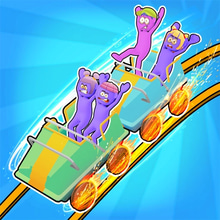
Roller Coaster Rush does not ease you in with a gentle sightseeing tour. One moment you are staring at a bright 3D track hanging in the sky, the next you hear the clack of wheels, feel the train lean forward and realise that you are the one in charge of this steel snake. No NPC conductor, no friendly autopilot. Just you, the throttle, the brake and a line of passengers who trust you way more than they should.
The first hill feels innocent enough. You roll up slowly, watching the world tilt away beneath you, colorful scenery sliding into miniature size as you climb. There is just enough time to think “this is fine” before the track tips over the edge and gravity grabs every wagon at once. If you kept the speed under control, the train dives, screams, and clings to the rails. If you got greedy, well… let’s just say the sky gets very empty where the rail ends and badly timed trains fly.
From that first drop, the game is very clear about its rules. Speed is power, but it is also danger. Roller Coaster Rush is not about smashing the accelerator and hoping for the best. It is about feeling the rhythm of each track, knowing when to let the train roll and when to tap the brakes like your life depends on it.
⚙️ Speed, brakes and terrible decisions
The core of the game sounds simple: press to accelerate, press to slow down, finish the track without turning the cart into confetti. But simple does not mean easy. Every curve, every jump, every drop has its own personality. There are long slopes where you can safely pick up speed and short brutal dips that will punish even a tiny bit of overconfidence.
You start to treat the interface like a musical instrument. Tap the accelerator to push the train up a climb, feather the brakes before a sharp bend, release everything at the exact right moment to let the wagons sail cleanly over a gap. When you nail it, the ride feels impossibly smooth. The train hugs the rails, your passengers bounce in their seats, and you get that small rush of “yes, that is exactly how I meant to do it.”
Of course, that is not always what happens. Sometimes you misread a hill, come into a curve way too hot and feel the back wagons lift like they are trying to escape orbit. Sometimes you brake too much, lose momentum and crawl up a climb like an exhausted snail. It is embarrassing and hilarious at the same time, especially when you realise that every mistake came from your thumbs, not from some invisible dice roll.
🌆 Tracks, views and tiny heart attacks
One of the reasons Roller Coaster Rush works so well is because the tracks are not just functional lines in space. They are full 3D routes that cut through bright environments, twisting around buildings, cliffs and bizarre structures like a theme park built by someone who thinks safety inspectors are optional. You might find yourself plunging through a canyon of neon signs in one level, then soaring over a calm bay in the next, with the water flashing past under your tracks.
The scenery is never there just to look pretty. It helps you read the track. A line of arches might signal a high speed tunnel section where braking is forbidden if you want to survive. A cluster of sharp rocks under a jump is the game’s polite way of saying “do not land here at the wrong angle.” As you move through the campaign, routes get crazier: steeper hills, tighter turns, longer gaps, multi-level structures where the track loops back over itself like a knot.
And every time you crest a big hill, there is that tiny heart attack moment. The world opens in front of you, the track disappears under your nose for a second, and you have no idea if you judged the speed correctly until the wheels either reconnect with a satisfying slam or you watch your wagons go one way while the rails go another.
😅 Fails, replays and that one perfect run
No matter how careful you are, you are going to crash. A lot. You will overshoot a jump by a cart length. You will enter a curve with just enough speed to throw the last wagon off the rails. You will underestimate how much weight your train carries after a long descent and watch the whole convoy leave the track like a flock of very confused birds.
Here is the good part: failure in Roller Coaster Rush is quick, clear and strangely addictive. The moment something goes wrong, the camera shows you exactly why. You feel that instant “oh, I should have braked there” or “I could have gone faster, I was too scared.” Instead of getting angry, you get curious. You restart the level and test a new rhythm. Brake a little earlier. Accelerate a little longer. Let the train roll naturally instead of pressing something every second.
Then there is that magical run where everything lines up. You hit the descent with just enough speed, skim through a curve like you glued the train to the tracks, launch over a gap and land so smoothly that you barely hear the wheels. The passengers survive, the score pops up, and you smile at the screen like you actually felt the wind in your face. That one perfect ride makes all the messy attempts worth it.
🧠 Learning to read the rail
Without throwing statistics or tutorials at you, the game slowly trains your instincts. You learn that tall hills are not just scary visuals, they are energy banks. The speed you build up on a long drop can carry you through an entire sequence of curves and jumps, if you do not waste it by braking too early. You realise that tight turns after a descent are warning signs: if you arrive too fast, you will pay for it.
Step by step, you begin to drive the train with your eyes as much as with your hands. You look ahead on the track instead of staring at the front wagon. You notice patterns in how obstacles are placed. A sharp curve followed by a jump? That probably wants a controlled exit and then a quick push of acceleration. A straight ramp leading into a void? Time to go all in and trust the rails.
It is not just about reflexes, it is about prediction. The more you play, the more you catch yourself thinking like a designer. “If I were building this level, what would I put after this climb?” And half the time, you are right.
🎮 Quick adrenaline hits on Kiz10
Roller Coaster Rush feels perfectly at home on Kiz10 because it fits that sweet pattern of “just one more track.” Levels are short enough to play in spare minutes, but challenging enough that you never quite feel done. You can open the game for a quick break, clear a couple of routes, and close it with your heart racing just a bit faster than before. Or you can sit down for a longer session and slowly work your way through a series of increasingly ridiculous tracks.
No heavy menus, no complicated setup. You load the game in your browser, see your train waiting at the start of the rails, and everything you need is right there: accelerate, brake, survive. It is the kind of game where you promise yourself to stop after beating one more level, then find yourself still riding half an hour later because you were so close to a perfect run and you just know you can do it.
For players who enjoy 3D driving games with a twist, Roller Coaster Rush gives you all the speed and all the risk without a single car in sight. It is you, a screaming train, tracks that hate hesitation, and a bunch of digital passengers who will either cheer you to the finish or silently judge your worst crashes. If you ever wanted to know what it feels like to be the one holding the brake lever on the wildest ride in the park, this is your chance to prove you can handle it on Kiz10.





 3.5 (158 votes)
 Share
Share
 Embed
Embed


