𝗦𝗔𝗡𝗗𝗬 𝗦𝗟𝗢𝗣𝗘 — 𝗙𝗥𝗘𝗘𝗗𝗢𝗠 𝗢𝗡 𝗪𝗛𝗘𝗘𝗟𝗦, 𝗣𝗛𝗬𝗦𝗜𝗖𝗦 𝗢𝗡 𝗬𝗢𝗨𝗥 𝗡𝗘𝗖𝗞 🏜️🚗
Sandy slope is the kind of driving experience that doesn’t pretend you’re here to be careful. It hands you a car, drops you into a wide sandbox, and basically whispers: “Go ahead. Do something stupid.” And the funniest part is, you will. Because this isn’t a racing game where the goal is perfect lines and pristine paint. This is a physics-heavy crash playground where the real entertainment is watching what happens when metal meets rocks, trees, buildings, and your questionable decision-making.
On Kiz10, Sandy slope feels like a sandbox driving simulator with a realistic damage model baked into the core. Every collision matters. Not in a dramatic “game over” way, but in a mechanical, gritty way. Hit a barrier wrong and your car doesn’t just bounce like a toy, it starts feeling different. Steering shifts. Acceleration feels off. The vehicle looks battered, sure, but you also sense internal damage, like the car is quietly begging you to stop using it as a battering ram… while you’re already lining up the next impact. 😈
There’s no storyline to follow, no scripted missions forcing you down a path. The fun is choice. Pick a mode, pick a car, pick a track or location, and then do whatever you want until you’re satisfied. Or until your vehicle becomes a rolling apology made of bent frames and bad intentions.
𝗧𝗛𝗘 𝗗𝗔𝗠𝗔𝗚𝗘 𝗜𝗦 𝗧𝗛𝗘 𝗦𝗧𝗔𝗥 𝗢𝗙 𝗧𝗛𝗘 𝗦𝗛𝗢𝗪 🧱💥
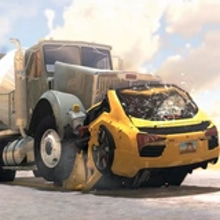
The realistic damage model is what makes Sandy slope stand out from “generic driving” experiences. In many crash-focused games, wrecks are just visual fireworks. Here, the destruction has weight. You slam the front end and it feels like you’ve changed the car’s future. You clip something at speed and suddenly the next turn is harder, the next landing is riskier, the next sprint is less confident. The car becomes a story written in dents.
That changes how you play. You start experimenting. What happens if you hit a rock sideways instead of head-on? What if you take a jump but land slightly nose-first? What if you thread a narrow path, then purposely fail it because the failure is the point? Sandy slope turns driving into a series of physics experiments where your reward is the wreck itself.
And because the visuals are simple but grounded, the impacts read clearly. You don’t need flashy effects to understand the moment. You feel it in the motion, the tumble, the loss of control, the way the car tries to recover and just… can’t quite. That’s the charm. It’s not trying to be cinematic in a scripted way. It’s cinematic because physics makes your chaos unpredictable.
𝗦𝗔𝗡𝗗𝗕𝗢𝗫 𝗠𝗢𝗗𝗘𝗦 𝗔𝗡𝗗 𝗖𝗛𝗢𝗜𝗖𝗘: 𝗬𝗢𝗨 𝗔𝗥𝗘 𝗧𝗛𝗘 𝗗𝗜𝗥𝗘𝗖𝗧𝗢𝗥 🎬🛣️
Sandy slope is built around modes, and each mode comes with its own objective displayed when you start. That means you can choose structure when you want it, or choose pure free roam when you don’t. Some days you’ll want a goal, a win condition, a reason to push harder. Other days you’ll want to drive off-route, explore locations, and “test” your car against the environment like you’re running a demolition lab.
What makes this satisfying is the lack of restrictions. You’re not locked into one track or one type of challenge. You can explore different areas, change cars, and chase different kinds of destruction. It’s freedom with consequences, and that’s the best kind. Because when you’re free, you take risks. When the damage is real, those risks become memorable.
And yes, the leaderboard is there, tracking wins. So even though the game is a sandbox at heart, it still gives competitive players a reason to keep pushing: win more, climb higher, prove your chaos has skill behind it.
𝗧𝗛𝗘 𝗖𝗔𝗥𝗦: 𝗧𝗘𝗦𝗧 𝗧𝗛𝗘𝗠, 𝗧𝗢𝗥𝗧𝗨𝗥𝗘 𝗧𝗛𝗘𝗠, 𝗟𝗘𝗔𝗥𝗡 𝗧𝗛𝗘𝗠 🚙🧪
The vehicle variety is where the experimentation gets juicy. Different car models respond differently to impacts. Some feel sturdy and stable, like they can take a beating and keep going. Others feel lighter or twitchier, which makes them better for stunts but worse for surviving a bad landing. You start recognizing personalities. You’ll find one car that drifts like a dream but crumples fast. Another that handles like a brick but stays alive longer. You’ll switch vehicles not just for looks, but for the kind of wreck you want to create.
That’s a weird sentence, but Sandy slope encourages it. You’re not trying to keep the car pristine. You’re trying to see the limits. How far can you push it before control becomes a suggestion? How many impacts before the car stops feeling like a vehicle and starts feeling like debris that still has a steering wheel attached?
If you’re into car crash simulation, damage physics, and sandbox driving, this is exactly the kind of loop that keeps you going. You’re always one experiment away from a better crash, a bigger stunt, a more dramatic breakdown.
𝗖𝗢𝗡𝗧𝗥𝗢𝗟𝗦 𝗔𝗡𝗗 𝗧𝗛𝗘 𝗙𝗘𝗘𝗟 𝗢𝗙 𝗦𝗟𝗢𝗣𝗘 🕹️⛰️
The controls are classic and easy to read, which is important because the challenge isn’t “how do I drive,” it’s “how do I survive my own driving.” On PC you use W for gas, A and D to steer left and right, and S or Spacebar for braking and reverse. That setup makes it easy to do the two things this game loves: build speed and then regret it.
On mobile, you use on-screen buttons, which keeps the game playable on touch. The key is keeping your steering smooth, because high-speed crashes come fast in a sandbox world. One overcorrection and you’re cartwheeling into a tree like the tree personally offended you.
And the slope itself matters. Sandy environments and uneven paths encourage sliding, drifting, and those moments where your car feels like it’s surfing instead of driving. That’s where the physics shine. You’ll feel traction change. You’ll feel the vehicle react to terrain instead of ignoring it. Even when you’re not crashing, you’re still managing momentum, and momentum is always trying to betray you. 😅
𝗛𝗢𝗪 𝗧𝗢 𝗛𝗔𝗩𝗘 𝗠𝗢𝗥𝗘 𝗙𝗨𝗡 𝗧𝗛𝗔𝗡 𝗬𝗢𝗨 𝗦𝗛𝗢𝗨𝗟𝗗 🧠🔥
If you want Sandy slope to stay satisfying instead of turning into random smashing, give yourself mini-challenges. Try surviving a long run with minimal damage, then immediately do the opposite and attempt to total the car in the most dramatic way possible. Try hitting obstacles at different angles and see how the car’s behavior changes. Try one clean drift line through a location, then intentionally clip a rock to see how damage affects the next drift. The fun is in comparing “before” and “after,” because damage makes the car evolve.
Also, don’t underestimate braking. In a physics-based racing sandbox, brakes aren’t just for stopping, they’re for control. Tap braking before a jump to keep the landing flatter. Ease into turns to avoid flipping. Or ignore all of that and launch the car full speed into a building because you’re here for the sound your brain makes when it realizes you just did that.
Sandy slope on Kiz10 is a driving sandbox built for freedom and destruction: explore, race if you want, crash if you want, and watch the damage model turn every collision into a mechanical consequence. No story, no limits, just physics and your curiosity… which is honestly the most dangerous combination. 🏜️🚗💥



 2.5 (170 votes)
 Share
Share
 Embed
Embed