⏱️ When You Move, Time Breaths Back
Still Kill gives you a rule that feels like a dare: your actions decide the flow of time. Stand still and the room becomes a painting. Lean forward and seconds wake up like startled birds. The first encounter teaches you more than a tutorial could. An enemy draws a blade in slow motion, the air trembles along its edge, and you realize hesitation is a tool, not a flaw. Stop. Watch the angle. Read the reach. Then slide a half step and everything rushes forward for a heartbeat as your counter slips under the strike. You’re not button mashing; you’re editing reality. Each decision tugs on the tempo, stretching a fraction of a second into a paragraph you can read, rewrite, and punctuate with steel.
🗡️ Minimalist Blades With Loud Personalities
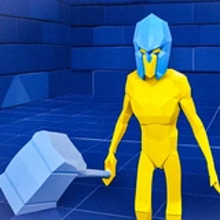
The arsenal starts small and honest. A plain short sword that favors clean entries. A heavier edge that hits like a door slamming shut. A thin dueling blade built for threading gaps that barely exist. Even with the visual restraint, each weapon feels different in your hands because the game binds timing to identity. Heavy blades demand earlier commits, ask you to start while the world is still syrup. Lighter blades let you wait rudely late and still win, rewarding nerve and tiny wrists flicks. Discovering a new blade isn’t just loot; it’s a new dialect. You test its cadence in the lobbies, then carry it to the maps like a secret you’re eager to try in public.
🎯 Read First, Then Remove the Problem
Enemies telegraph without shouting. A shoulder dips. A knee loads. A wrist flinches toward a throw. The maps are arranged like quiet questions, each corner an exam in spacing and patience. You learn to count animations the way musicians count bars. Two slow steps, one breath, tilt, release. When a projectile hangs in the air like a thought you haven’t finished, you step aside by inches and let the scene resume just long enough to watch it pass. Then freeze again. Reframe. Take the line that was not there a blink ago. The joy isn’t in speed but in precision, in shaving a fight down to the cleanest sequence of yes, that, exactly that.
🌐 Arenas That Teach Without Talking
The maps carry personality without clutter. A stark rooftop where wind suggests direction and long sightlines punish sloppy angles. A gallery of concrete pillars that turns every approach into geometry homework and every escape into a magic trick. A neon alley that looks simple until you notice reflections betraying positions you can’t see head-on. Minimal textures mean your eye lands only where it should: the edge of a blade, the arc of an incoming strike, the open square where the counter lives. The environment never screams; it hums with cues, and you start to hear them as if you had always known how.
🧠 The Science of Perfect Counters
The counter window isn’t just a number. It’s a feeling your hands learn to trust. You’ll start wide and safe, parrying with a margin that wastes damage for certainty. Then you’ll narrow it, discovering that the exact instant of contact grants you more than survival. It grants momentum. Land a perfect counter and the world snaps brighter. Enemies stagger longer. Your follow-up hits harder. The game’s minimalist aesthetic hides a generous physics conversation: weight transfers, angles change, the camera nods yes you did it. Miss by a hair and you survive, but the scene gets heavy again, asking you to prove patience one more time.
⚙️ Controls That Disappear When You’re Brave
Still Kill is stingy with inputs. Move, aim, strike, parry, dash. That’s the whole dictionary, which means sentences are on you. On desktop the mouse lets you write arcs like calligraphy. On mobile a short thumb drift becomes a draft of intent that the game respects. There’s no HUD litter screaming for attention. Health is a clear shape, stamina a whisper at the edge, weapons swap with the grace of a thought you’d already decided to think. When fights go wrong, it’s never because the interface lied; it’s because you moved when you should have watched, or watched when you should have moved.
🩸 Risk Lives in Inches, Reward in Frames
The temptation with a “time moves when you move” rule is to sprint anyway, to test courage by turning the knob to chaos. Sometimes that works, and it feels beautiful: a three-hit line that stitches through a room before anyone understands the sentence you wrote. More often, you’ll learn that risk is measured in inches. Edging right so a spear’s path misses by a pixel leaves you with a counter angle twice as generous as the frontal approach. Taking a single forward tap to wake a swing, then freezing to let the swing hang helplessly, delivers patience as damage. You’ll invent tiny rituals—a breath before a dash, a micro-step to summon the lunge you want, a stillness that insults an enemy into overextending—and those rituals become style.
🗺️ Modes and Maps That Reward Curiosity
Across skirmish rooms and compact boss arenas, variety means mentality shifts. A multi-level map with catwalks turns timing into traffic control; you create jams and then solve them with gravity. A tight dojo punishes greed and praises footwork that barely scuffs the floor. The best runs arise when you stop trying to win and start trying to understand a space. Where does a pause break a patrol? Which pillar converts a dangerous rush into a single safe duel? The moment a room goes from “hard” to “readable,” the game becomes calmer, almost gentle, even while blades whistle around your ears.
🧭 Why Minimalism Works Here
There’s nothing to hide behind. No fog of effects to make you feel cleverer than you are. The style strips away decoration until only decision remains. That’s why every success lands so hard. A single silent parry and a light tilt of the wrist can erase an opponent and tell a small story at the same time. The music follows suit—percussion that respects silence, pulses that line up with your breath when you’re doing it right. In that space, failure stops feeling like punishment and starts feeling like an interesting clue. You aren’t “bad”; you’re early by a frame. Fix the frame. The whole room changes shape.
🗡️ Finding New Blades Feels Personal
Unlocks happen at a pace that keeps experimentation fun. A curved saber clicks with your habit of late entries. A straight, disciplined blade makes you fall in love with precise diagonals and quick corrections. You’ll swap often not because the previous weapon failed you, but because each new edge teaches a fresh lesson about time, distance, and ego. Every discovery feels like a handshake with a new teacher: welcome, here is the timing you didn’t know you needed.
🎮 From Panic to Poise
Your first hour is noise; your tenth is music. You stop lunging. You stop apologizing with extra swings after a miss. You start leaving fights with stamina left because you learned to let enemies talk first. The delight isn’t in becoming unstoppable—Still Kill never lets you feel that way—it’s in becoming undeniable. You know exactly why that last room went well. You can point to the held breath, the one perfect counter, the dash that turned a crossfire into a duel. Improvement is visible and addictive, the rare loop where self-control is the most overpowered skill.
✨ Why You’ll Keep Saying “One More Room”
Because the core idea never gets old. Because time as a fabric you can pull and release is a toy that keeps inventing new games for you. Because every blade is a new sentence structure and every map is an essay in how to use it. Because when you leave a perfect encounter—three inputs, two frames of hush, one immaculate exit—you feel like you learned something useful about attention itself. Still Kill is a calm storm you carry in your hands. Walk in, breathe, and let the world move only when you tell it to. 🖤⏱️🗡️





 3.5 (156 votes)
 Share
Share
 Embed
Embed


