🧵🌌 A Puzzle That Feels Like Touching Space With Your Fingers
String Theory doesn’t start with explosions. It starts with a quiet dare. Here’s a world made of lines, gravity, and cold little rules that don’t care if you’re confused. You’re dropped into a sleek, spacey puzzle experience on Kiz10 where “movement” isn’t just moving a character around. It’s bending a path, shaping tension, nudging angles, and doing that tiny gamer flinch when a plan almost works… almost. The whole game feels like a science experiment that escaped the lab and learned how to smirk.
The core idea is deliciously simple: you interact with strings and the environment to guide motion through hazards. But the simplicity is a trap, in the nicest way. Because once you’ve adjusted one string, everything else changes. Momentum becomes moody. Gravity becomes a prankster. A gentle arc becomes a catastrophic slingshot. You’ll think you’ve built a perfect route, then watch your solution drift one millimeter off and spiral into a black hole like it was always meant to happen. 😶🌫️
🌀🧠 The Kind of “Physics” That Makes You Talk To Your Screen
This is a physics puzzle game that makes you negotiate with reality. Not real reality, obviously. Game reality. The kind where a tiny change in curvature can decide whether you glide safely past danger or smash into it with the elegance of a thrown spoon. You’ll spend a lot of time doing micro-adjustments, then leaning back like, “Okay… okay… that might work,” while your brain runs a silent checklist of everything that could go wrong. And it usually finds something.
The tension is in the timing and the geometry. You’re not just solving static puzzles; you’re setting up motion like a director blocking a scene. If you pull too hard, the trajectory turns aggressive. If you don’t pull enough, the movement becomes timid and collapses short of the goal. Somewhere in the middle is the sweet spot, and the game knows you’re looking for it, so it hides it behind a thin layer of chaos. 😅
🕳️✨ Black Holes, Gravity Tricks, and Tiny Disasters
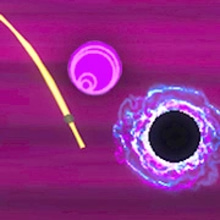
Let’s talk about the vibe. Black holes aren’t “background decoration” here. They’re the kind of hazard that feels elegant and cruel. They don’t chase you like a monster. They just exist, calmly, with that quiet pull that makes every decision feel heavier than it should. You’ll line up a path, feel confident, and then the gravitational tug will curve your motion in a way that’s technically fair and emotionally insulting. 🕳️🙃
And that’s the fun of it. String Theory turns space into a puzzle box. The obstacles aren’t loud; they’re precise. They look clean, minimal, almost polite… until they destroy your plan. There’s a special kind of satisfaction when you finally read the room correctly and realize why you were failing. Not because the game was random, but because you were trying to brute-force something that wanted finesse.
🎮🧵 The “One More Attempt” Spiral
This is the kind of game where retries feel like part of the language. You fail, you learn, you tweak, you try again. The loop is tight, and that’s dangerous. Because each failure feels like it contained information. You’re never just losing; you’re gathering data like a tiny stressed scientist. “Okay, so the pull is stronger than I thought.” “Okay, so the arc overshoots if I release too early.” “Okay, so I should stop being greedy and aim for control.” Then you immediately do the greedy thing again because you’re human. 😭
On Kiz10, it’s perfect for those sessions where you want your brain active but your hands relaxed. Except… your hands won’t stay relaxed. Not when you’re one clean adjustment away from solving the level. Not when the motion looks perfect for half a second and your heart rate spikes like you’re defusing a bomb made of string.
🧩🚦 Planning vs Panic, the Eternal Duel
String Theory is secretly a battle between two versions of you. There’s Calm You, who thinks in angles and probabilities, who lines up the next move like it’s chess. And then there’s Panic You, who sees the solution working and starts rushing like the universe is about to turn off the lights. The game rewards Calm You almost every time. It wants patience. It wants you to watch, predict, and set things up with intention.
But the best moments happen when you combine both. When you plan carefully, then commit with confidence. When you stop second-guessing mid-action. When you let the system do what you designed it to do. That’s when it feels cinematic. A string curves just right, momentum carries the motion through danger, gravity assists instead of sabotaging, and you land the outcome with the smug satisfaction of someone who absolutely meant to do that. 😌✨
🪐🎭 A Minimal World That Still Feels Dramatic
Even though the presentation is clean and not overloaded, it doesn’t feel empty. The space theme, the hazards, the pull of gravity, the sense of floating danger… it all adds up. You’re solving puzzles, yes, but it feels like you’re navigating a weird little cosmic stage. Like you’re rewriting the rules of motion with your fingertips. It’s oddly poetic for a game that also makes you groan out loud when a solution fails by a hair. 😵💫
There’s also that satisfying sense of mastery that builds over time. Early on, you’re guessing. Later, you’re predicting. You start to recognize how strings behave, how arcs form, how forces stack. You stop reacting and start composing solutions. The game becomes less “trial and error” and more “I see the shape of the answer.” And when that clicks, it’s addictive.
🧠🔭 Little Habits That Make You Feel Like a Genius
Here’s the thing you learn after a few levels: you don’t need faster reflexes, you need cleaner thinking. Watch the whole path before you act. Give yourself a moment to visualize how the pull will bend the motion. Make one change at a time. If you change everything at once, you’ll never know what actually fixed the problem. It’s like tuning an instrument. One tiny turn, then listen.
Also, accept that some puzzles want you to be precise, not heroic. If you’re trying to force a dramatic slingshot move and it keeps failing, the game might be quietly begging you to take the boring route. And yes, boring routes can be beautiful. Especially when they work. 😌🧵
🏁🌠 Why String Theory Belongs on Kiz10
String Theory hits a very specific mood: thoughtful, tense, elegant, and slightly chaotic underneath the surface. It’s a physics-based puzzle game where your best weapon is understanding, your worst enemy is impatience, and every solved level feels like you just outsmarted gravity itself. If you enjoy puzzles that reward experimentation, spatial reasoning, and that “wait… what if I bend it like this?” kind of curiosity, you’ll have a great time here.
It’s the kind of game that makes you feel clever without holding your hand, and it makes you laugh at your own mistakes because the failures are so clean and instantaneous. One moment you’re a genius, the next you’re watching your plan get swallowed by a black hole like it’s comedy. And honestly? That’s a pretty perfect deal. 🕳️😄🧠



 3.8 (22 votes)
 Share
Share
 Embed
Embed