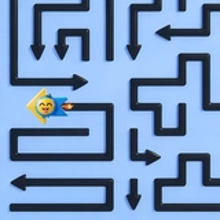
At first glance it looks gentle. A clean board. A few bright arrows. A couple of hearts floating like quiet promises in the corner. Then you touch an arrow and the whole puzzle wakes up. It slides until something stops it, and in that tiny moment a roomful of possibilities appears. Super Arrow Go is the kind of logic game that teaches you to see around corners. No timers press your back, no alarms demand hurry. It’s just you, direction, distance, and the soft click when a plan lands exactly where you pictured it. That calm is not an accident. It’s the design. The game wants your brain, not your panic.
🧭 Soft start sharp mind
Early boards are polite introductions. One arrow frees another, a neat little chain where progress feels like a handshake. You learn the grammar fast. Arrows move in straight lines. Obstacles are punctuation. The edge of the grid is a period that stops motion cleanly. Your goal is simple and specific: guide every arrow to the exit without bumping a friend or wasting a heart. When that core clicks, the board stops being pieces and becomes space.
🧠 Planning that feels like magic you made
The best moves begin before your finger moves. Your eyes walk the lanes, note where a horizontal arrow could park to become a guardrail, and where a vertical arrow needs a stopper to avoid overshooting the gate. You start imagining “ghost positions” one move ahead. It’s half chess, half traffic engineering, with a touch of Tetris cadence in how you stack solves. When you finally slide three arrows in sequence and watch a perfect corridor appear, the little spark in your chest is real. You didn’t guess. You saw it.
🧩 Levels that teach without lectures
Variety arrives on tiptoes. A simple wall becomes a mirror for clever rebounds. Static blocks split lanes into tidy corridors. Later, toggles flip barriers open and shut, asking you to route arrows in a particular order. Switch tiles act like courteous doormen, letting one path open only after you’ve parked a specific arrow where it belongs. None of it shouts. Every new rule shows up with an easy board first, then a trickier one that rewards careful sequencing and patient eyes.
😌 No clock just clarity
There’s no timer chewing your composure. You can sip water, breathe, and trace options with a finger hovering above the screen like a conductor testing a phrase. Hints exist, not to replace thinking but to nudge it. A single suggestion often resets your perspective and that’s enough. The rest is you enjoying the small ceremony of getting a hard thing right without hurry. It’s the calmest kind of challenge, the one you can play when the day feels loud and you want your brain to make clean lines again.
🎯 Tiny techniques that change everything
Park with purpose. An arrow that finishes one tile short of a wall might be a future stopper for a perpendicular friend. Use “pre-stops” by placing an arrow as a temporary brake, then move it again once its job is done. Think in pairs: if Arrow A must reach the right gate, what arrow can you plant as a vertical fence three moves earlier. When stuck, reverse the story—start from the exits and ask which square the last turn must happen on. That backtracking trick unlocks more boards than any single hint.
🔁 Undo is a superpower not a shame
The undo button is an ally. Tap it freely to test hypotheses without fear. You’ll discover rhythms: two steps forward, one back, three forward, a clean finish. The game encourages experimentation by keeping everything crisp. There’s no penalty for curiosity, and that’s why your solutions improve. You’re not memorizing patterns; you’re training instincts.
🧪 Puzzles with personality
Some boards are little crowd scenes where every arrow matters equally. Others are character pieces where one stubborn diagonal exit demands the rest of the team behave. You’ll learn to spot keystone moves—the first placement that makes the board solvable. Once you know how to recognize that anchor, your solving time drops and your satisfaction spikes. It feels like learning a language and then suddenly hearing yourself speak it without translating.
🎮 Controls as honest as graph paper
Swipes are crisp. Slides travel until a true stop, never a phantom one. The interface stays out of the way: minimal chrome, clear colors, and smooth motion that leaves your attention where it belongs—on relationships, not UI. On touch or mouse, the feel is consistent, which is why your mind relaxes enough to do exact work.
🎨 Clean design that helps you think
Color choices separate arrows without shouting, and subtle shadows make lanes legible at a glance. Little glows on exits pull your eye just enough to keep goals salient when a board gets busy. Animations are quick, celebratory but brief, so momentum never goes cold between attempts. The whole presentation says the same thing in different ways: we respect your focus.
📈 Difficulty that climbs like a pleasant hill
The curve is fair. Just when your hands start to autopilot, a mechanic flips your assumptions and you have to think fresh. But it never feels cruel. Big boards arrive with generous structure, small boards tighten rules to spark creativity. The sweet spot arrives often—the zone where you’re challenged and capable at the same time. That’s where time disappears in the best way.
🪄 Hints that teach habits not answers
When you choose a hint, expect a nudge toward a critical relationship rather than a full script. Maybe the game highlights a blocker that should become a bridge. Maybe it marks the only safe parking square for a key arrow. These soft pointers grow your toolkit. The next time a similar pattern appears, you’ll spot it unaided and smile at how quickly your eyes learned.
🔊 Sound that nudges not nags
Soft ticks when arrows stop. A brighter chime when gates accept a piece. A warm little swell when a board clears and your hearts stay intact. Audio is feedback, not decoration, and it supports that feeling of calm concentration that makes hard puzzles feel welcoming.
🧘 Why it fits perfectly in your Kiz10 rotation
Because it respects your time. You can solve one board in a minute or sink into a dozen with a cup of tea and come away feeling sharper, not drained. Because it’s the kind of challenge you can pause mid-thought and return to with a better idea. And because the mix of clarity and depth suits Kiz10 so well—a space where play is quick to start and surprisingly deep when you want it.
🙂 The feeling you’ll chase
Clearing a board with every heart intact feels like tidying a shelf in your head. You wipe away the mental clutter and stack little wins into a neat row. That’s why you’ll keep coming back. Not because you have to. Because it feels good to think well.





 Share
Share
 Embed
Embed


