🌰🍃 It fell. Now it has to survive the world.
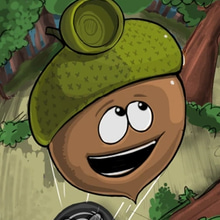
The Acorn begins with the simplest little disaster: a tiny acorn drops from a tree and suddenly the entire forest feels like it was designed by someone who hates gravity and loves traps. On Kiz10, this is a physics puzzle game that doesn’t need a long story to feel dramatic. The story is the fall. The story is the roll. The story is you staring at a harmless-looking path and slowly realizing it’s a hallway of bad ideas waiting for you to touch the wrong thing.
You’re not controlling a warrior, a car, or a superhero. You’re guiding a fragile little nut that can’t fight back. That’s what makes it tense in a weirdly cinematic way. Every time the acorn moves, it feels like a commitment. A tiny “yes, I’m doing this” that might turn into a full-body regret two seconds later. And when you finally slip through a trap sequence cleanly, it doesn’t feel like luck. It feels like you read the room, respected the physics, and timed your decisions like a careful thief.
🧠⚙️ The forest is basically a machine
What makes The Acorn satisfying is how it turns the environment into the real puzzle. It’s not a game where you mash buttons and hope. It’s a game where you study the setup, notice what can be triggered, and then decide the order that won’t get your acorn smashed, skewered, or tossed into a place it can’t escape.
The levels feel like little contraptions. Some are about timing, where you wait for the “safe moment” that lasts half a heartbeat. Some are about sequence, where one wrong trigger makes everything worse. Some are about restraint, where doing nothing for a second is smarter than doing something right now. The Acorn teaches you that patience isn’t passive. Patience is a move. A strong one. 😅
And because the object you’re protecting is small and constantly rolling, you also get this extra layer of tension: even when you make the correct decision, the acorn might still drift in a way you didn’t expect. Not unfairly, just… realistically. Physics doesn’t care that you meant well.
🌪️🌰 Momentum is the villain with a friendly smile
There’s a particular kind of pain in physics puzzle games: the “I nudged it slightly” lie. You think you’re making a tiny adjustment, but the acorn picks up speed like it’s late for something, bounces off an edge, and suddenly you’re watching chaos unfold while your brain whispers, no no no no… stop… please stop. The Acorn lives on those moments.
It’s not just about moving forward. It’s about managing momentum like it’s a wild animal. Let it roll too fast and it becomes uncontrollable. Slow it down too much and you miss timing windows. You learn to think in tiny impulses: a light push, a small pause, a careful trigger, then a quick correction before the acorn drifts into the worst possible corner.
And then you hit that magical moment where you finally control the flow. The acorn rolls exactly where you want. It slips through a gap. It avoids the trap by a pixel. You exhale without realizing you were holding your breath. That’s the payoff.
🕯️🧩 The “obvious route” is usually a trap
The Acorn is the kind of puzzle game that enjoys bait. You see a straight path and your instincts say, go. The level says, sure, go… and then punishes you for trusting it. So you adapt. You start reading the stage like a suspicious detective. What’s going to move? What’s going to drop? What looks safe but isn’t? What will happen if the acorn rolls into that corner with too much speed?
You also start learning a very specific skill: predicting the next two seconds. Not the whole level. Just the next two seconds. If you can see what happens immediately after your action, you can stay in control. If you act without thinking, you’ll spend the next few seconds watching consequences you can’t undo. The game is basically saying, hey, be present. Be careful. Don’t get cocky. And it does it without lecturing you, which is the best kind of teaching.
🌲⚠️ Tiny danger, big tension
Because the acorn is small, everything feels bigger. A little spike feels like a death sentence. A small gap feels like a canyon. A moving hazard feels like a giant swinging door in a hallway you can’t turn around in. The scale makes the puzzle feel dramatic even when the screen is simple. It’s you versus the contraption, and your hero is a nut with zero self-defense skills. Perfect.
The game also nails that “quiet panic” atmosphere. There’s no loud soundtrack screaming at you to hurry, but you’ll still feel urgency because the acorn doesn’t wait politely. It rolls. It slides. It drifts. If you trigger something at the wrong time, the acorn keeps moving anyway, and now you’re improvising. That’s where most fails happen, honestly. Not because the puzzle is impossible, but because you tried to fix a mistake while the acorn was already committed to falling into trouble.
🎭😮💨 Failing is fast, learning is faster
The best part about The Acorn is that it doesn’t waste your time. You fail, you immediately understand why, and you want another try because the solution feels close. Not “close” in a vague way, close in a specific way. You can almost feel the correct timing. You can almost see the safer order. You can almost keep the acorn from rolling too far. That “almost” is addictive.
And the game gets inside your head with tiny improvements. On attempt one, you panic. On attempt two, you hesitate. On attempt three, you start to plan. By attempt five, you’re doing it clean and thinking, wow… I actually got better. That’s the real reward loop: the feeling that you’re mastering a little physics language, one trap at a time.
🌰✨ The satisfaction of a clean escape
When you finally guide the acorn through a rough section, it feels like you pulled off a tiny heist. Not a loud victory, more like a smooth escape. The kind where you land in the safe zone and your brain does a small celebration dance even if your face stays serious. You’ll have moments where you do something perfectly and then laugh because it felt so close to disaster that it shouldn’t have worked… but it did.
That’s why The Acorn belongs on Kiz10. It’s quick to understand, but it has enough bite to keep you engaged. It’s a physics puzzle that rewards calm thinking, good timing, and a slightly paranoid attitude toward “easy paths.” Help the acorn survives the forest’s nonsense, and enjoy the strange joy of winning a battle where the main weapon is patience. 🌰🌀



 4.9 (53 votes)
 Share
Share
 Embed
Embed


