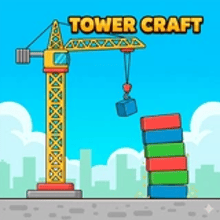
The first brick swings in front of you like a promise. The crane glides over a tiny construction site, the block dangling left and right, and somewhere below waits a lonely base tile begging for company. You tap, the brick drops, and for a split second you hold your breath to see if it lands clean or tilts the whole structure into a slow motion disaster. Welcome to Tower craft, where every placement feels small until the tower is tall enough to make your palms sweat. 🧱
At the beginning, the game keeps things gentle. A simple colored brick, a calm crane, a clear goal. You match a red block with a red layer, a blue with blue, and watch the structure rise one piece at a time. The rule is almost childishly simple keep colors together and keep the shape stable. But that simplicity is exactly what makes your mistakes so obvious. When you misplace a brick, you know it is on you, not on some hidden stat or random event.
First you just drop. The crane passes above the center, you tap on instinct, the brick lands with a satisfying thud, and the tower barely moves. Then the crane speeds up. The arc becomes wider, the timing tighter. You still see the gap where the new piece should land, but your finger hesitates half a second and suddenly the brick hits off to one side. The tower wobbles, you lean your head as if that will somehow help, and you realise you are not just building a stack, you are arguing with physics in real time.
Slow Motion is your first real lifeline. One tap and the frantic swinging softens into a graceful arc, as if someone grabbed time by the shoulders and told it to calm down. In that slowed state you can trace the crane’s path, feel the rhythm of its swing and line up the perfect drop instead of praying for it. It is tempting to lean on this power constantly, but you also know it is there for those scary moments when a single misaligned brick could send the top of your tower into a cartoon spiral.
Laser Sight takes that control and turns it into precision. When you activate it, a narrow guideline appears, drawing the ideal drop line between the crane and the stack. It does not place the brick for you, but it strips away doubt. You can see exactly where the piece will land if you commit at the right moment. The first time you use Laser Sight on a high, slightly crooked tower, you feel almost like a surgeon. One accurate placement and the entire structure settles, as if relieved you finally stopped improvising. 🎯
Underneath all that, Tower craft is quietly teaching you to read patterns. Every level gives you a goal. Maybe you need to reach a specific height. Maybe you have to stack a certain number of bricks in a row without a major wobble. To hit those goals, you start thinking in groups rather than single pieces. Three yellow bricks in a cluster on one side might hold the next color nicely. A low, wide layer of matching blocks becomes your psychological safe floor, a place you trust even as the crane accelerates.
The color matching rule is more than a visual detail. When you group bricks of the same color, the tower feels solid, like those layers lock together. When you ignore that and slap random colors onto each other, the stack looks chaotic, and you feel it in the way you play. A neat red band makes you relax for a moment. A messy layer of mixed bricks makes you brace for the next sway. Even if the physics are fair, your brain reacts to the visual order or chaos, and that reaction changes your timing.
As the levels shift, the game starts to nudge you out of your comfort zone. The crane speed ramps up earlier. Brick sizes change just enough to break your old habits. Some layers offer fewer safe spots, forcing you to place a piece close to the edge and trust that the next one will fix the balance. Occasionally you get a run where every drop just… works. The tower rises straight and proud, colors lining up like someone drew them in a notebook beforehand. Other times, every placement feels like an apology for the last one.
That is where the little inner monologue kicks in. You mutter “one more brick and I’ll fix the lean” while dropping something that clearly does not fix anything. You promise yourself you will use Slow Motion on the next swing, then panic and hit it late, watching the crane crawl in the least convenient position. You activate Laser Sight with full confidence, then somehow mis-time the tap and clip the tower instead of reinforcing it. Tower craft does not need a scoreboard to make you laugh at yourself. Your own brain handles that just fine. 😅
The best runs are the ones where you stop thinking about tools and start feeling the rhythm. The crane becomes predictable. You watch it pass over the center, count a beat in your head, and tap at exactly the right moment. You do not need Slow Motion for a while, because your timing is synced to the swing. Laser Sight becomes a backup plan, not a crutch. Bricks land almost perfectly, the tower rises straight, and you get that quiet sense of flow that only good stacking games manage to create.
Then, inevitably, you push your luck. Maybe you are chasing a new personal height. Maybe you are just curious how far the structure can stretch before it starts to tilt. One slightly off center brick does not look too bad, so you ignore it. The next one leans in the opposite direction, trying to compensate, and the whole thing starts this subtle sway that never quite stops. At that moment you feel like a tightrope walker who took one extra step too far. Now every new block is a decision between playing safe or risking a bold placement that might straighten everything out.
Outside the moment to moment tension, there is the simple truth the game quietly drops on you progress is not saved. If you leave, the tower goes with you. There is no giant continue button waiting when you come back. That sounds harsh, but it also makes each session feel self contained and strangely pure. You are not grinding a long campaign or worrying about permanent upgrades. You are living inside one tower at a time. Either you master this crane today, or you start fresh tomorrow.
That design choice changes the way you approach each run. Knowing that your masterpiece will not sit in a menu forever, you stop obsessing about perfection and start enjoying the process. You remember the feeling of a particularly clean stack, not just the number at the end. You get attached to the little rituals you build for yourself maybe you always open with three careful drops using Slow Motion, or you save Laser Sight for exactly one high pressure moment near the top. Those rituals, and the tiny superstitions that come with them, make the game feel more human than any endless progression bar.
There is also something quietly relaxing in the way Tower craft balances skill and forgiveness. Drop a brick slightly off center and the tower will wobble, but it will not instantly topple unless you truly push it. You get a chance to recover, to place a counterweight layer on the opposite side, to breathe and fix your mistake. That soft grace period keeps you from rage quitting on minor errors while still reminding you that stacking carelessly will catch up with you in the end.
In short sessions, Tower craft is a quick reflex and timing challenge. In longer ones, it becomes a gentle study of balance, patience and pattern recognition. You feel yourself learning without anyone explaining it out loud. You start to see invisible lines running down the middle of the tower. You sense when the crane’s swing is friendly and when it is about to betray you. You know when to trust your eye and when to lean on Slow Motion or Laser Sight.
On Kiz10, it slots perfectly next to other stacking and physics puzzle games but carries its own identity with the mix of color matching, tool based precision and that honest “no save” structure. It is easy to understand, tricky to master, and very, very good at tricking you into whispering “one more tower” at midnight. If you like watching simple shapes become something tall, slightly unstable and strangely personal, you will feel right at home here, staring up at your own wobbling creation and wondering if this next brick will be the one that makes it legendary or takes it all down. 🌆





 2.5 (157 votes)
 Share
Share
 Embed
Embed


