🌆🚦 Welcome to a city that never truly stops
Traffic City: 2050 feels like stepping into a future where the buildings glow, the streets hum, and everyone is late for something. It is not about driving the cars yourself. It is about being the invisible hand that decides who moves, who waits, and who is about to cause a very expensive problem because they have been staring at a red light for too long. You are running the intersections, and in this world, intersections are basically living creatures. They breathe traffic in, breathe traffic out, and if you mess up the rhythm, they bite.
The game is a traffic control puzzle at heart, but it plays like a pressure cooker. A few cars show up and it feels manageable. You flip lights, you keep lanes moving, you feel smart. Then the congestion grows, the timings get tighter, and suddenly you are not “solving” an intersection so much as negotiating with a crowd of impatient drivers who all believe their route matters more than everyone else’s. 😅
🔴🟢 The power of a button and the panic of consequences
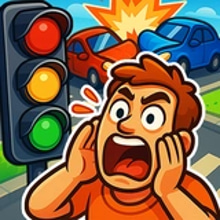
The traffic light is a tiny tool with huge consequences. One click can keep a flow clean. One click can cause a crash. Traffic City: 2050 makes that relationship very clear, very fast. You are always balancing two urges that fight each other in your head. Let them go, keep it moving, you hate queues. Or hold them, protect the crossing, avoid chaos. The best runs happen when you stop thinking like a person in a car and start thinking like the city itself.
And the funniest part is how the game trains you to read the intersection like a mood. You begin to sense when a lane is about to become a problem. You notice the build up. You spot the one car that looks like it is going to do something reckless if you leave it waiting one second longer. You start acting before trouble happens, and that is where the game becomes addictive. You are not reacting. You are predicting. 🧠✨
🚗💢 Impatient drivers are the real hazard
The city would be easy if everyone followed the rules forever. They do not. Traffic City: 2050 adds a simple twist that makes everything more tense. If drivers wait too long, they might ignore the red light and go anyway. That one detail changes how you plan everything. It means you cannot just freeze a lane for safety and forget it. You are managing human behavior, and humans are famously unreliable.
So you start giving small mercy greens to lanes that are getting angry. Even if it is not “optimal” in a clean mathematical sense, it is optimal in the messy reality sense. You keep the flow just healthy enough that nobody snaps. And when someone does snap, when a car pushes through a red like it owns the street, you get that flash of dread. Not because the game is unfair, but because you saw it coming and you still missed the timing. 😭
🚑🚔 Priority vehicles that laugh at your schedule
Then the special vehicles appear, and suddenly your neat little plan starts sweating. Police cars and ambulances can push through regardless of the signal. That means you have a new rule floating above all the other rules. Emergency vehicles do not negotiate. They arrive like a loud reminder that the city is bigger than your puzzle.
This changes how you watch the lanes. You stop looking only at congestion. You start scanning for urgency. You might be holding one direction on red, thinking it is safe, when an ambulance appears and barrels through anyway. Now you must create space, not just stop traffic. You must prevent the accident that would happen when a normal driver tries to move into the path of something that does not care about your light cycle.
There is a strange satisfaction when you handle this well. You see the emergency vehicle, you shift the flow, you keep everyone from colliding, and you feel like you just did something heroic with nothing but timing. 🚨😮💨
🧩⏱️ The real puzzle is rhythm, not speed
A lot of players assume traffic control means always keeping something moving. Traffic City: 2050 teaches the opposite. Sometimes the smartest move is to hold. Sometimes the smartest move is to release a lane for a short burst, not a long one. Sometimes you need to let a queue grow for a moment so you can clear a different choke point safely. The game rewards rhythm.
You start playing in pulses. A green here for a breath. A green there to relieve pressure. A quick switch before the intersection turns into a knot. It feels musical in a weird way. Like you are conducting a noisy orchestra where every instrument is a car horn you cannot hear but you can feel in your nerves. 🎼🚗
🛰️🌧️ When the intersection becomes a personality test
The longer you play, the more Traffic City: 2050 becomes a test of how you handle stress. Do you panic switch when you see a queue grow Do you freeze and stare at the mess hoping it solves itself Do you overhelp the loudest lane and forget the quiet one that is about to explode into rule breaking
You will catch yourself making emotional decisions. You will favor the lane that annoyed you last round. You will try to “teach” a queue a lesson by making it wait, and then you will pay for it because a driver runs the red and ruins your whole clean plan. And honestly, that is part of the charm. The game feels alive because it does not let you play like a robot. It pushes you into real judgement calls.
There is a point where you stop looking at individual cars and start seeing shapes. Streams. Pressure zones. Little storms forming at the corners of the map. That is when you level up as a player. 🌪️🧠
⭐💰 Smooth flow, clean streets, and the thrill of a perfect cycle
When everything clicks, the game feels incredible. You get a cycle where traffic flows smoothly, no one waits too long, emergency vehicles pass without drama, and the intersection looks like it is finally working the way it was designed to. It is a small miracle. It lasts a few seconds. Then new cars arrive, new problems appear, and you are back in the storm. But those few seconds are why you keep playing.
The reward loop matters too. You are not only surviving. You are optimizing. You are trying to earn better outcomes, better performance, the kind of run that makes you feel like a true traffic manager in a futuristic city. Each successful moment feels like progress, and each failure feels like a lesson you immediately want to correct. That is the best kind of puzzle design. It makes you want another try without making you feel punished. 😌
🌙🚦 The quiet obsession of “just one more intersection”
Traffic City: 2050 is dangerous in the way short, tense puzzle strategy games often are. You think you will play for a minute. Then you tell yourself one more cycle. One more intersection. One more attempt where you will keep everyone safe and still move the city efficiently. You start noticing tiny improvements in your thinking. You start switching less randomly. You start anticipating rule breakers. You start respecting emergency vehicles like they are the city’s wild card.
And when you lose, it is not a dramatic game over in your heart. It is more like a soft frustration that sounds like, I could do better. That feeling pulls you back in.
So if you like puzzle games that feel like real time strategy, if you enjoy timing, planning, and keeping chaos from collapsing into crashes, Traffic City: 2050 on Kiz10 is exactly that kind of challenge. It is a future city, but the stress is timeless. Keep the flow. Keep the peace. And try not to let one impatient driver ruin your whole masterpiece. 🚦😅





 Share
Share
 Embed
Embed


