🌊➡️ First Tap, Instant Focus
Wave Dash starts in that sneaky way the best rhythm games do. It looks simple. A little arrow. A corridor. A beat that feels friendly for about one breath. Then you tap, the arrow tilts, the world tightens, and suddenly you are locked in. Not because the game is yelling at you, but because it does not need to. It gives you a moving problem and a soundtrack that quietly dares you to keep up. One input. One responsibility. Do not touch the walls. Do not blink. And please, for the love of your pride, do not panic tap like a woodpecker having a breakdown. 😅🎧
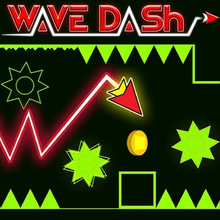
The core idea is clean: every tap or Space jump changes your path through these wave like corridors. You are not just jumping over spikes, you are drawing a line through danger, shaping a route in real time. That makes it feel weirdly personal. When you crash, it is not because the controls are confusing. It is because you were half a beat late, or half a beat early, or you tried to do something heroic when the level clearly asked for patience.
🎵 The Beat Is a Map, Not Decoration
There is a moment where Wave Dash stops feeling like reaction and starts feeling like reading. You begin to notice how patterns breathe. A tight zigzag is not random, it is a sentence. A long slope is a pause. A sudden kink in the corridor is the game clearing its throat before it hits you with the real section. Once you catch that rhythm, you stop mashing and start timing. Your taps become smaller, calmer, almost polite. You ride the music instead of fighting it.
And that is the sweet spot. The flow. The part where your hands move and your brain goes quiet, not asleep, just focused. You know what is coming because the level is telegraphing it through motion and sound. It is still hard, still brutal, but it feels fair in that sharp way where you can say, yeah, that was my fault, and somehow that makes you want to try again immediately. 😤✨
⚡ Tight Corridors and the Art of Not Overcorrecting
Wave Dash loves narrow spaces. Like, loves them a little too much. You will slide into sections where the corridor looks like it was designed by someone who hates breathing room. And that is where the real skill shows up. The game punishes overcorrection more than anything. If you tap too hard, too often, you create your own wobble. That wobble becomes a crash.
So you learn restraint. Tiny adjustments. One clean tap, then a quiet glide, then another tap, like you are tracing a line with a steady hand. It feels almost like handwriting. And when you nail a tight corridor perfectly, it is one of those small victories that makes you grin for no reason. Then the next pattern shows up and humbles you instantly. Classic. 😭➡️
🏁 Fast Restarts, Faster Decisions
One of the smartest things about Wave Dash is how quickly it gets you back into action. You crash, you restart, you are already moving again. No long punishment screen. No dramatic lecture. Just another attempt, as if the game is saying, alright, you learned something, right, go prove it.
That quick loop is dangerous because it makes you stubborn. You start telling yourself you will stop after one clean run, and then you fail by a pixel and you have to run it back. And the next attempt is better. And the next is worse. And suddenly you are doing speedrun math in your head like, if I keep this pace through the middle section, I can save time. It becomes a little obsession, the good kind, the kind that makes a short session turn into a full blown “okay, last try” spiral. 😅⏱️
🧩 Ranks, Icons, and That Quiet Need to Look Cool
Wave Dash does not just ask you to survive, it gives you reasons to care. Unlocking icons feels like a tiny reward for your stubbornness. It is not only cosmetic, it is a little badge that says you did the work. You pushed through the hard part. You kept your timing together when the corridor tried to squeeze you into a mistake.
And chasing ranks adds that extra edge. Suddenly it is not only about finishing, it is about finishing clean. About hitting the pattern with confidence instead of scraping through it. About shaving seconds, keeping momentum, turning a messy run into something you would actually brag about. Even if you never brag, you will still know. Your hands will know. 😎🏆
🛠️ Level Editor Energy, AKA Build Your Own Pain
The level editor is where Wave Dash turns into a playground for creative chaos. Making a level sounds innocent until you realize what you are really doing. You are designing rhythm traps. You are arranging corridors, spacing, and timing windows. You are deciding where the player should feel safe, then immediately taking that safety away.
And the funniest part is testing your own creation. You place a section and think it is reasonable. Then you play it and crash ten times in a row and stare at the screen like, wow, I made this, I did this to myself. That is when you start learning what good design actually means. Not just hard, but readable. Not just fast, but fair. You begin to understand pacing, where to give a breath, where to tighten the screws, where to hide a tricky angle that feels spicy but not impossible. 😈🧠
Sharing creations adds another layer. It is a different kind of competition. Not only who can clear levels, but who can craft a route that feels satisfying, who can build something that makes people go “okay, this is mean… but it is good.”
🎮 Controls That Stay Simple While Your Brain Gets Complicated
Tap or Space to jump sounds like a joke in a game this intense, but that is the whole point. The control scheme stays simple so the difficulty can live in timing, spacing, and nerves. You are not fighting buttons, you are fighting hesitation. You are fighting your own tendency to tap twice when you only needed once. You are fighting that little voice that whispers “go faster” when the correct move is to stay smooth.
Over time, you start trusting smaller inputs. You stop trying to force the arrow into place and start guiding it. That is when the game feels less like a wall and more like a dance, still brutal, still sharp, but beautiful in a weird neon way. 💃➡️
🌌 The Flow State You Keep Chasing on Kiz10
Wave Dash is for players who love that razor thin moment between control and chaos. The kind of rhythm platformer where you feel your heart speed up, then you settle in, then you crash, then you laugh, then you try again. It is quick, focused, and strangely calming once you stop fighting it.
If you want a game that rewards precision, pattern reading, and clean speed runs, this one hits. If you want to build levels and share your own brand of corridor cruelty, it hits even harder. And if you just want to tap to the beat and see if your hands can keep up with your ambition, Wave Dash is waiting on Kiz10. One more run. Just one more. 😅🌊





 2.5 (174 votes)
 Share
Share
 Embed
Embed