💣🧟 When the Best Plan Is “Blow Up the Undead”
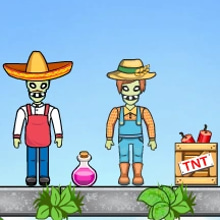
Zombie Bombs sounds like the kind of game that understands something very important about zombie fiction: sometimes bullets are too clean, swords are too personal, and what you really need is a good explosion in exactly the right place. Not a random explosion, obviously. A clever one. The kind that sends one zombie flying into another, drops debris where you need it, clears a whole ugly corner of the map, and makes you feel much smarter than you probably were five seconds earlier. That is the fantasy this title creates immediately. And on Kiz10, the closest verified match to that exact concept is ZomBlast, a zombie physics puzzle game where you place grenades with care, trigger chain reactions, and try to remove every undead target with the tools you have.
That setup works beautifully because it combines two things players love: zombies and consequences. A zombie game gives you pressure. A bomb puzzle gives you precision. Put them together and suddenly every level becomes a tiny argument between your plan and the world’s physics. The zombies are there, sure, shambling around like the usual public nuisance they are, but the real challenge is how to erase them efficiently. A bad throw is wasted opportunity. A weak blast is embarrassing. A perfect blast? That is art. Messy, loud, slightly immoral art, but art all the same.
And that’s why a game like Zombie Bombs gets its hooks into people so fast. It doesn’t need a giant plot. It doesn’t need a dramatic hero speech or a bunker full of lore documents. It needs a level, a few undead targets, a handful of explosives, and the delicious promise that there is a smarter solution hiding in plain sight. That promise is dangerous. Because once a puzzle game convinces you that you could have solved it better, your free time is basically over.
🧠🔥 Explosions Are Better When They’re Earned
The best thing about a bomb-based zombie game is that the action is never truly mindless. It looks chaotic, yes. It sounds chaotic. There are blasts, bodies, debris, all the good ingredients. But the joy comes from control. Zombie Bombs should feel like a game where one carefully chosen detonation matters more than a dozen desperate ones.
That changes the entire mood. You stop thinking like a survivor and start thinking like a demolition problem-solver with a grudge. The level becomes a machine. Angles matter. Distance matters. Timing matters. You start noticing weak spots in structures, dangerous clustering in enemy placement, and little details in the environment that might turn a decent move into a brilliant one. That is where the game gets satisfying. Not from raw destruction alone, but from destruction that proves you understood the scene.
And because zombies are such wonderfully stubborn targets, the puzzle side gets funnier too. Nothing makes you question yourself like clearing almost the entire level and leaving one pathetic undead creature wobbling on a platform you forgot to account for. Suddenly that last survivor becomes the most annoying being on the planet. You had a clean solution. You were ready to feel proud. Now you’re staring at one remaining zombie like it personally insulted your engineering. Perfect. That kind of irritation is the heartbeat of physics puzzle games.
🪵☠️ Why Zombie Physics Puzzles Feel So Good
There’s something uniquely satisfying about physics-based zombie games because the world participates in the kill. You are not always blowing enemies up directly. Sometimes you are nudging the level into helping you. A blast shifts an object. That object rolls or falls. That movement triggers another collapse, another impact, another piece of accidental-looking disaster that was absolutely part of your plan. Probably.
That layered destruction is what makes a title like Zombie Bombs feel richer than a basic shooter. You are not only attacking enemies. You are manipulating space. A wooden beam is no longer scenery. A ledge is no longer background. A hanging object, a loose platform, an awkward stack of junk, these are all suddenly candidates for controlled catastrophe. And “controlled catastrophe” might be the best possible phrase for this genre.
The zombie theme helps too, because zombies are ideal puzzle targets. They are slow, visible, often placed in funny or awkward positions, and deeply satisfying to remove. A human enemy might feel tactical. A zombie feels mechanical in the best way. Something to solve. Something to erase with force and timing. The genre lets you be ruthless without making the tone too grim. After all, the undead are already bad news. Dropping the right explosive near them feels less like tragedy and more like overdue maintenance.
🎯🧟 One Survivor Ruins the Whole Mood
If you’ve played games like this before, you already know the emotional cycle. At first, the level looks easy. A couple zombies here, maybe one tucked into a corner, maybe one balancing in a way that clearly exists to annoy you later. You think, okay, I see this. One grenade here, maybe another there, done. Then the physics happen. Something bounces wrong. A blast radius falls just short. A structure survives in a smug little half-broken state. And now the level is not easy anymore. Now it is personal.
That is the fun. Zombie Bombs should absolutely thrive on those moments where confidence turns into improvisation. A good puzzle does not only test your first idea. It tests whether you can recover when your first idea was, in hindsight, deeply unserious. That recovery loop keeps the game lively. You are always one attempt away from a cleaner solution, one better placement away from feeling clever again.
And unlike more abstract puzzle games, this one gets to be loud about it. The feedback is immediate. If the move works, you know. Things explode. Targets disappear. The board transforms. If it fails, you also know, because some undead leftover is still standing there making your entire strategy look amateur. Very useful. Very humbling.
⚙️💥 Kiz10 Energy: Fast Start, Smart Chaos
This type of zombie bomb puzzle fits Kiz10 extremely well because it belongs to that classic browser sweet spot: easy to start, instantly readable, hard to stop once the retry loop kicks in. The verified Kiz10 match, ZomBlast, is explicitly described as a zombie physics puzzle game built around grenade placement, chain reactions, and efficient undead elimination, which is almost exactly the DNA the title Zombie Bombs suggests.
That matters because browser puzzle games live or die by how quickly they make sense. You should be able to load in, understand the objective, fail once, improve, and feel the difference immediately. Kiz10’s verified zombie puzzle catalog supports that rhythm well. Titles like Zombie Gunpocalypse center on ricochets and traps, while Z-Infect leans into chain reactions and physics-driven spread. Even Teddy Bear Zombies Grenades uses timed explosive throws against waves of creepy plush zombies, which shows how strong the site’s zombie-plus-explosives niche really is.
That range also tells you why the concept stays sticky. Explosion games are satisfying. Zombie games are satisfying. Puzzle games that let one smart move do a lot of work are incredibly satisfying. Combine all three and you get that dangerous “just one more level” effect. You want a cleaner detonation. A better chain. Fewer wasted explosives. Less shame.
😈🧩 The Real Goal Is Looking Smarter Than the Level
At its best, Zombie Bombs is not really about blowing things up. That’s only the language it speaks. The real goal is elegance. Can you clear the undead with fewer explosives? Can you spot the weak point immediately? Can you make the blast look effortless instead of desperate? Those are the little questions that turn a simple zombie physics game into a proper obsession.
Because the truth is, anyone can spam explosives in a panic. But a good player? A good player waits. Reads the level. Notices the angle. Thinks about how gravity will behave after the blast. Times the throw. Then watches the whole ugly undead setup collapse exactly as intended. That moment always feels great. Not because the explosion is big, but because it proves the level made sense to you.
And when a game delivers that feeling repeatedly, it becomes hard to leave alone. That is exactly why a title like Zombie Bombs belongs on Kiz10. It has the right kind of browser-game tension: compact levels, visible stakes, satisfying destruction, and the constant possibility that the next attempt will be the one where everything finally clicks. One blast. One chain reaction. One less zombie problem in a world that clearly has too many. That’s a pretty good deal.





 4.3 (6 votes)
 Share
Share
 Embed
Embed


