🍏 Slingshots, revenge, and absolutely no chill
Angry Fruits is the kind of game that understands one very simple truth: launching produce at things is never not funny. It does not matter how old you are, how serious your day has been, or how much dignity you think you have left. The moment a furious piece of fruit goes flying through the air and crashes into a shaky structure with a loud, satisfying mess, that dignity takes a small vacation. And honestly, good for it. On Kiz10, Angry Fruits feels like a bright, chaotic physics puzzle game built for players who enjoy destruction with a bit of strategy and a lot of attitude.
The setup is gloriously simple. You aim, pull back, release, and hope your angry little fruit missile turns a smug enemy hideout into a collapsing pile of regret. That is the base rhythm, but the real fun comes from how much can happen after one good shot. A weak plank gives way. A stack leans. Something explodes or tumbles or rolls exactly where it should. Suddenly the entire level folds in on itself like it was held together by bad decisions and optimism. That is the sweet spot Angry Fruits keeps chasing, and when it hits, wow, it hits.
What makes this style of puzzle game so addictive is that every level feels like a tiny dare. The game stares at you and says, “Go on then. Break it properly.” Not randomly. Not wildly. Properly. You are not just flinging objects into the void. You are studying angles, testing structure weakness, and deciding whether the smartest move is direct impact or a more theatrical collapse. It is destruction, yes, but classy destruction. Well... maybe not classy. Effective, at least 😏.
🍉 Fruit with feelings, apparently
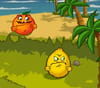
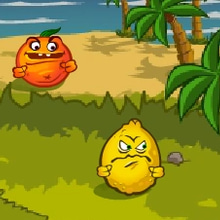
There is something deeply entertaining about the tone of Angry Fruits. These are not just ordinary fruit minding their own business in a bowl somewhere. No, these are furious little projectiles with a mission. Maybe the enemies stole something. Maybe they built one smug tower too many. Maybe the fruit simply woke up and chose violence. Whatever the reason, the vibe is immediate. This is not about farming. This is not about slicing fruit politely for a picnic. This is about sending apples, melons, and other juicy maniacs flying straight into enemy defenses until the whole level looks like a physics experiment gone emotionally wrong.
That fruit theme gives the game extra personality. A lot of physics shooters rely on the impact itself, but Angry Fruits gets additional charm from the absurd contrast. Fruit should be refreshing. Fruit should be harmless. Fruit should be inside smoothies, not acting like tiny siege weapons. That mismatch makes every shot more entertaining. It is ridiculous, and the game knows it. Good. Ridiculous is useful. Ridiculous keeps a puzzle game from feeling sterile.
And because of that, the whole experience feels lighter even when the challenge ramps up. You are not trudging through grey military levels or generic targets that nobody cares about. You are in a colorful world where destruction is playful, expressive, and just a little bit petty. That matters. It keeps the game energetic. It turns retries into comedy instead of frustration. Miss a shot? Fine. Your pineapple just introduced itself to the ground at high speed. Try again.
🎯 The strange beauty of one perfect shot
At the heart of Angry Fruits is a delicious little idea: one shot can do everything if you place it correctly. That is what makes players stay. Not just the destruction, but the possibility of elegant destruction. Anybody can fling wildly and hope for the best. A good player watches the level first. Where is the weak support? Which block is holding too much weight? What happens if the fruit lands slightly behind the front wall instead of right into it? There is a lot of quiet thinking behind the noise, and that is why the game works so well.
You start to notice the architecture of failure. Towers that look stable but really are not. Crates balanced on nonsense. Heavy objects waiting for the tiniest nudge. The game teaches you to see disaster before it happens. You stop looking at structures as buildings and start reading them like arguments. This plank is lying. That platform is nervous. That stack is pretending to be solid. One good hit and the truth comes out.
And when the truth does come out, it is beautiful. A chain reaction in Angry Fruits feels almost poetic in a chaotic, fruit-powered sort of way. One impact leads to another. A beam falls. A stone rolls. An enemy vanishes beneath the consequences of poor construction. You sit there for one second in total silence, watching the debris settle, and then your brain goes, “Yes. Exactly that.” It is a small reward, but it hits with weird force.
🍍 Chaos has rules, which is rude but fair
The funny thing about games like this is how quickly they humble you. Early on, you feel clever. You hit a few easy targets, knock over a couple of towers, maybe even finish a level with fewer shots than expected. You begin to believe you have mastered the art of weaponized fruit. Then the game introduces a new arrangement, a trickier angle, a more protected enemy, and suddenly you are staring at the screen like a confused engineer in a grocery store war zone.
That difficulty curve is part of the charm. Angry Fruits does not become impossible; it becomes more demanding. It asks you to slow down, observe more carefully, and think about the full consequences of each launch. Maybe brute force is not enough here. Maybe the answer is precision. Maybe the answer is patience, which is annoying, because patience is always showing up in puzzle games acting like it owns the place.
Still, when the game pushes back, it pushes in the right way. You want to try again because the solution always feels nearby. Not obvious, maybe, but nearby. The level is not mocking you. It is inviting you to understand it better. That makes retries feel productive instead of exhausting. One more shot, one more adjustment, one more angle. Suddenly you are twenty minutes deep into perfecting fruit trajectory like this is a respected academic field.
🥝 Why it feels impossible to stop playing
Angry Fruits on Kiz10 is built for that dangerous little phrase: “just one more level.” Physics puzzle games are experts at this. They divide progress into neat chunks, give you instant feedback, and make every success feel earned. Angry Fruits adds extra flavor by making those successes loud, colorful, and slightly ridiculous. It is not just that you win. It is that you win by turning a level into a miniature demolition show powered by angry produce. That is memorable.
It also helps that the controls are easy to understand. You do not need a giant tutorial or ten layers of menus. You see the sling, you understand the mission, and your brain immediately starts calculating nonsense like a cartoon mathematician. That accessibility makes the game easy to jump into, but the puzzle structure keeps it interesting long after the first few levels. It is simple on the surface, sneaky underneath, and very good at making you feel both smart and mildly chaotic at the same time.
So if you enjoy physics games, slingshot puzzle games, destruction-based challenges, and browser levels where one clever shot can change everything, Angry Fruits is a strong pick on Kiz10. It is bright, energetic, and satisfyingly dramatic without ever becoming too serious. You pull back, release, and watch the whole plan either succeed beautifully or collapse into nonsense. Either way, it is entertaining. Sometimes that is all a game needs. A slingshot, some very upset fruit, and a target that clearly had it coming 🍓.



 5 (26 votes)
 Share
Share
 Embed
Embed