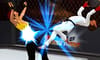
🥊🔥 The bell rings and your brain goes quiet
Art Of Free Fight doesn’t open with a long story or a gentle tutorial voice. It opens with the ring, the lights, that “alright… guess we’re doing this” feeling, and an opponent who clearly didn’t come to chat 😅. It’s a fast, arcade-style fighting game on Kiz10 where the whole point is simple and brutally honest: win the bout. Not “look stylish while losing.” Not “survive for a while and feel proud.” Win.
And the best part is how quickly it pulls you into that fighter mindset. Your eyes start tracking shoulders and feet. Your hands start making tiny decisions before you even notice. You stop thinking in full sentences and start thinking in flashes. Block. Step. Hit. Back off. Punish. Breathe. Repeat.
🧠👊 The real fight is timing, not button panic
There’s a moment every player has in this kind of ring battle game: you try to mash your way to victory, it works for about three seconds, and then you get caught by a clean counter that makes you feel personally disrespected 😭. Art Of Free Fight rewards the opposite of panic.
It wants you to watch. To wait half a heartbeat. To recognize when an opponent is committed. That’s where your damage becomes real. A well-timed strike feels heavier than five desperate swings, because it lands when the other fighter can’t answer. The game turns fighting into a tiny conversation of threats and answers. You throw something out, the opponent reacts. They throw something out, you react. When you start reading that rhythm, the match suddenly feels less random and way more satisfying.
🥋⚡ Footwork is the secret superpower nobody brags about
Landing hits is fun, sure, but surviving long enough to land the right hits is where the game actually lives. You learn quickly that standing still is basically an invitation. Movement isn’t just “go left, go right.” Movement is strategy. It’s how you avoid taking damage for free. It’s how you reset when a trade goes wrong. It’s how you bait a swing and make your rival whiff into empty air like they’re shadowboxing their own regret 😈.
And when you do that successfully, it feels amazing. Not loud amazing. Quiet amazing. The kind where you nod at the screen like “yes, that was correct,” while your heart is racing like you just defended a title.
💥🥊 Hits that feel earned, not donated
Art Of Free Fight has that nice arcade punchiness where exchanges feel immediate. You’re not building a 40-hit combo spreadsheet. You’re picking moments. You’re taking short, clean openings and turning them into pressure.
The most satisfying wins usually aren’t the ones where you bulldoze the opponent. They’re the ones where you get clipped early, adjust, and then start winning the round in small pieces. You block better. You swing less. You punish more. You stop chasing. You start controlling. Suddenly the opponent looks slower, not because they changed, but because you did. That’s the good stuff. That’s the “I’m actually improving” feeling that makes you queue up another fight even when you promised yourself you were done 😅.
😬🩸 The danger zone where you get greedy
Let’s talk about the classic ring mistake: you hurt the opponent and your brain screams FINISH THEM. You rush in. You throw everything. You forget defense exists. And then you eat a counter and watch your confidence fall down a staircase.
This game teaches a very fighter-like lesson: being ahead doesn’t mean being safe. When you smell a KO, you still have to stay clean. Tight pressure, controlled aggression, not a chaotic sprint into punishment. The funniest part is you’ll know this… and still mess it up sometimes. Because humans love drama. And Art Of Free Fight loves punishing drama. Fairly. Immediately. 😭
🏆🧊 Opponents that make you earn respect
As you keep fighting, the game’s challenge starts to feel like a ladder. Early opponents teach you the basics: don’t stand there, don’t swing for no reason, don’t ignore defense. Later opponents feel more stubborn. They don’t crumble when you look at them. They force you to play tighter.
And that’s where the ring fantasy kicks in. You start treating each match like a little event. You enter, test the waters, find what works, then build pressure like you’re writing the round yourself. When you finally beat a tough opponent, it’s not just “I won.” It’s “I figured it out.” And that feels way better than luck.
🎮😵 The mental loop: lose, adjust, win, get cocky, lose again
This is the cycle and it’s honestly kind of perfect. You lose a match and you instantly know why, even if you pretend you don’t. You were swinging into nothing. You weren’t blocking. You kept moving the same way. You got predictable.
So you run it back. This time you’re calmer. You block more. You wait for openings. You punish. You win. Then you get cocky, start playing wild again, and the game humbles you. It’s like a tiny boxing gym in your browser, built to keep you honest 😅.
That push-and-pull is why Art Of Free Fight stays fun on Kiz10. It’s not trying to be overly complicated. It’s trying to be sharp. Quick reads, quick reactions, quick lessons.
🌪️🔥 Why it’s so easy to keep playing “one more fight”
Art Of Free Fight hits because the matches are direct and the feedback is instant. You never feel lost. You always feel like you’re one adjustment away from a cleaner win. Maybe you block just a bit later. Maybe you stop chasing and let the opponent walk into you. Maybe you move first, then strike.
And when it clicks, the ring feels cinematic. The opponent swings, you slip away, you punish, the momentum flips, and suddenly you’re the one dictating the pace. That’s the fantasy every fighting game chases. This one delivers it in a simple, punchy way that fits perfectly on Kiz10. Step in, fight smart, chase the KO, and try not to let your ego throw the match for you. Try. 🥊😈





 4.3 (44 votes)
 Share
Share
 Embed
Embed