🐧❄️ The snow isn’t falling… it’s hunting you
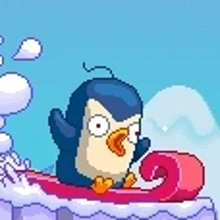
Avalanche: A Penguin Adventure starts with a joke that stops being funny the moment you move: the mountain is alive, and it’s trying to bury you. You play as a small penguin on an icy slope, and the real enemy isn’t a boss with a health bar. It’s the white wall behind you that keeps creeping upward, swallowing the space you just used, erasing your safety like it never existed. On Kiz10, it feels like pure arcade survival with a platformer heartbeat: jump, climb, react, breathe, repeat. Except you don’t really breathe. You do that half-breath thing where you’re focused and slightly panicked because the snowline is right there again.
This is the kind of game that turns “up” into a lifestyle. You’re constantly scanning the next ledge, the next safe step, the next tiny landing that won’t betray you. And it’s not a calm climb either. The avalanche pushes your decisions forward. It forces you to commit. If you hesitate, you lose. If you rush, you also lose, just in a more humiliating way. That’s the charm: it’s simple to understand, but it demands a steady rhythm, and it punishes sloppy movement with cartoon cruelty.
🧊🦶 Slippery platforms and the art of not overreacting
The controls feel immediate, which is great, because the mountain doesn’t wait for you to learn slowly. You move, you jump, you land, and every landing matters. Ice games always have that tiny extra tension because your character doesn’t feel glued to the floor. You can drift. You can slip. You can land on a ledge and still slide off it if you don’t correct cleanly. Avalanche: A Penguin Adventure uses that slippery feeling to keep everything spicy. It’s never enough to “reach” a platform. You have to land it like you mean it.
And here’s where the game gets sneaky: the avalanche makes you want to mash movement. But mashing is how you slip. The better you play, the calmer you look. You make smaller corrections. You jump with intention instead of panic. You stop zigzagging for no reason. The game rewards that calm style because calm style keeps your penguin aligned for the next jump, and alignment is survival.
🐟✨ Temptation on the mountain: fish, points, and bad decisions
Collectibles in this game are not innocent. Fish and pick-ups sit in places that feel “just reachable,” which is the most dangerous phrase in platform gaming history. You’ll see a fish slightly off your safe line and your brain will instantly do the math wrong. You’ll tell yourself you can grab it and still land the next jump. Sometimes you can. Sometimes you touch it, feel proud for half a second, then realize you’ve drifted into a worse angle and the next platform is now a nightmare.
That’s why the game feels alive. It isn’t only testing your reflexes. It’s testing your discipline. Can you ignore bait when the avalanche is close? Can you choose the safer route and accept that you’ll leave points behind? Or do you play like a greedy little penguin goblin and risk everything for one shiny snack? The funniest part is you’ll do both, depending on your mood, and the game will expose you either way.
🏔️😵💫 The avalanche pressure turns every jump into a countdown
The rising snowline changes how you think. Without it, this would be a normal platform climb. With it, every second has a price. You start planning routes in micro-segments. You stop thinking “I need to climb the mountain” and start thinking “I need three clean jumps right now.” You’ll also feel the tension in your hands when you get slightly behind the snowline. That’s when the game turns into controlled panic. You stop being fancy. You stop hunting collectibles. You pick the fastest safe path and you commit hard.
And when you recover, when you regain a little height and the snow drops slightly out of your immediate threat range, the relief is real. It’s not dramatic, it’s just that quiet internal “okay, okay, we’re alive.” That relief is addictive because it makes you want to keep that lead. You start playing tighter. You start respecting your landings. You stop taking stupid jumps. And then, inevitably, you take a stupid jump anyway because your confidence gets too loud.
🌨️🧠 Flow state: when the climb becomes a dance
The best runs in Avalanche: A Penguin Adventure happen when you hit that flow state. Your eyes are one platform ahead, not glued to your character. Your jumps land clean. Your movement feels smooth instead of frantic. You start chaining climbs like it’s one continuous motion, a kind of slippery choreography where you’re always moving upward but never rushing so hard you lose control.
In that moment, the avalanche becomes background pressure instead of pure terror. It’s still there, but you’ve turned it into motivation rather than panic. And the game feels amazing right there, because it’s not complicated fun. It’s honest fun. You’re winning because you’re consistent, not because you got lucky.
😂🐧 The fails are quick, the restarts are immediate, and that’s the trap
This is one of those arcade games where you die and instantly want another try because the mistake is obvious. You jumped too late. You landed too far on the edge. You chased a fish when the snowline was already too high. You hesitated and gave the avalanche free distance. The game doesn’t waste your time with long reloads, so your brain goes straight into “run it back” mode.
That’s why it fits Kiz10 so well. It’s a fast loop with strong replay energy. You can play for two minutes or twenty, and the difference is usually one clean run that makes you think you’ve improved… followed by a run that humiliates you again.
Avalanche: A Penguin Adventure is a survival platform climb where speed matters, but control matters more. If you love quick platform reflex games, rising danger pressure, and that satisfying feeling of escaping by inches while the mountain tries to erase you, this penguin sprint is exactly your kind of chaos.





 Share
Share
 Embed
Embed