🍳🧪 Welcome to the Kitchen, Where Everything Is a Trap Waiting to Happen
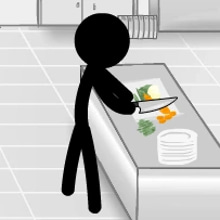
Causality Kitchen looks innocent for about two seconds. A normal kitchen scene, a couple of stickmen doing their little routines, objects placed like harmless props… and then your brain clicks into the game’s real language: cause and effect. You’re not here to cook. You’re here to set off a chain reaction so precise it feels like directing a tiny disaster movie with one brutal rule taped to your forehead: nobody can witness another stickman going down. On Kiz10, that rule turns a simple point-and-click puzzle into a sneaky logic challenge where timing matters more than speed and patience is basically your weapon.
The funniest part is how “everyday” the tools feel. This isn’t a fantasy dungeon filled with obvious hazards. This is a kitchen. That means counters, cupboards, hot surfaces, sharp things, heavy things, things that swing, slide, spill, roll, snap, or fall. Everything is normal until it’s not. You click one object and suddenly the whole room starts behaving like a Rube Goldberg machine that’s had too much caffeine. And you’re the invisible hand behind it, trying to make it look accidental, quiet, and perfectly timed. 😅
🕵️♂️👀 The Real Enemy Is the Witness, Not the Puzzle
Most puzzle games ask, “Can you figure out what to do?” Causality Kitchen asks, “Can you do it without anyone noticing?” That changes everything. You stop thinking only about the trap and start thinking about sightlines, routines, tiny pauses, and those irritating moments when a stickman turns around for no reason like they suddenly remembered they left the stove on. The game trains you to observe first. Watch who walks where. Notice who stands still and stares. Identify which characters have the worst habit of being in the wrong place at the wrong time.
That “no witnesses” rule creates this delicious tension because it’s never enough to trigger the right chain reaction. It has to happen at the exact right moment. You might have the perfect plan, but if one stickman is looking in the wrong direction at the wrong second, it’s instant failure. Not “minus points.” Just… nope. Reset. Try again. And yes, it can be infuriating. But it’s also the reason solving a level feels so clean, like you didn’t just pass a puzzle, you executed a plan. 😈
🧯⏱️ Cause-and-Effect Feels Like Music (If Music Wanted to Ruin Your Day)
There’s a rhythm to these levels. Click… wait… click… wait… then a sequence plays out and you hold your breath like you’re watching dominoes fall. The best solutions feel like a beat you finally learned. Not too early. Not too late. Just right. And once you start hearing that rhythm, you begin to play differently. You stop spamming clicks. You stop poking everything out of curiosity. You become selective, almost calm, because you know one careless action can start a chain you can’t undo.
What makes the kitchen setting work so well is that reactions feel believable in a cartoon way. Something tips, something slides, something triggers something else. It’s easy to understand what happened after it happens, which means the game feels fair even when you fail. You usually know why you failed. “Oh. He saw it.” “Oh. I triggered that too soon.” “Oh. I didn’t realize that guy walks back.” The lesson is obvious, and that’s what makes you hit restart instead of quitting. 😅🔁
🥄🧩 The Fun Part: Turning Ordinary Objects Into a Plan
Causality Kitchen is basically a puzzle about potential. A kitchen is full of objects that can interact, and the game wants you to see the room like a set of switches rather than decorations. You start asking weird questions. What happens if this moves first? What if I block that path? What if I delay this trigger so the witness walks away? What if I distract the “watcher” indirectly by changing the environment?
And suddenly you’re thinking like a stage manager. You’re not controlling the stickmen directly, but you’re controlling the world around them. You’re nudging events so the room does what you want. That’s where the satisfaction lives: not in clicking fast, but in clicking smart. The kitchen becomes a miniature system, and you’re trying to run it without anyone noticing the gears. 🧠⚙️
😂🍽️ Dark Humor, Light Controls, and That Guilty Little Smile
Let’s be honest, the tone is mischievous. It’s stickmen, it’s exaggerated outcomes, it’s a puzzle built around cartoon disaster logic. The humor comes from the absurd seriousness of the rule. Everyone is so fragile, everyone is so nosy, and you’re the invisible force trying to make everything happen “naturally.” The game doesn’t need gore, it doesn’t need shock value. The comedy is the contrast: cute simple characters in a kitchen, and you acting like a stealth mastermind. It’s ridiculous. That’s why it works. 😅
Controls stay simple, which is perfect for this kind of game. You’re not wrestling with movement. You’re not fighting complicated mechanics. Your job is to think, watch, click, and wait. That simplicity keeps the focus on the puzzle itself, and it makes every failure feel like your fault in a way that’s annoying but motivating. Because if it’s your fault, it means you can fix it. 😤
🧠✨ How You Start Solving Levels Like a Real Chaos Architect
At first, you’ll click too quickly. You’ll trigger something cool and immediately lose because someone saw it. That’s normal. The game is teaching you patience through mild suffering. The trick is to treat each level like a tiny story with timing beats. Watch the loop first. Identify the stickman who is the biggest witness problem. Then look for ways to isolate targets, block vision, or force a delay so the “moment” happens off-screen, out of mind.
You’ll also start appreciating the order of events. In Causality Kitchen, order isn’t a detail, it’s the entire solution. Some actions only work if another action already happened. Some triggers create a distraction window that lasts only a second. Some outcomes are safe only if the wrong character is turned away. The more you play, the more you think in sequences instead of single clicks. That’s when the game stops feeling random and starts feeling like a real logic challenge. 🧠🫧
And when you finally clear a level with zero witnesses, it hits different. It feels… clean. Quiet. Like you outsmarted the room itself. Then you immediately look at the level and think, “There’s probably another way to do that,” and that’s how the game hooks you again. 😅🍳
🎮🍽️ Why Causality Kitchen Fits Perfectly on Kiz10
Causality Kitchen is built for quick brainy sessions, but it’s also dangerous because it’s hard to stop mid-problem. Each stage is compact, self-contained, and easy to restart, so you fall into that loop where you’re always one adjustment away from success. It’s a stickman puzzle game with a stealthy twist, a cause-and-effect playground dressed up as a kitchen, and the kind of simple control scheme that lets the logic shine. If you like point-and-click strategy, chain reactions, and that strange satisfaction of making chaos look like an “accident,” this is exactly the flavor.
Now go on. Watch the room. Read the routine. Click once, wait, click again… and try to act surprised when everything goes exactly as planned. 😈🍳✨















 4.2 (46 votes)
 Share
Share
 Embed
Embed


