🎢💣 A roller coaster that stopped caring about safety
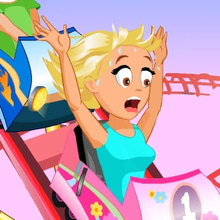
Crazy Roller Coaster starts with the kind of theme-park fantasy you’re supposed to enjoy… and then immediately flips it into panic. The ride has “lost control,” which is a polite way of saying the track is now a moving trap and you’re the tiny passenger expected to survive it. On Kiz10, it plays like an arcade reflex game where the coaster keeps charging forward while the world throws obstacles at your face like it’s trying to swat you off the rails. It’s not about finishing a story. It’s about lasting. It’s about making the right micro-move in the right half-second, over and over, until your hands stop being hands and become a nervous autopilot.
The funniest part is that it’s simple. You don’t need a manual. You don’t need to “learn a build.” You have a ride, you have incoming hazards, and you have one job: don’t fall. That simplicity is exactly why it gets intense so fast. When the rules are clear, every mistake feels personal. You can’t blame anything complicated. You clipped something because you reacted late. You got greedy because you tried to slip past an obstacle when you should’ve played safe. You can practically hear the coaster laughing as it keeps going without you. 😅
🧠⚡ Reflexes, but the kind that come from pattern-reading
At first, you’ll play Crazy Roller Coaster like it’s pure reaction. Something appears, you move, you survive. That works for a moment. Then you realize the real skill isn’t only reacting to what you see, it’s reading what’s coming next. Obstacles don’t just exist; they arrive in sequences. The track has rhythms. The gaps have timing. If you treat every hazard like an isolated surprise, you’ll survive a few seconds and then get humbled by a combo that demands two correct moves in a row.
So you start watching ahead. Your eyes stop living on your character and start living on the path in front of you. That’s where the game transforms from “chaotic ride” into “timing challenge.” You learn to make smaller, cleaner movements instead of dramatic swerves. You learn that panic movement is louder than it is useful. And once you get a feel for the rhythm, you start surviving longer without feeling like you’re fighting the controls. The coaster is still wild, but your decisions become calmer, and calm is basically a superpower in a game like this.
🎭🎢 The track is a stage, and you’re improvising a stunt scene
There’s a cinematic feel when you’re playing well. The ride is moving fast, obstacles are rushing in, and your movement becomes this tiny choreography: shift, dodge, steady, repeat. When it clicks, it feels like you’re threading through danger on purpose. When it doesn’t click, it feels like you’re flailing in public. That contrast is what makes Crazy Roller Coaster so replayable. You can feel the difference between a clean run and a messy run instantly.
And the game is great at creating those “I barely survived that” moments. You slip past an obstacle by a hair, you recover your position, and for one second you feel unstoppable. Then the next hazard appears and reminds you that being unstoppable is an emotion, not a plan. 😭
🚧🧷 Dodging isn’t hard. Dodging while staying lined up is.
Most players don’t lose because they can’t dodge one obstacle. They lose because dodging one obstacle puts them in the wrong place for the next one. That’s the real trap. The level design doesn’t just test your reflexes, it tests your recovery. After you dodge, can you re-center? Can you stabilize your position so you’re ready for the next threat? Or do you drift into a bad lane and then run out of time to fix it?
This turns the game into a rhythm of “avoid, then reset.” Avoid the danger, then return to a safe, flexible position. If you always stay on the extreme edge of the track after a dodge, you’re living on borrowed time. The best runs happen when you keep yourself in a place where multiple future options remain possible. That sounds like strategy, but it’s really just discipline. The game rewards discipline because discipline prevents the spiral.
😈🎢 The spiral: one tiny mistake becomes a full collapse
Crazy Roller Coaster is a master at the classic arcade spiral. You make one small error. You dodge late and end up out of position. Now you’re rushing to correct. The correction is too big, so you overcorrect. Now your movement is messy, and messy movement is how you clip the next obstacle. The game doesn’t need to punish you with complicated penalties because the spiral itself is the penalty.
The way out is annoyingly simple: stop trying to fix everything at once. After a mistake, focus on stabilizing your line first. Get back to a safe position. Then deal with the next obstacle cleanly. That’s how you rebuild control. This is why the game feels fair even when it’s brutal. It’s not random. It’s consequences. The run doesn’t end because the coaster suddenly decided to be unfair, it ends because your rhythm broke and you didn’t repair it in time.
🎯💨 Speed pressure without a “timer”
Even if there isn’t a giant countdown screaming at you, Crazy Roller Coaster still feels timed because the track never stops. The forward motion is the timer. You don’t get to pause and think. You don’t get to “set up” slowly. Every decision is forced by motion. That’s what makes it thrilling. The game creates urgency naturally, by moving the world forward whether you’re ready or not.
It also means your confidence gets tested constantly. You can’t solve the level once and be done. You have to stay sharp for as long as you’re alive. That’s why short sessions turn into longer sessions. You’ll say “one more try,” not because you need to see the ending, but because you know your last run wasn’t clean. You know you can dodge that sequence better. You know you can survive longer if you don’t make that one specific mistake again. You might be right. You might also make a new mistake that’s even more embarrassing. That’s arcade life. 😅
🎢✨ The real reward: that smooth, controlled run
When you finally hit a run where everything feels smooth, Crazy Roller Coaster becomes weirdly satisfying. Your dodges are early, your recoveries are clean, your movement stays controlled, and the ride feels like a fast-flowing line instead of a chaotic scramble. That’s the sweet spot. You’re not just surviving, you’re mastering the tempo. And once you’ve felt that tempo, you’ll chase it again, because the game makes it feel achievable without ever making it feel guaranteed.
Crazy Roller Coaster on Kiz10 is pure arcade survival: simple controls, high pressure, quick restarts, and a skill curve that’s really about staying calm while the track tries to shake you loose. If you love reflex games where every second is a decision and every mistakes teaches you something obvious and painful, this ride will keep pulling you back. 🎢🔥





 Share
Share
 Embed
Embed


