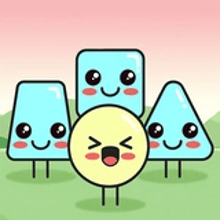
Open the candy-colored box and a tiny parade spills out—circles with bashful blush, triangles practicing their best “I’m totally normal” faces, squares that look like they ironed their corners this morning. Somewhere in this polite crowd, one little rebel didn’t get the memo. Maybe it’s a smidge taller. Maybe its grin leans left instead of right. Maybe it’s humming a single off-beat “boop.” That’s Cute Shapes in a nutshell: a cozy observation puzzle that turns micro-differences into micro-celebrations, sneaking a focus workout into a five-minute smile session.
First contact is gentle on purpose. A short prompt floats at the top—Find the odd one. That’s it. You scan the grid. A circle blinks, another yawns, a third sticks out a tongue (rude, but adorable). Tap the outlier and a soft pop of confetti answers back, the UI nods, and the next grid slides in as if pulled by a friendly breeze. Misses never scold; they puff a cotton-ball sound, the shapes giggle, and you try again with eyes a fraction sharper. The loop is brisk but kind, a little sip of puzzle that doesn’t demand, only invites.
What makes it sticky is how differences evolve. Early boards play fair: size hiccups, a wrong color chip, a cheeky wink in a sea of serious stares. But soon the game starts whispering clever tricks. One triangle’s shadow sits half a pixel longer. A square’s outline softens into barely rounded corners. Two ovals match… until the music ticks and one bobs on the off-beat. You begin reading not just color and form, but posture, rhythm, even the way a blush blooms under glossy varnish. Your scan pattern matures from random wandering to tidy loops: top row sweep, column flick, quick expression pass, final silhouette check. Seconds later you’re tapping with the confidence of a shape whisperer.
The cast has range. Stars sparkle like they attended charm school; rhombi look perpetually unimpressed (they’ll grow on you); teardrops act like they were just told a joke and are deciding whether to laugh. Personality isn’t decoration here; it’s signal. A smile that breaks the grid’s symmetry, an eye that glances when everyone else stares ahead, a single freckle that migrated one notch—that’s enough to win the level if you’re paying attention. Sometimes sound joins the party. In “rhythm sets,” a chime tags each blink and the renegade taps half a beat early. With headphones, you catch it instantly; without them, you start to “feel” it anyway, like toe-tapping for your eyes.
Themes keep the surprise fresh. The Chalkboard pack scribbles lines with powdery texture; the odd one out might have a smudge where no smudge should be. The Gummy set glistens—differences hide in gloss highlights and soft refractions. Starlight mode bathes shapes in midnight blue; silhouettes do the talking, and the wrong profile looks like a tiny constellation error. A beach day set adds wavy heat haze, making you trust edges over color. Each theme is a new language of clues, and you pick it up in a level or two because the game teaches by showing, not by lecturing.
Progression is a gentle staircase, not a cliff. Boards get denser, palettes subtler, expressions quieter. Some rounds ask for two correct taps, others for a sequence—smallest, then saddest, then squarest (don’t worry, you’ll know it when you see it). Timed challenges exist for spice, but timers breathe, not bark. Prefer to sip puzzles with tea? Relax mode removes the clock entirely and adds a soft breathing animation to keep your scan unhurried.
Missions add just enough purpose to keep your brain curious. Nail three perfect boards in a row. Spot an emotion mismatch under a soft countdown. Clear a “monochrome” grid where color won’t help and silhouette reigns. Finishing tasks sprinkles coins into your jar and occasionally unlocks new helpers, themes, or celebratory confetti styles (yes, the rainbow llamas are real, and yes, they are fabulous). Nothing walls off fun behind grind; missions are nudges toward mastery disguised as mini-games.
Helpers are optional, thoughtful, and cute enough to adopt on sight. A drowsy cloud drifts near the quadrant where truth lives, puffing when you’re close. A little lantern firefly blinks brighter when your cursor or finger passes over the right row. A shy pencil underlines a column after a graceful delay if you’re stuck. They never blurt the answer; they steer attention. For kids, late-night players, or anyone with tired eyes, they transform “almost” into “aha” without stealing the joy of discovery.
Accessibility is baked in. High-contrast outlines sharpen edges. A color-blind mode swaps tricky red/green cues for distinct hatch patterns and dots, so “wrong color” boards stay fair. Motion-tame settings smooth bounce loops. Touch targets are roomy on phones; cursor snap offers a gentle magnet on desktop for shaky hands. Even the prompts get simpler if the game notices repeated misses; it’s like a coach lowering the bar so you can jump clean and remember what success feels like.
Under the cuteness, a pleasant science experiment is happening in your head. Visual discrimination gets a daily stretch. Working memory helps you ping-pong between two candidates and compare tiny tells. Selective attention—your brain’s ability to choose a signal and ignore noise—learns to purr. You’ll notice the effect outside the game: a quicker eye for typos, a sharper glance for a missing keycap, a suspicious talent for picking the ripe avocado. The best part? You trained by hanging out with shapes that make silly faces.
A few tiny habits turn “good” into “I swear this board blinked first.” Read the prompt out loud; it primes the right feature. Scan rows, then columns, then do a micro-blink between two far-apart shapes—differences jump like old-school flipbooks. Squint slightly to defocus color and emphasize silhouette. If sound is enabled, hum along; off-beat culprits reveal themselves sooner when you’re in rhythm. And when nothing pops, look away for two seconds, then look back; the odd one often announces itself the moment your brain resets.
There’s a quiet social layer, too. Ghost scores keep best times honest without turning the vibe competitive. Family mode seeds boards with bigger tells so everyone can play together on the couch and cheer clean taps like tiny home runs. Stickers and frames unlock for finishing streaks or mastering themes; they’re playful badges more than bragging rights, a scrapbook page for your favorite sessions.
Why does “one more board” keep winning the argument with your calendar? Because puzzles resolve in seconds and still feel like little triumphs. Because the art and audio are kind, not clingy, and your progress is visible in how your eyes move—cleaner loops, fewer false taps, more “got it” before the music reaches the chorus. Because Cute Shapes respects the best kind of game time: small, satisfying, and ready to pause without penalty when the kettle sings. Mostly because noticing is fun when the world gives you charming things to notice. A tilted smile. A softer corner. A blink that arrives on the wrong beat and somehow makes your day better.
So yes—tap the different one. Let the confetti pop. Let your focus bloom for a minute and then go about your life a little more observant. On Kiz10, a fresh grid is always a click away, and Cute Shapes will be waiting with another pastel crowd and a tiny rebel begging you to spot them.



 4.5 (150 votes)
 Share
Share
 Embed
Embed