🕳️⚪ Gravity is the referee and it hates you
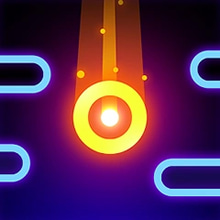
FallDown looks innocent for about two seconds. A clean screen, stacked platforms, a little ball, a few gaps… and then the game quietly reveals the real villain: time. Not “time” like a clock in the corner, more like a pressure wall pushing down from above, insisting you move, decide, commit. It’s an arcade skill game built around a single idea that never stops evolving: find a hole, drop through it, repeat, survive. On Kiz10, it hits that sweet spot where the rules are crystal clear but your hands still get sweaty because the next decision is always slightly worse than the last one. 😅
You’re constantly falling, but you’re also constantly hunting. The platforms come like layers of a cake made of bad intentions, each one daring you to pick the right gap before the top presses down and turns your run into a pancake memory. It becomes a rhythm game without music, where the beat is your own panic and the melody is the sound of you whispering “no no no” while you slide left and right like a tiny marble possessed. 🎮
🎯💨 The controls are simple, the consequences are not
Moving left and right is all you do… and somehow it’s enough to create drama. You’re not doing combos, not building towers, not collecting an inventory full of nonsense. You are guiding a ball toward survival. That’s it. And yet every platform is a new micro-puzzle: which gap is actually reachable, which gap is a trap, which gap looks close but will cost you two precious seconds to line up? Those seconds matter. That’s the cruel elegance of FallDown. The game doesn’t need complicated mechanics to feel intense; it just needs you to care about being one platform ahead.
At first, you’ll play it like a casual drop game. You’ll drift toward the nearest hole, slip through, feel clever. Then the speed increases and suddenly you’re not casually drifting anymore, you’re making fast choices with limited space. Your ball starts feeling heavier, like it has mood swings. Your brain starts predicting movement before your fingers do. And when you’re late by a hair? The game doesn’t scold you. It just ends you. Brutal, clean, almost polite. 😭
🧠🕳️ The real game is “gap math”
This is where FallDown becomes weirdly addictive. You start learning “gap math,” that little mental calculation you do without noticing: distance to the hole, time to align, the platform edges, your momentum, how much correction you can afford before the pressure ceiling steals your breathing room. You stop chasing the closest gap and start chasing the safest path. Sometimes that means ignoring the hole right beside you because it’s going to force an ugly angle on the next layer. Other times it means taking a risky drop because it’s the only way to avoid getting boxed in above.
And the best part is how personal your style becomes. Some players play smooth and calm, gliding and correcting early, like they’re gently steering a coin on a table. Others play like they’re swatting bees, sharp moves, rapid decisions, chaotic confidence. The game allows both, but it rewards consistency. If your movement is sloppy, FallDown punishes you fast. If your movement is disciplined, it starts feeling like you’re slipping through a machine that’s trying to catch you and failing by millimeters. 😈
⏱️🔻 That ceiling is basically a threat letter
Let’s talk about the top pressure, because that’s the psychological weapon. Without it, FallDown would just be “drop through holes” forever, kind of relaxing, kind of repetitive. With it, every moment becomes urgent. You don’t get to stop. You don’t get to admire your last clean drop. You don’t get to hesitate while you negotiate with your own indecision. The ceiling makes every platform a deadline.
This changes how you think. You don’t just think “where is the hole.” You think “how do I keep moving so I’m never stuck hunting.” You begin to value flow over perfection. You accept a slightly messy drop if it keeps you descending. You learn that waiting for the perfect alignment is often the worst choice, because the perfect alignment is a luxury you don’t own. The ceiling owns it. 🥲
🎢🌀 Momentum feels like a personality trait
FallDown is funny like that: your ball has momentum, but it also feels like it has attitude. If you drift too far, correcting back can feel like dragging a stubborn pet away from something it wants to sniff. If you over-correct, you clip an edge, lose time, and suddenly the ceiling is close enough to feel like it’s breathing on your scalp. The game teaches you to make smaller moves sooner. Big panic swipes are the enemy. Calm adjustments are the secret sauce. 😌
And when you finally hit that “flow state” run, it’s almost cinematic. Drop, slide, drop, slide, drop. Your movement becomes economical. You start reading the next platform before you even pass the current one. You’re not reacting anymore; you’re forecasting. It feels like the ball is falling through the world on purpose, like gravity is working for you instead of against you. And then, of course, you get greedy, you overcommit to a gap that’s just a little too far, and the run ends instantly. Classic FallDown. 😂
🏆⚠️ High score hunger and the “one more try” curse
FallDown is built for that stubborn, competitive part of your brain. It doesn’t need a story to motivate you. Your score becomes the story. You start remembering your best run like it’s a personal myth. “I almost hit that number.” “I had the perfect rhythm.” “If I didn’t mess up that one platform…” It’s always that one platform, isn’t it? The game turns mistakes into memories, and memories into reasons to restart.
That’s why it works so well on Kiz10. It’s fast, immediate, and endlessly replayable. You can jump in for thirty seconds and still feel like you played something intense. You can play for ten minutes and watch your skill improve in real time. The learning curve is sneaky: it doesn’t feel like practice, it feels like revenge. You’re not training. You’re settling a score with gravity. ⚪😤
🌈🕹️ Simple visuals, sharp instincts
The clean look isn’t just style, it’s function. FallDown needs you to read gaps instantly. It’s not trying to distract you with clutter. The platforms are the language. The holes are the punctuation. Your ball is the protagonist, and your reflexes are the narrator. When it’s working, you don’t “think” about moving. You feel it. Left. Right. Drop. Faster. Calm. Again.
And in that simplicity, there’s a kind of honesty. You win becauses you’re precise. You lose because you weren’t. No excuses, no random nonsense, just your decisions under pressure. It’s the kind of skill game that makes you laugh when you lose because you know it was your own fault… but you still glare at the screen anyway. 😤
🔥🕳️ The takeaway: fall smarter, not harder
FallDown isn’t about falling fast. It’s about falling clean. It’s about building a rhythm that survives panic. It’s about knowing when to take the closest gap and when to take the smarter gap. It’s short, sharp, and addictively replayable, the kind of HTML5 skill challenge you can keep chasing because the game always feels beatable… right up until it isn’t. On Kiz10, it’s a perfect “just one more run” trap, and honestly? That’s the point. 🕳️⚪✨



 4.5 (10 votes)
 Share
Share
 Embed
Embed