📱🌀 A phone that does not jump, it argues with gravity
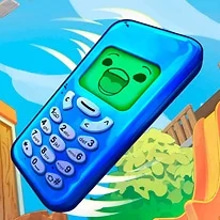
Flipping is Hard has a simple idea that instantly feels unfair in the funniest way. You control an old flip phone, and the only real movement you get is rotation. No clean double jump, no friendly dash, no “oops” button. You flip. That is it. And somehow, with only that, you are expected to climb through a surreal vertical world made from everyday junk, forgotten furniture, toy boxes, blanket forts, random shelves, and weird objects stacked like somebody built a tower during a sleep deprived night and then said, yep, this is a platforming level now.
The first minute feels cute. You flip once, land, flip again, and you think, okay, I can learn this. Then you discover what the game actually is. It is not about going fast. It is about surviving your own tiny mistakes. One slightly wrong angle and the phone slides off an edge like it has a personal grudge. One extra flip and you overcommit, bounce, tumble, and watch your progress disappear with a quiet little “nope.” And the worst part is that it is always your fault, which makes you want to try again immediately. 😅
🧠⏳ Perseverance as a gameplay mechanic
The game has that special kind of difficulty where failure is not a rare event, it is the normal weather. You are supposed to fall. You are supposed to panic. You are supposed to stare at a ledge and hesitate because your brain is doing math it never asked for. The funny thing is that you slowly start liking this loop. Not because it is easy, but because every small improvement feels earned in a way most games do not dare to demand.
You will have runs where you climb higher than ever, feel proud for exactly two seconds, then slip in the dumbest possible way and fall back down like a cartoon tragedy. And you will feel the urge to quit. Then you will do one more attempt, because the memory of that higher spot is now stuck in your head. Your hands remember it. Your eyes remember it. You know you can get back there. So you go again. That is the real hook. The game turns stubbornness into progression.
🧲🧱 The world is made of objects that look harmless until they are not
The environment is part playground, part fever dream. You climb over big household shapes that feel familiar, but the physics makes them behave like slippery puzzles. A surface that looks flat might have a tiny tilt that sends you drifting. A corner that looks safe might snag you, flip you awkwardly, and throw you sideways. You start reading objects like they are terrain in a survival game. Not just what they are, but how they will react when a rotating phone smacks into them.
You also start noticing the mood of the climb. Some sections feel like careful stepping stones. Others feel like chaos ramps where one bad flip turns into five accidental flips you did not plan. And the game does not apologize. It just watches you adapt, slowly, painfully, and then suddenly you realize you are doing it. You are controlling the chaos instead of being launched by it.
🎢😬 Momentum is both your best friend and your worst enemy
Rotation creates momentum, and momentum is a liar. It gives you these beautiful moments where everything lines up, your flip lands perfectly, and the phone pops up to the next platform like it was meant to be there. It feels smooth, almost elegant. Then you try the same thing again and the angle is a hair off, and now momentum becomes a wrecking ball. You bounce, you slide, you tip, you fall, and you can literally feel your soul leaving your body for a second. 😭📱
Learning how to manage momentum is the real skill ceiling. Sometimes you need a bold flip to climb. Sometimes you need a tiny controlled rotation that feels boring but keeps you alive. The game rewards patience in a way that is sneaky. When you rush, you fall. When you calm down and treat each landing like it matters, you start climbing higher without even realizing you slowed your ego down.
🧩🪛 Micro decisions that feel huge
Flipping is Hard is full of moments where you make a decision that lasts half a second but decides your next five minutes. Do you go for the risky ledge that saves time, or the safer route that takes longer but protects your progress. Do you flip early and hope, or wait and risk losing momentum. Do you commit to a climb that looks possible, or reset your position patiently first.
The game makes these choices feel dramatic because the cost is real. Falling is not a minor setback. Falling can be a long drop that sends you back to a place you are sick of seeing. And because the goal is to reach your friend at the top, the story motivation stays simple and emotional in the background. It is not complicated. It is just this feeling of, I am doing all this flipping nonsense because I promised I would get there. That little purpose makes the suffering fun instead of pointless.
😵💫😂 The rage moments are real, but they are also kind of funny
At some point, you will have a moment where you whisper, why did I flip like that. You will blame the physics. You will blame the object shape. You will blame your finger. Then you will replay it in your mind and realize you flipped too hard, too late, with too much confidence, like you were trying to impress an invisible audience. The game punishes showmanship. It rewards calm. Which is hilarious, because it still makes you want to be flashy.
And when you finally land a difficult section cleanly, it feels like relief. Not the loud victory of beating a boss, but the quiet satisfaction of not messing up. That is the kind of win this game gives you. Small, sharp, meaningful wins that stack into progress.
🌙🧗 The climb becomes a personal story
After a while, the tower stops being random objects and becomes your map. You remember the “annoying slope.” You remember the “ledge that steals momentum.” You remember the “place where you always fall if you get greedy.” It becomes intimate in a strange way, like you and the level are arguing but also learning each other.
And then, in the middle of all that, you will have a run where everything clicks. Your flips are controlled. Your pauses are smart. Your landings are calm. You climb past your previous best like it was not even that hard. And you will laugh, because two minutes ago it felt impossible. That is the magic of these hard precision platformer games. They do not change. You change.
Flipping is Hard on Kiz10 is a challenge that turns a simple mechanic into a full on endurance test. If you like physics, precision, and that stubborn feeling of “I can do this, I swear,” this is the kind of game that will steal your evening and then make you thank it for the struggle. 📱🏰🔥





 4.5 (153 votes)
 Share
Share
 Embed
Embed