🏛️💣 THE CITY IS LOST, BUT YOUR GRENADES ARE VERY FOUND
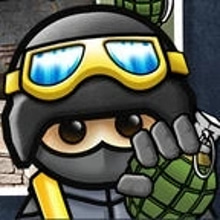
Fragger Lost City on Kiz10 throws you into a crumbling ancient ruin full of enemies who look way too comfortable standing around near explosive-friendly walls. Your weapon isn’t a rifle, a sword, or some heroic magic spell. It’s a grenade. A simple toss. A small metal problem with a timer and a personality. And the entire game is built around one delicious idea: if you can aim well, you can solve violence like a puzzle.
It starts off feeling easy in that suspicious way. You see an enemy, you set an angle, you throw, boom, problem solved. Then the levels begin to show you the real face of the game: tight corridors, odd platforms, enemies hiding behind geometry, and situations where a direct hit isn’t even the best option. That’s when Fragger Lost City becomes addictive. It stops being “throw grenade at enemy” and becomes “how do I use physics to make this explosion do the work for me?”
🧠🎯 AIMING IS YOUR LANGUAGE HERE
The controls are simple enough to learn in seconds, but the results can get surprisingly deep. You’re constantly adjusting power and direction, trying to land the grenade close enough to do damage while avoiding wasted throws. Because grenades are limited. Limited grenades mean every toss matters. You don’t just throw because you can. You throw because you believe in that throw. You commit. You watch the arc. You hold your breath for half a second. And then the grenade bounces in a way you didn’t expect and you make that little sound of disbelief like, really? That’s how we’re doing it today? 😅
What makes it fun is that the game rewards creative solutions. Sometimes you lob a grenade high and let it drop behind cover. Sometimes you bank it off a wall like a billiards shot that ends with an explosion instead of applause. Sometimes you aim at the floor near a ledge so the blast sends enemies tumbling. It’s not just precision. It’s imagination with consequences.
🏺🌀 PHYSICS PUZZLES DISGUISED AS CHAOS
Fragger Lost City is basically a physics puzzle game wearing an action costume. Enemies are the target, sure, but the real “puzzle pieces” are the environment: platforms, walls, corners, slopes, and small spaces that can turn a grenade into a miracle or a disaster. A slight change in angle can be the difference between a clean clear and a useless bounce that lands harmlessly somewhere embarrassing.
You’ll start learning little physics truths without trying. Grenades bounce differently depending on the surface and the approach. Tight rooms amplify the chaos. Elevated platforms let you drop grenades into protected zones. And blast radius is the quiet king of the game. You don’t always need direct hits. You need good placement. That’s the whole trick: put the explosion where it matters, not where your instincts tell you to aim.
😈💥 THE ENEMIES DON’T HAVE TO BE SMART TO BE ANNOYING
The enemies in games like this often stand around and look tough, but the real challenge isn’t their AI. It’s the layout. They’re positioned to tempt you into bad throws. One enemy is in the open to lure you into wasting a grenade, while the dangerous cluster is tucked behind a wall, laughing in silence. You’ll face situations where enemies are spread out just enough to make you choose: do you pick them off one by one, or do you attempt a higher-risk toss that can clear multiple targets at once?
And this is where the “lost city” vibe helps. Ruins are full of awkward angles. Half walls. Broken ledges. Unexpected gaps. Your grenade doesn’t care about your plan; it cares about geometry. The city turns every level into a little arena of trial and error, except the error part is loud and smoky.
🧨🧱 THE BEST THROWS ARE THE ONES THAT LOOK LIKE AN ACCIDENT
There’s a special kind of satisfaction in this game: winning with a throw that looks completely ridiculous… but works perfectly. You toss a grenade, it clips a corner, ricochets off a wall, drops into a pocket you couldn’t hit directly, and clears the whole room. For a moment you feel like a tactical genius. Then you try to repeat it and fail immediately, because the universe doesn’t like arrogance. Classic grenade behavior.
This “accidental mastery” is why Fragger Lost City stays replayable. It keeps giving you opportunities to feel clever, and it keeps you honest by reminding you that you’re still learning. The game isn’t about playing one perfect run forever. It’s about refining your eye for angles and discovering safer, smarter arcs that you can actually repeat.
🏜️🧩 LIMITED GRENADES = REAL TENSION
The limited ammo is what turns casual tossing into real decision-making. If you have infinite grenades, you can brute force. Here, you can’t. You may get a small number of throws per stage, and that creates this constant internal negotiation. Is this shot worth it? Is it better to go for the safe single kill, or try a risky multi-kill that saves grenades? Should you reset now because you already wasted one, or continue and hope you can recover?
It’s a simple pressure system, but it’s effective. The game makes you care about efficiency without turning into a calculator. You feel it in your hands: fewer throws means cleaner thinking. You stop spamming. You start planning. You start scanning the level before you throw, looking for the “best explosion location” instead of the “nearest enemy.”
👀🗺️ HOW TO READ A LEVEL LIKE A PLAYER, NOT A PANICKER
If you want to get better fast, the biggest shift is this: stop throwing immediately. Look first. Identify which enemies are protected by walls. Notice which platforms can be used to drop a grenade behind cover. Look for clusters. Look for edges. An enemy near a ledge is basically begging to be blasted off it. An enemy in a tight corner is asking for a bounce shot. The environment is full of hints if you slow down long enough to see them.
Then think in two steps. Step one: where can I place an explosion that changes the room? Step two: what does that change unlock? A good first throw often isn’t the one that kills the easiest target. It’s the one that opens the layout, clears a cluster, or removes the most annoying enemy position so the rest becomes simpler.
😅🔥 THE “ONE GRENADE LEFT” MOMENT
Every player hits this moment. You’ve made it deep into a level. You’ve got one grenade left. One enemy remains, but they’re in the worst spot possible. Your hands suddenly get very serious. Your brain starts narrating like it’s a movie. Okay, okay, just a clean toss, no hero stuff. You aim carefully… then the grenade bounces wrong and you feel your soul leave your body for half a second.
That tension is exactly what makes the game memorable. It’s not just about explosions. It’s about committing to a shot when you know you can’t waste it. When you nail that final toss, it feels like you didn’t just win a level, you solved it. You earned the clear.
🏁🏛️ WHY FRAGGER LOST CITY ON KIZ10 STILL FEELS GOOD
Because it’s pure, concentrated gameplay. You aim, you throw, you watch physics do its thing, and you learn. The levels are short enough to encourage retries, but clever enough to keep you thinking. It’s a grenade puzzle game that makes you feel smart when you succeed and makes you laugh (or groan) when you fail. And that balance is important. It keeps the tone light even when the challenge tightens.
If you like action puzzle games, physics-based aiming, and the satisfying chaos of explosions that you actually planned (don’t tell anyone it took three attempts), Fragger Lost City on Kiz10 is a perfects fit. It’s strategy disguised as destruction, and destruction disguised as a lesson in angles. And yes, you will miss a shot that looked impossible to miss. It’s tradition. 💣😅





 3.9 (26 votes)
 Share
Share
 Embed
Embed