💥 Welcome to the world’s most irresponsible gameshow
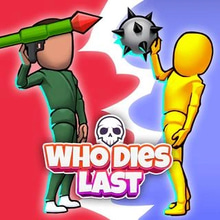
The lights pop on, someone yells “go!” and a dozen poor ragdolls wobble into an arena armed with exactly three things: gravity, hubris, and your questionable judgment. Who Dies Last is part physics toy, part puzzle gauntlet, part “I didn’t mean to do that but also I totally meant to do that.” Your win condition is gloriously simple: everybody else meets a creative demise before your champion does. How you make that happen—timed triggers, chain reactions, or one perfectly rude shove—is the joke, the plan, and the highlight reel.
🧠 Puzzles that prefer mischief over math
Each stage is a tiny contraption waiting for a nudge. There’s a fan with an attitude, a swinging mace that loves applause, a conveyor that seems innocent until it isn’t, and a button in a place no sensible person would stand. Tap once and watch dominoes fall: a crate slides, a lever flips, a plank tips, and suddenly three opponents are bowling pins while your survivor clings to a ledge like an action hero with jelly for bones. Success isn’t about memorizing solutions; it’s about seeing the joke hidden in the geometry and delivering the punchline at exactly the right beat.
🕹️ Controls that make chaos feel earned
You don’t need a pilot’s license. You need timing. A single tap activates a hazard, a long press charges a launch, a quick swipe nudges your wobbling volunteer into “safe-ish” territory. The game keeps the verbs small so the outcomes can be big. Miss the beat and your ragdoll becomes slapstick. Hit it and the arena sings—gears whirr, springs boing, and somewhere a rival sails majestically into a pit with the grace of a confused swan. The feedback is immediate and honest; when a plan fails, you can point to the half-second you were late and promise to be petty and punctual next time.
🧪 Chain reactions you can taste
The sweetest clears don’t use one trap—they use five. Drop a barrel so a fan catches it, let it roll into a switch that frees a wrecking ball, then time a floor plate so two enemies “coincidentally” meet said wrecking ball at the exact moment gravity remembers their names. The arena is a pantry full of ingredients, and you’re learning recipes. A little push here, a delayed trigger there, and suddenly you’re plating a catastrophe that would make a Rube Goldberg machine blush.
👥 Ragdolls with personalities (and very bad instincts)
They don’t talk, but oh do they communicate. One opponent always sprints for the shiny button that screams “trap.” Another lurks near the high ground like a cat who read a blog about tactics. A third trips on nothing every 12 seconds, which, frankly, is a gift. Reading these habits turns luck into literacy: bait the button-gremlin with a coin, body-block the climber into a moving platform, and leave the klutz alone—physics will handle your light work.
⚔️ Modes for a snack or a binge
Quick Match is espresso chaos: 30-second rounds where a single perfectly-timed trigger writes legend. Gauntlet strings themed arenas—“wind & wheels,” “lava & levers,” “everything is bouncy and so are your morals”—and tallies your survivors like a cheeky accountant. Puzzle Mode removes timers, adds move limits, and dares you to achieve “all perish but one” using exactly three interactions. Daily Arenas remix hazard layouts so the strategy you perfected at breakfast betrays you at lunch in the funniest way possible. Instant restarts keep the loop hot; you’ll be yelling “again” faster than your brain can file a complaint.
🎯 Scoring that applauds style, not just survival
Outlasting the crowd is the baseline. Doing it with panache is the multiplier. Near-miss bonuses ping when your ragdoll’s nose kisses danger and lives to tell the tale. “Two birds, one bop” scores when a single trigger erases a pair. A tiny halo glimmers on the timer when you commit to clean exits—trigger, hop, breathe—which is the game’s way of saying “we see your elegance.” Leaderboards track most efficient clears, most opponents removed by a single object, and bravest (read: dumbest) stunts that somehow worked.
🏟️ Arenas that teach without lectures
Starter stages are honest: one fan, one pit, one idea. Mid-game turns the volume knob. Rotating platforms demand rhythm. See-saw bridges reward weight management (yes, in a ragdoll brawl, weight management). Magnet walls yank metal crates into perfect, horrible alignment. Late arenas go full designer grin: mirrored rooms where triggers cross-influence, vertical stacks where timing echoes from floor to floor, and a glass corridor that looks safe until the first pebble ricochets and the entire world becomes marbles, limbs, and lessons.
🔧 Toys & traps with delicious attitude
Fans: gentle nudge to hurricane slap in 0.5 seconds. Springs: humble until you stack them, then suddenly you own a human trebuchet. Rotors: polite while idle, petty when spun. Glue pads: comedy gold—park a rival on one and watch panic do cardio. Portals: yes, there are portals, and yes, you can drop a box into one portal and your problems out of another. Every toy has a tell and a taste; blending them is how you cook mayhem that photographs beautifully.
😂 Tone: slapstick, but strategic
The humor is big, cartoony, and somehow endearing. Limbs flail, eyes widen, and the UI throws you a wink when you clearly meant to do that even if you didn’t. But beneath the giggles is clean design. Distances are readable, physics are consistent, and traps fire on beats you can learn. The joke lands because the craft is tight.
🎧 Audio that doubles as coaching
Springs twang in two notes: low for a weak launch, high for a face-moon trajectory. Fans ramp with a rising whirr that peaks exactly when pushback hits its stride. Floor plates clack a frame before they snap, a precious cue if you’re threading a sprint. When you chain a triple, the soundtrack blooms for a bar like the arena itself applauding. Play with headphones and you’ll trigger earlier, bait smarter, and laugh louder.
🧠 Tiny lessons that turn panic into poetry
Don’t stand next to the thing you’re about to activate unless your will includes “ragdoll.” Trigger on exits, not entries—the clean line after the click is how you survive. If a stage looks symmetrical, it’s lying; there’s always one kinder side. Use opponents as weights: two on a see-saw buys you a launch angle money can’t buy. Nudge, don’t shove; momentum is a multiplier, and small taps set big arcs. And when greed whispers “one more push,” ask yourself a simple question: do I like my legs?
🧰 Accessibility & fairness under the chaos
Color-coded cues clarify danger—yellow “warming up,” red “live now,” soft blue “cooling down.” A reduced-motion toggle trims big camera shakes, and high-contrast outlines keep silhouettes clean in busy scenes. The physics model never changes behind your back; a jump that works once works forever, which is why speedrunners will find tricks that look illegal and are secretly blessed by the rulebook.
📈 Progression that respects your time
You unlock arenas, modifiers, and silly cosmetics by doing the thing the game wants: clever eliminations. Finish a set with three survivors in a row? Enjoy “Hardcore Wind.” Yeet four foes with one object? Here’s “Mega Spring.” Cosmetics are delightful nonsense—traffic-cone hats, adhesive bandage capes, victory mustaches—that make losses funnier and wins louder without touching balance. The real currency is confidence; the game just adds sparkles.
🌟 Why it’s a Kiz10 no-brainer
Because it delivers the holy trifecta: obvious rules, juicy feedback, instant retry. Because five minutes buys three laugh-out-loud clears, and an hour becomes a reel of perfect timings, heroic escapes, and one legendary crate bounce you’ll bring up at dinner. Who Dies Last turns physics into punchlines and puzzles into applause. Step onto the stage, tap the wrong button on purpose, and pretend you planned the miracle that follows.





 2.5 (162 votes)
 Share
Share
 Embed
Embed