💎 Clicks, Color, and the Sudden Collapse of Your Afternoon
Gems Crusher is one of those puzzle games that looks friendly for about five seconds, and then quietly steals your full attention with the confidence of a tiny jewel-covered criminal. The idea is simple in the most dangerous way possible: click groups of matching gems, remove them from the board, and score as many points as you can. That sounds innocent. Relaxing, even. Then you realize the whole game is built around greed, timing, pattern reading, and that very specific puzzle disease known as “I can definitely do better on the next run.”
That is where Gems Crusher starts to shine on Kiz10. It does not need a complicated setup, a hundred tutorials, or some giant dramatic backstory about the ancient kingdom of magical gemstones and their emotional trauma. No. It just hands you a board full of colored gems and says, go on then, be clever. Remove the biggest groups. Think ahead. Chase points. Try not to ruin a beautiful setup by clicking too early like an overexcited goblin with a mouse.
And honestly, that restraint is exactly why the game works. It knows the core mechanic is enough. You scan the board, find clusters of the same color, and decide when to break them. Bigger groups mean bigger rewards, so every move becomes a little argument between patience and temptation. Do you clear that decent cluster now, or wait one turn and hope the board opens into something enormous and glorious? Sometimes you wait and feel like a genius. Sometimes you wait and create a colorful disaster that ends your momentum instantly. Puzzle life is cruel like that.
🟣 Small Groups Are Fine, Big Groups Feel Illegal
The scoring hook in Gems Crusher is what turns a simple puzzle board into a real obsession. Sure, you can remove small sets and keep the board moving, but the real thrill comes from building larger clusters and smashing them in one satisfying click. That is where the game stops being casual and starts becoming personal. Suddenly you are not just clearing pieces. You are hunting value.
That changes how you look at everything. A random gem is no longer random. It is part of a future opportunity. A weird little corner is not just clutter. It is a potential combo waiting for the right collapse. The board starts behaving less like a static puzzle and more like a living machine full of chain reactions and bad decisions. You begin to understand that every click rewrites the whole field. Columns shift. Colors fall. New chances appear. Old chances vanish. It is all beautifully unstable.
And that instability is exactly the fun. Gems Crusher keeps asking a very sneaky question: are you playing for safety, or are you playing for glory? Safe moves keep the board manageable, sure, but huge scores come from nerve. From patience. From letting the pattern grow until one click sends half the board into a sparkling collapse. Those moments are fantastic. Ridiculous, a little greedy, maybe irresponsible... but fantastic.
✨ A Puzzle Game Built on Temptation
What makes this style of gem puzzle so addictive is that every board feels like a promise. Not a guarantee, a promise. You look at the layout and immediately start imagining the version of it that could be much better. If these two colors merge... if that column drops... if I leave this alone for a second... maybe the whole center turns into one giant score bomb. That constant possibility keeps your brain active in a really satisfying way.
You are never just reacting. You are speculating. Forecasting. Making little private deals with the board. “Okay, listen, if I clear this blue group now, I need those red gems to fall together and save my dignity.” Sometimes the board cooperates. Other times it stares back in total silence while your plan collapses into nonsense. That unpredictability gives the game energy without making it feel random. Your decisions still matter. In fact, they matter more because the consequences spread farther than you first expect.
There is also something wonderfully honest about a puzzle game like this. The rules are easy to understand. Click same-colored gems. Bigger groups give more points. That is it. The difficulty comes from judgment, not confusion. The game never needs to hide behind complicated systems. It just places the pressure directly on your choices, which is exactly where a good score-based puzzle belongs.
🧠 The Board Is Quiet. Your Brain Is Not.
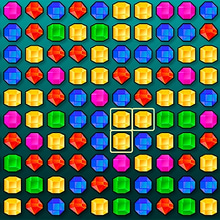
A lot of the tension in Gems Crusher comes from how calm the screen looks compared to how loud your thoughts get. Visually, it is just gems. Colorful, tidy, maybe even cheerful. Mentally? Absolute noise. You are calculating, hesitating, re-checking clusters, wondering whether the greedy move is brilliant or deeply embarrassing. This kind of internal chaos is what makes simple puzzle games so replayable. The board is clean, but the decision-making gets messy fast.
And then there is the classic trap: one nearly perfect run. That is always how it starts. You get a strong board, make a couple of satisfying clears, build a huge cluster, and suddenly your score is climbing with that lovely arcade rhythm. Now the game has you. Completely. Because once you have seen what a good run looks like, every weaker run becomes unacceptable. Now you are chasing the feeling, not just the points.
That is a powerful loop on Kiz10. Quick to start, easy to read, and dangerously hard to leave behind. Gems Crusher fits that browser puzzle sweet spot where you can jump in instantly, understand the objective in seconds, and still spend far longer than intended trying to beat your previous score. It is a perfect “just one more game” machine, which is frankly suspicious behavior for a bunch of colored stones.
🔥 When One Smart Click Feels Like a Firework
The best moments in Gems Crusher are all about release. You wait, plan, hold back, and then finally hit the cluster that changes everything. A giant section disappears. The board shifts. New groups form. Your score jumps. For one brief glorious moment, you feel like the smartest human alive. Not because the game told you so, but because you earned that little explosion of order through patience.
That reward is more satisfying than it looks from the outside. People see gem games and think relaxing puzzle, simple stuff, nice colors. Which is true, sort of. But there is also this delicious greed inside the design. The game pushes you to delay gratification, to read patterns, to trust that bigger opportunities are possible if you stop clicking like a maniac every two seconds. It becomes a game about discipline as much as perception.
And of course, discipline immediately vanishes the moment you spot a huge cluster and slam the mouse button with the emotional control of a raccoon in a candy store. That is part of the charm too.
🎮 Why Gems Crusher Works So Well on Kiz10
If you enjoy classic puzzle games, color-matching challenges, score attack gameplay, and that old-school feeling of turning a simple board into a serious personal mission, Gems Crusher is an easy win on Kiz10. It has all the right ingredients: clear rules, strong visual feedback, satisfying board collapse, and enough score-driven tension to keep every run meaningful.
It also understands something important about browser puzzle games. They do not need to be huge to be memorable. They just need a mechanic strong enough to make the next attempt feel necessary. Gems Crusher absolutely has that. One board becomes two. Two become six. Then suddenly you are leaning forward, studying gem clusters like a jewel detective who has forgotten what sunlight is.
That is the magic here. Not complexity for its own sake. Not noise. Just color, pattern, patience, and the thrilling little moment when one click turns half the screen into points. Gems Crusher makes that moment feel great, over and over again. And really, once a puzzles game can do that, it does not need much else.



 4.2 (7 votes)
 Share
Share
 Embed
Embed