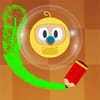
✏️✨ YOU GET ONE TOOL: A PENCIL THAT BENDS REALITY
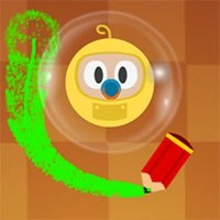
Magic Pencil is the kind of puzzle game that makes you feel clever even when you’re failing. Because the failure isn’t “you didn’t understand,” it’s “your idea was funny but physics disagreed.” And honestly, that’s the best kind of puzzle loop. You’re given a simple concept on Kiz10: draw something, then watch it become real enough to interact with the world. Lines turn into ramps, bridges, blockers, supports, tiny miracles made of scribbles. And once you realize you can solve a level in ten different ways, the whole game turns into a sandbox of creativity disguised as a brain teaser.
It’s not about perfect art. It’s about perfect intention. Your drawing can look like a shaky noodle and still save the day if it lands in the right place. The pencil doesn’t judge your handwriting. The level does. That’s what makes Magic Pencil fun: it turns doodling into strategy, and it makes you experiment like a curious player instead of forcing one “correct” solution.
🧠🧩 PUZZLES THAT START SIMPLE, THEN GET WEIRD (IN A GOOD WAY)
At the beginning, the game eases you in. You draw a basic line, something falls, something rolls, the goal is reached. Cute. Then the levels start asking for more thought: you need to time your drawing, you need to anticipate how objects will bounce, you need to build shapes that don’t collapse, you need to stop something from falling into disaster. The puzzles become less like “draw a line here” and more like “invent a small machine out of scribbles.”
That’s where it gets addictive. Because every level feels like a little laboratory test. You draw an idea, the world reacts, and you immediately learn whether your idea was genius or chaos. Sometimes you’ll surprise yourself. You’ll draw a simple curve and it creates the perfect ramp. You’ll draw a tiny wedge and it redirects a rolling object exactly where it needs to go. Other times you’ll draw something ambitious, it will wobble, fold, and fail like a weak chair, and you’ll just stare at it thinking… why did I believe that would work? 😅
🎯⚙️ PHYSICS IS THE REAL BOSS
Magic Pencil is secretly a physics game. Gravity, momentum, balance, friction, all the invisible rules are what you’re actually fighting. The pencil is just your way of negotiating with them. That makes the game feel fair, because when something fails, you can often explain why. Your bridge was too thin. Your ramp was too steep. Your support was placed too far to the side. Your drawing was heavy in the wrong place and tipped over. You don’t need a textbook, you just need observation.
Once you start thinking like that, your drawings become smarter. You stop drawing huge shapes and start drawing useful shapes. Small supports. Triangles. Curves that guide motion smoothly. Barriers that catch an object gently instead of slamming it. The game rewards efficiency, and it also rewards calm experimentation. Every attempt teaches you something.
🖍️😈 THE FUN OF “WRONG” SOLUTIONS THAT ARE STILL HILARIOUS
One of the best parts of drawing puzzle games is that even bad ideas can be entertaining. You’ll draw a giant wall and it’ll fall over like a dramatic actor. You’ll draw a perfect ramp and then the object will launch off it into the void like it’s trying to escape the game. You’ll attempt a delicate bridge and it’ll collapse instantly, and for a second you’ll laugh because it looked so confident. Magic Pencil has that playful feel where messing up doesn’t feel like punishment, it feels like slapstick science.
And because you’re drawing, the game becomes personal. Your solution isn’t just a button press, it’s your shape. Your design. Your weird, wobbly invention. That makes success feel better too. When you solve a level, you don’t feel like you followed instructions. You feel like you built something that worked.
🧠✨ A MINDSET THAT MAKES YOU SOLVE LEVELS FASTER
If you’re stuck, don’t draw bigger. Draw simpler. Big drawings look powerful, but they usually create new problems: they topple, they block the wrong area, they add weight in weird ways. Small, deliberate shapes are often better. A tiny ramp can guide motion more cleanly than a giant slide. A single support can hold a platform better than a messy pile of lines. And triangles are your best friend. Triangles in physics puzzles are basically magic. They hold, they brace, they stabilize. If you’re not sure what to draw, draw a triangle and see what happens. 😄✏️
Also, think one step ahead. Not just “where should the line be,” but “where will the object be three seconds after I draw this?” The game is about future motion. The pencil is your way of shaping that future.
🎮🌟 WHY MAGIC PENCIL IS PERFECT ON Kiz10
Magic Pencil fits the Kiz10 style perfectly because it’s fast to start, easy to understand, and endlessly replayable. It’s a puzzle game, yes, but it feels more like play than work. You’re experimenting, learning, and improvising, and every level gives you a chance to solve it in your own way. That freedom makes it feel fresh, even across many stages.
If you like draw-to-solve puzzles, physics challenges, creative brain games, and the satisfaction of watching your doodle become a working solution, Magic Pencil is exactly that sweet mix of clever and chaotic. It’s relaxing, then it’s tricky, then it’s funny, then it’s satisfying, all in one neat pencil-shaped package. ✏️🧩✨



 3.8 (47 votes)
 Share
Share
 Embed
Embed