Tiny Minions Big Brainwork 🧠💛
Minion Lab looks innocent for about three seconds. The screen opens on a clean grid, a few glowing color buttons and some tiny square Minions staring at you with that “please do not mess this up” energy. Each Minion has a color. Each button has a matching color. Your job sounds simple guide every Minion to the button that belongs to them. No timers screaming at you. No explosions. Just you, a quiet lab and a puzzle that gets more stubborn the longer you stare at it.
You slide the first Minion and instantly realize the catch. When a Minion moves, it does not stroll one tile and politely stop. It keeps sliding until something blocks it. A wall, another Minion, maybe a corner. Suddenly every move is bigger than you expect. One tap and your Minion shoots across the board, overshoots the target and ends up sulking in the wrong corner.
That is the heart of Minion Lab. It turns gentle color matching into a proper logic challenge where distance, obstacles and order matter as much as the destination.
How The Color Lab Really Works 🎨🔬
Each level is a small laboratory table filled with tiles. The Minions start on certain squares, the color buttons wait on others and between them sit all kinds of obstacles. There might be fixed walls, blocks you can use as stoppers, and narrow corridors that force your moves into specific lines.
You choose a Minion and slide it up, down, left or right. It travels in a straight line until it hits something. If you aimed well, it stops exactly on its matching button and locks in with a satisfying feeling, like a plug finally snapping into a socket. If you misjudge the path, it shoots past where you wanted it to stop and now sits in a position that makes the rest of the puzzle even harder.
Very quickly you realize that the board is less about colors and more about routes. The real question is not “where does this Minion belong” but “what can I use to stop them at the right moment.” Walls become tools. Other Minions become temporary barriers. Even the buttons themselves sometimes act as anchors so you can park one Minion just right to help another.
Every Move Has Consequences 🧩🚧
Minion Lab does not let you move a Minion without changing the entire situation. The moment you slide one character, you alter the available walls, the open lanes and the way other Minions can travel. That means you cannot just solve every path separately. You have to think in sequences.
Maybe the blue Minion has a clear shot to its button right away, but if you take that easy move you lose the perfect stopper you needed for the yellow one. Maybe the green Minion is blocking a corridor that the red Minion will desperately need later. You start to see each Minion as both a problem and a tool.
So you plan. You move yellow first, using blue’s body as a wall. Then you reposition green to open a corner. Only after all of that do you send blue home. When it works, the level almost feels like a little animation you choreographed yourself, every slide triggering the next step in a tiny mechanical dance.
From Simple Slides To Devious Setups 😈🧪
The early levels are kind. They teach you the basics. Slide here, stop there, one or two Minions, maybe a wall or two placed in obvious positions. You feel clever, you clear everything in a few moves and you wonder if the whole lab will be this relaxing.
Then the game quietly sharpens its teeth. The grid fills with more Minions, more colors, more tight corridors. Some buttons hide in awkward corners where a straight shot is impossible unless you first rearrange the entire board. That perfect stopper you relied on earlier now starts in the worst possible place.
You might face layouts where one wrong move traps a Minion permanently, forcing a restart. You slide them into a corner and realize there is no way to pull them out without first blocking the path for someone else. Other stages feel like riddles that only unlock when you realize one surprising trick, like using a button as a temporary wall or deliberately parking a Minion in the middle of the board just to create a new stopping point.
It is the kind of game where you sometimes sit with your finger hovering over the key, thinking “if I move this one now, am I going to regret it in two turns” and you are often right to be suspicious.
When Mistakes Become Your Teacher 😅🔁
You will absolutely ruin levels in the funniest ways. You will slide a Minion with total confidence, watch them zoom across the grid and lock themselves into a useless corner. You will send two Minions colliding and realize you have just blocked off the only path to a button. You will carefully plan three moves ahead and still discover on the fourth move that you overlooked one tiny wall.
Minion Lab does not punish you with long game over screens. You simply reset and try again. But every failure leaves a small blueprint in your head. You remember that moving yellow first cuts off a path for green. You remember that blue needs that wall near the top left, so you cannot use it as a stopper for someone else. The level stays the same, but you change.
Sometimes the best thing you can do is intentionally test bad ideas. What happens if you slide this Minion straight into that block Does it open a new route or create a trap Knowing why something does not work is just as valuable as knowing why it does. Eventually you do not just have one perfect solution; you understand the whole architecture of the puzzle.
Calm Thinking Versus Impulsive Moves 🧘♂️⚡
There is a fun tension in Minion Lab between patience and impulse. On one hand, it is a pure logic puzzle game. You can take as long as you want. No countdown is forcing you to move. The smartest approach is often to stop, breathe and mentally simulate a move before you commit.
On the other hand, these little Minions are so simple and the controls so responsive that it is hard not to slide them around just to see what happens. Some runs will be thoughtful and careful, with you mapping out half the solution in your head before touching the keyboard. Others will be pure experimentation, moving everyone around in a flurry of “maybe this works” moments until you either stumble into the solution or completely break the board and reset with a laugh.
Both styles are valid and, honestly, both are part of the fun. Some levels practically beg for slow, calculated planning. Others are perfect playgrounds for chaotic testing where you discover tricks you never would have found by overthinking. The game happily lets you bounce between those moods.
Little Characters Big Personality 💛🔲
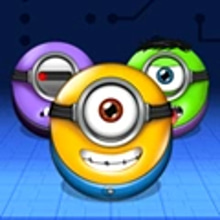
Even though Minion Lab is all about logic, the presentation keeps things light. The Minions might just be colored blocks, but they feel like tiny lab workers waiting for instructions. Seeing a yellow Minion shoot across the map to land perfectly on a yellow button is weirdly satisfying, like watching someone slide into the perfect parking space.
The color coding is not just cute it is functional. At a glance you know which Minion belongs where and can mentally pair them up before you move a single piece. As levels get more complex and more colors appear, that visual clarity keeps your brain from melting. You can focus on routes and sequences instead of squinting to figure out which piece belongs to which goal.
Every successful level leaves the board looking neatly solved, all Minions sitting proudly on their buttons like they knew the plan the whole time. It is a small visual reward, but it hits your brain in the same way as lining up puzzle pieces or finishing a satisfying pattern.
Why Minion Lab Fits So Well On Kiz10 🌐🧩
On Kiz10, Minion Lab sits in that perfect space between calming and challenging. You can play it in short bursts, solving a level or two during a break, or sink a longer session into stubborn puzzles that refuse to fall. There is no pressure to rush, no complicated controls to learn, just pure logic wrapped in a friendly, colorful grid.
Kiz10.com
It is ideal for players who love puzzle and logic games where every move matters. Kids can enjoy the clear colors and simple idea of matching Minions to buttons. Older players and puzzle fans get deeper satisfaction from finding the exact move order that makes a “crowded” board suddenly fall into place.
If you enjoy sliding block puzzles, sokoban style thinking or any game that turns a small board into a big brain teaser, Minion Lab on Kiz10 delivers. Each level feels like a tiny lab experiment where you test hypotheses, adjust when things go wrong and finally reach that sweet moment where every Minion sits exactly where they should. 🧪✨





 4.1 (143 votes)
 Share
Share
 Embed
Embed