💰🧝 A tiny elf with a very serious money problem
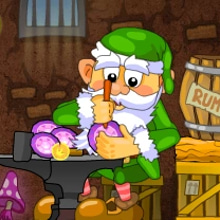
Miser Elf is the kind of game that tells you exactly who the hero is and immediately warns you not to trust his priorities. This is not a noble elf on a grand mission to save the forest. This is not a magical guardian protecting ancient peace. No, this little troublemaker wants coins. All of them. Every shiny piece. Every tempting bit of treasure. If there is gold on the screen, his whole soul locks onto it like a possessed shopping cart with legs.
That is what makes the game fun right away. Greed is a fantastic engine for arcade puzzle gameplay. It is simple, a little ridiculous, and very easy to understand. The goal is not buried under complicated systems or fake drama. You are here to collect everything, clear the level, and prove that your brain works slightly faster than your bad impulses. Kiz10’s page describes Miser Elf as a game where the elf wants all the coins and you must use the jewel to collect every coin in each level.
And that “use the jewel” detail matters. It instantly gives the game a more unusual flavor than a standard run-and-grab platformer. This is not just about moving left and right while stuffing pockets. There is a mechanic in play, something that changes how you think about each level. The jewel is not decoration. It is the real key to progress. That means every stage becomes less about speed alone and more about figuring out the cleanest, smartest way to sweep the board without leaving treasure behind like some kind of amateur.
🪙 Greed turns simple levels into brain traps
At first, Miser Elf probably looks almost too harmless. Coins. Small stages. A clear objective. Maybe a cute little character who looks like he should be helping bake cookies instead of inhaling wealth with this kind of dedication. Then you start playing, and the real tone appears. Because once a level asks you to collect every single coin, nothing is casual anymore.
Now every movement matters.
A coin in the corner is not “just there.” It is a problem. A route that looks obvious might be wrong because it leaves one stubborn coin trapped behind bad positioning. A level that seemed easy can suddenly become a tiny logic prison built entirely around your own greed. That is where Miser Elf gets its bite. It takes a simple objective and quietly wraps it around puzzle thinking. The more valuable everything looks, the more carefully you have to act.
That is always the best kind of design in games like this. It lets the goal stay easy to explain while making the execution much trickier than expected. You are not memorizing lore. You are not juggling twenty systems at once. You are just trying to collect every coin… and somehow that becomes a proper challenge. Beautiful. Slightly humiliating. Very effective 😅
💎 The jewel changes everything
The jewel mechanic is the part that gives Miser Elf its identity. Kiz10’s description does not just say “collect the coins.” It specifically says you have to use the jewel to do it. That tiny sentence is doing a lot of work. It suggests that the game is built around interaction, planning, maybe positioning, maybe puzzle timing, maybe stage control. Whatever exact form it takes, the message is clear: the coins are not simply picked up by wandering around. There is a method. A tool. A little trick hidden inside the rules.
And that makes the game much more interesting than a straightforward collector. Once a special object becomes part of the solution, the level stops being just a map and starts becoming a system. You are not only asking where the coins are. You are asking how the jewel changes access to them, how it helps gather them, and how to avoid turning the whole thing into a mess through one impatient move.
That shift is where the puzzle energy comes alive. Suddenly your brain starts doing weird little calculations. “If I use the jewel here, can I still reach that coin?” “Do I clear the easy side first or save it for later?” “Why did I think that was a smart plan?” These are excellent questions. Games that create this kind of internal monologue are usually doing something right.
🧩 Small levels, surprisingly personal frustration
One of the best things about compact puzzle games is how personal failure feels. In a huge open world, getting something wrong can feel distant. In a small coin-collection stage, the mistake is right there, staring at you. One missed route. One awkward move. One coin left behind like a tiny golden insult. Miser Elf almost certainly thrives on that kind of tension.
And weirdly, that is a compliment.
Because when a puzzle game is good, frustration does not just annoy you. It hooks you. It makes you want to solve the stage cleanly, elegantly, maybe even smugly. You stop playing to finish and start playing to prove a point. Not to the game, really. To yourself. You knew the route was there. You saw the pattern. You were close. So now the next attempt becomes personal.
That replay loop is where games like Miser Elf get dangerous. The levels are small enough that retrying feels easy. The goal is clear enough that improvement feels possible. The mistakes are obvious enough that you can imagine fixing them instantly. Put all that together and suddenly “just one more level” becomes a tiny life philosophy.
🎮 Cute surface, ruthless little puzzle core
There is a special joy in games that look friendly but behave like puzzle gremlins. Miser Elf sounds exactly like one of those. The elf theme keeps everything playful. The coins make the objective feel inviting. The jewel gives the mechanic a magical twist. But underneath that bright setup is a level structure built to expose hesitation, greed, and poor planning one move at a time.
That contrast is gold. Literally, in this case.
It also gives the game more personality than a generic logic puzzle. You are not moving abstract blocks around a blank screen. You are helping a deeply coin-motivated elf vacuum up treasure with suspicious determination. That helps the whole thing feel livelier. More mischievous. Less clinical. Even when you are stuck, the mood stays playful enough to keep the frustration from turning sour.
And honestly, greed is funny. That matters more than people think. A puzzle game becomes much more memorable when the central objective has a little comic identity to it. Miser Elf is not collecting coins because destiny demands it. He is collecting them because apparently enough is not a concept he respects. Wonderful character trait. Very useful for game design.
🌟 Why Miser Elf fits Kiz10 so well
On Kiz10, Miser Elf makes perfect sense as a compact browser puzzle game with a simple premise and sticky replay value. The live Kiz10 page lists it as an HTML5 browser game and describes the whole challenge in one clean sentence: this miser elf wants all the coins, and you must use the jewel to collect them in every level. That is exactly the kind of direct concept that works beautifully for quick online play.
The game also sits naturally beside other Kiz10 titles involving elves, collectibles, light puzzle logic, and stage-by-stage progression. Real live Kiz10 pages such as Robert The Elf, Mushroomer, Christmas Friends, and Elf Archer show that the site already has a lane for elf-themed adventure, platform, and puzzle experiences, while titles like Super Jump World reinforce the coin-collecting platform vibe.
That is why Miser Elf works. It keeps the idea focused, the challenge readable, and the personality strong. A greedy elf plus coins plus a jewel-based collection mechanic is more than enough to build a game that feels playful, tricky, and surprisingly hard to put down. You come in expecting something small. Then one awkward level with one stubborn coin decides to ruin your evening in the most entertaining way possible.



 5 (15 votes)
 Share
Share
 Embed
Embed