🚨 Sprinting for freedom, one mistake from disaster
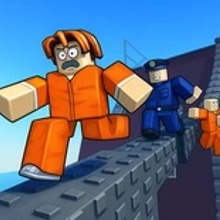
The siren never really stops in Obby Prison Escape Speed. It blares in the back of your mind as you bolt across thin walkways, vault over gaps that look too wide, and side-eye guards who seem way too eager to shove you into the nearest hazard. This isn’t just a simple prison escape it’s a constant speed test where the floor can vanish, the bubbles can swallow you, and the sharks are just waiting for that one lazy jump. You’re not strolling out of here. You’re sprinting like your last checkpoint depends on it… because it does.
⚡ Obby parkour with the fast-forward button held down
This is pure obby energy, stripped down and then cranked up. Every stage throws something at you that wants to slap your timing: moving platforms that hesitate just long enough to mess with your rhythm, disappearing tiles that punish standing still, tight corridors where a guard patrols like a moving wall. You move with WASD or on-screen controls, jump with Space, and the camera swings behind you as you weave through each section. There’s no combat. No crafting. Just raw movement, reactions, and the constant feeling that the level is smirking a little each time you misjudge a jump by a pixel.
🧠 Memory, rhythm and “I swear I’ll get it this time”
The first time you see a new trap, it’s chaos. A wave of bubbles rolls at you faster than you expected. A floor section flickers out beneath your feet. A shark-lined pool leaves exactly one safe path and you only notice it as you fall past it. But that’s where the game gets addictive. You respawn, you breathe, and you start to map the pattern in your head. Guard turns here, tiles vanish in this order, bubble wave hits right after that corner. One run later, you’re already smoother. Five runs later, you’re bouncing through the same section like it was always easy. Obby Prison Escape Speed quietly proves how far repetition and rhythm can push your reflexes.
🧱 Guards, bubbles, and sharks with bad intentions
Prison should be about walls and bars. Instead, this place feels like a theme park designed by someone who really loves hazard signs. Guards are the first problem: they patrol narrow platforms, block doors, and turn tight corners into split-second timing tests. Bubbles come next, rolling along the track like slow-motion tsunamis that erase anything in their path. You either outrun them or accept that you’re about to take another bath. Then there are the sharks, circling under glass floors or lurk beneath broken bridges, ready to punish sloppy jumps with one bite and one instant restart. Every hazard wants something different from you speed, patience, or a completely new route.
🏃♂️ Flow runs and panic jumps
On good runs, your movement feels like a dance. You chain jumps across disappearing tiles, slide past guards right as they turn away, bounce off springy platforms and land exactly where you meant to. Your fingers stay loose, your camera stays calm, and you reach the next checkpoint without even realizing you were holding your breath. On bad runs, you hop too early, clip a corner, bounce off a guard, miss a timing window, and watch the whole sequence crumble into panic hops that somehow make things worse. The contrast is what keeps you hooked. Every clean run proves you’re capable. Every messy one dares you to roll back in and fix it.
🎮 PC or mobile, same prison, same pressure
Whether you’re on PC with WASD and mouse, or swiping around on your phone, the basics stay the same. Forward, back, strafe, jump, rotate camera. The controls are simple on purpose so the difficulty comes from level design, not finger gymnastics. On mobile, dragging to adjust the camera mid-run feels surprisingly natural once you’ve failed a few times and learned to flick your view just ahead of your feet. On PC, the mouse makes it easy to peek around corners and line up tricky diagonals. No matter the platform, the game always boils down to the same question: did you move when you meant to, or did you flinch half a second too late?
🎯 Speedrunners, try-hard friends, and your own ghost
Obby Prison Escape Speed lives for people who like to chase themselves. Beating a level once is the warm-up. The real game starts when you replay it just to shave a second off your time or clear it without a single death. You’ll start planning cleaner routes: do you risk the tougher upper path for a faster line, or take the safe route and settle for consistency? Friends turn into benchmarks. They’ll brag about reaching a certain stage or clearing a route deathless, and suddenly you have a new goal you absolutely didn’t care about five seconds ago. The course doesn’t change, but how you move through it does.
💎 Risky collectibles and “do I really want that coin?” moments
Sometimes the game dangles rewards in places that are clearly rude. A collectible sits just off the main path, hanging over a shark pit or hiding behind a guard who never seems to look away for long. You don’t need these extras to reach the exit, but they taunt you every time you pass. Do you keep your safe, consistent line and ignore them, or reroute your whole run for a shiny bonus that might ruin your perfect pace? Taking those risks turns a normal attempt into something more dramatic. When you pull it off, it feels like you stole treasure from the level design itself.
🧩 Micro-skills that suddenly make everything easier
Little habits start to form the more you play. You learn to nudge the camera slightly down so you can see where you’re landing, not just where you’re jumping from. You start using small “feather” taps on movement keys instead of full presses so you don’t overshoot narrow beams. You practice backing off a ledge just enough to bait a guard into moving, then sprinting past while they reset. None of these tricks are explained outright, but they click naturally as you grind stages. One day you realize that sections that used to feel impossible now barely register as difficult—and that shift is entirely because your brain quietly leveled up.
🚪 One more escape attempt, then another
By the time you’ve spent a while with Obby Prison Escape Speed, the prison doesn’t feel like a place anymore; it feels like a playlist of reflex tests. You’ll have a favorite section, a hated section, and that one jump you’re unreasonably proud of. You might only play a few minutes at a time—one run between tasks, one more attempt after a close call—but the urge to come back stays. Because you know the guards are still pacing, the bubbles are still rolling, the sharks are still circling, and somewhere in there is a run where you absolutely nail everything. And you’d really like that run to have your name on it.





 Share
Share
 Embed
Embed


