🟦🟧 THE MOMENT YOU GET THE GUN, THE ROOM STOPS BEING A ROOM
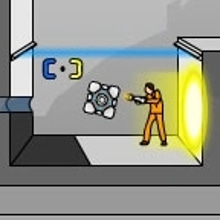
Portal: The Flash Version drops you into a clean, quiet space that pretends it’s harmless. White walls, simple platforms, a door that feels smug. Then you pick up the portal device and everything changes. Walls stop being walls and start being choices. Distance stops being real. The ceiling quietly becomes a highway. On Kiz10, this game hits that perfect browser sweet spot where the idea is instantly understandable, but the execution makes your brain do weird little backflips. You fire one portal, you fire the other, you step in, you step out somewhere that should not be possible, and for a second you feel like a magician with a physics degree. Then you take one careless step, fall into a pit you created yourself, and remember you’re still human 😅
The goal is simple in the most dangerous way. Reach the exit. Not by smashing through enemies, not by grinding stats, but by understanding space like it’s a puzzle sentence you can rewrite. Each chamber is a miniature argument between you and gravity. Gravity says down. The portals say “down is optional.” Your job is to convince the level that your version of reality is better.
🧠⚡ THINKING IN LOOPS, NOT LINES
A normal platformer asks you to move from left to right. Portal: The Flash Version asks you to think in loops. You don’t just ask, “How do I get there?” You ask, “Where can I make ‘there’ be?” You start scanning surfaces like you’re shopping for doorways. That wall? Maybe. That ceiling? Definitely suspicious. That tiny ledge you ignored? Suddenly the most important real estate in the room.
And the coolest part is how quickly your brain adapts. Early puzzles teach you the grammar. Blue portal plus orange portal equals travel. Put them facing each other and you get a weird infinite hallway vibe. Put one on the floor and one on a wall and you turn falling into forward speed. You start noticing that movement isn’t only movement anymore, it’s stored energy. If you drop far enough, you can launch yourself. If you launch yourself, you can reach places that seemed decorative. The game is basically training you to weaponize your own clumsiness.
🌀🏃 MOMENTUM IS YOUR SECRET SUPERPOWER
Here’s where it gets addictive: the game doesn’t just let you teleport, it lets you carry momentum through portals. That means every fall can become a jump, every jump can become a cannon shot, and every mistake can become a plan if you’re shameless enough to pretend you meant it. You’ll have moments where you set up a portal pair, take a running start, dive in, get flung out like a pinball, and land perfectly on a platform you couldn’t reach before. When that happens, it feels incredible, like you just pulled off a stunt in slow motion.
But momentum is also the reason you’ll fail in the funniest ways. You’ll fling yourself too hard and fly past the safe platform. You’ll bounce off a ledge and tumble into a hazard. You’ll panic-fire a portal mid-air and accidentally create an exit that launches you straight into trouble. The game is constantly balancing power and punishment. It gives you a tool that can break the room, then asks if you can control the chaos you just unleashed.
🧊🧱 CUBES, BUTTONS, AND THE STRESS OF “WHERE DID MY BOX GO”
At some point, the rooms stop being just portals and jumps. They introduce objects you need to carry, place, and protect. A cube becomes more than a cube; it becomes your passport to the next door. You’ll carry it carefully like it’s precious, then accidentally drop it into a pit and stare at the screen in complete silence because you know the cube didn’t deserve that 😭
This is where the puzzles get deliciously layered. You’re not only placing portals for yourself, you’re placing portals for the cube’s journey too. You might need to fling it across a gap, slide it onto a switch, or keep it safe while you reposition. Suddenly you’re juggling: your own movement, the cube’s position, the timing of hazards, and the fact that you can’t be in two places at once… unless you cheat space correctly.
🟥🔫 TURRETS, ENERGY THREATS, AND “OH NO, THEY AIM”
Then the game gets rude. Turrets show up. Not in a heavy shooter way, but in a “this room now has consequences” way. They punish lazy routes and force you to plan safe lines. You can’t just stroll forward. You have to think about angles, cover, and how portals can become safety tunnels. You’ll start using portals like peeking windows, firing them from behind walls, stepping through only when you know you won’t be turned into confetti.
And there’s something satisfying about beating danger with brains. When you redirect your path so the turret can’t see you, when you slip behind it by using a portal in a place that feels illegal, you get that smug feeling of “I outsmarted you.” It’s not about reflexes. It’s about geometry and audacity. The kind of audacity that makes you try ridiculous portal placements just to see if the room will allow it.
🧨🕳️ TRAPS, CRUSHERS, AND THE SOUND OF REGRET
Some chambers introduce hazards that feel like they were built by someone who hates optimism. Moving platforms, crushing devices, deadly pits, timed threats that demand you commit. The challenge isn’t only solving the puzzle, it’s solving it cleanly. Because portals are powerful, but they’re also unforgiving. A portal placed slightly wrong can throw off your timing. A portal placed too early can put you in danger. A portal placed in panic can create a perfect escape route for your enemies and a perfect disaster route for you.
This is where the game’s pacing shines. It keeps rooms short enough that retries don’t hurt, but clever enough that you feel smart when you finally nail it. You start recognizing patterns. You learn when to set an “entry portal” first and keep it safe. You learn to place the “exit portal” at a height that doesn’t ruin your landing. You learn to stop rushing, because rushing is how you fling yourself into a crusher like you’re volunteering.
🧪😵 THE REAL FUN: MAKING A PLAN, THEN WATCHING IT EXPLODE
Portal: The Flash Version is at its best when you’re half confident and half terrified. You walk into a room, you think you understand it, you set up a plan, and then the plan collapses in a spectacular way. Not because the game is random, but because you didn’t predict one detail. Maybe the momentum is higher than you expected. Maybe the cube bounces weirdly. Maybe the portal angle flings you sideways. These “almost” failures are the magic. They teach you faster than success does.
After a few attempts, you start iterating like a real puzzle solver. You change the order. You move the portal slightly. You wait half a second. You choose a different surface. And then suddenly it works and you feel that rush, that little electric “YES.” It’s not a big RPG victory. It’s a brain victory. The kind you want again immediately.
🏁✨ WHY IT STILL FEELS GREAT ON Kiz10
This game works because it never forgets what makes portal mechanics fun: the feeling that you’re rewriting the rules while still respecting them. It’s not just a gimmick. It’s a full puzzle language. You’ll play for the joy of solving, the joy of flying through your own doorway, the joy of realizing that the solution was right there and you simply weren’t thinking like a portal player yet.
So take your time, aim your portals with intent, and treat every room like a weird math joke you can win with creativity. When you finally step through the last portal and reach the exit, it doesn’t feel like you escaped a room. It feels like you escaped the normal universe for a while… and came back with proof that space can be bullied. 🟦🟧😈





 Share
Share
 Embed
Embed