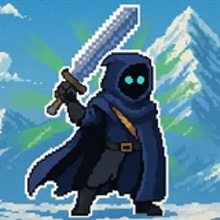
The world does not end with a roar in Shadow Path. It breaks with a flash. One impossible explosion tears through the sky and then everything goes strangely quiet. When the light fades, the runes that once protected the land are gone, scattered like burning leaves across distant realms. Out of that silence a figure steps into view, all edge and outline, more silhouette than flesh. That is you. A walking shadow on a mission to stitch the world back together rune by rune 🌑✨
From the first moment you move, Shadow Path feels like a pure platform adventure built by someone who actually loves tight controls. Your character glides across the ground with a responsive stride, leaps with a satisfyingly crisp arc and snaps to ledges with just enough forgiveness to make risky jumps feel thrilling instead of unfair. This is a game where a single mistimed step can send you straight into spikes, but when you nail a sequence of jumps between crumbling platforms and swinging blades, it feels like you have been training your whole life for that exact fifteen seconds.
The game splits its story across three acts, each one a self contained journey through a different biome. At first you find yourself in broken forests and mossy ruins, where the sky still has some colour left and the danger hides in bushes and collapsed bridges. Later acts drag you deeper into more hostile environments cavern mazes lit by sickly crystals, frozen heights where the wind itself seems to shove you toward the edge, crumbling fortresses that look like they remember the explosion all too well. Every biome carries its own rhythm and its own way of trying to throw you into the abyss 🏞️❄️🏰
Movement is the language of Shadow Path, and the levels are the sentences. Each of the thirty stages pushes you to read the environment like a script. A narrow ledge above a line of spikes suggests a slow careful approach, while a series of wide platforms with enemies patrolling on top screams run fast or get cornered. You will bounce on staggered platforms to avoid swinging axes, slide under low ceilings to dodge arrows, and time leaps between walls that seem determined to reject you. The game constantly mixes straightforward runs with sections that ask for a little more brain and a lot more timing.
Enemies are never just decorations waiting to be farmed. Skeletons clatter toward you in predictable but dangerous patterns, forcing you to choose between jumping over them or striking at exactly the right moment. Archers stand at annoying angles, lining up shots that punish lazy approaches and reward players who use terrain cleverly. Wolves charge in sudden bursts, turning safe ground into a sprint zone where hesitation gets you bitten. Flying mice swoop down in jittery arcs, guarding vertical sections where you are already nervous about your jumps 🐺🦇
You always have options. You can cut through enemies directly, learning attack windows and spacing so you land blows without taking damage. Or you can treat combat as another puzzle and simply avoid them, slipping past skeletons with tight jumps and luring wolves into traps designed for something else entirely. Shadow Path feels just as satisfying when you clear a room without swinging a single strike as it does when you carve through it with perfect timing. Both routes are valid, and both speak to the idea that you are more shade than soldier.
Traps are the unblinking eyes of this world. There are ten different types waiting for you, each with its own personality. Some are classic spikes that punish drops that are just one pixel too far to the side. Others are dart launchers hidden in walls, waiting to loose a projectile the moment you cross a line you did not know existed. You will find collapsing floors that barely support your weight, rotating blades that sweep corridors in precise patterns and platforms that vanish a split second after you touch them. The first time you meet a new trap type you almost always lose a heart. The second time you start to smile because now you understand the rules.
By the time you reach the latter half of the game, Shadow Path begins to mix these traps together like a composer building a crescendo. Spikes guard the landing zones for moving platforms. Blades spin between arrow volleys. Wolves chase you through rooms where the floor only exists for a heartbeat at a time. Levels start to feel less like simple obstacle courses and more like small stage plays where you are improvising the choreography in real time. When you finally reach a safe rune at the end of a brutal stage, there is this tiny moment where you just stop, breathe and let your fingers unclench 🎮
The three acts each culminate in a boss that embodies the corruption unleashed when the runes were scattered. These fights are not impossible walls, but they do demand attention. One boss might stomp across a small arena, sending shockwaves through the ground that force you to read the timing and jump exactly when the floor ripples. Another might hover above platforms, raining projectiles in patterns that look chaotic at first and then slowly reveal a safe path once you calm down enough to look closely. Each boss carries its own visual flair and attack cycle, turning your platforming skills into weapons as important as your basic attacks.
Shadow Path is not just about jumping and hitting things. NPCs wait along the way, tucked into corners of villages and hidden rooms. Some are quiet villagers who survived the explosion’s aftermath and now live in the shadow of something they cannot understand. Others are travellers, scholars or strange beings who seem to know more about the runes than they are willing to explain. They hand you quests that range from simple tasks collect something, deliver something to more narrative beats that reveal bits of history and hint at deeper stakes.
These small side quests serve several purposes. They guide you toward secret routes you might have missed, introduce mechanics before the main levels punish you with them, and give your shadowy figure a little more humanity. When you help someone rebuild a collapsed bridge or recover a relic that belonged to their family, the world feels less like a collection of platforms and more like a place that was alive before it was broken. Their reactions change subtly as you progress. Some NPCs grow more hopeful as you gather runes. Others become nervous as the evil that rose with the explosion stirs more violently in distant acts.
Two game modes offer different ways to experience all this. You can play in a more relaxed mode, treating Shadow Path as a stylish adventure where the focus falls on exploration and story. Or you can step into a more demanding mode that sharpens the difficulty curves, pushing you to perfect your runs, master enemy patterns and squeeze every bit of precision from your movement. Speedrun minded players will find plenty of opportunity to chase cleaner routes and faster times, planning how to shave seconds off tricky sections without getting shredded by traps.
What makes Shadow Path really sit comfortably on Kiz10 is how cleanly everything fits together. The pixel art has that modern retro glow, sharp and expressive without drowning in noise. Each biome has its own colour language, from eerie purples and deep blues in haunted areas to fiery tones in more corrupted regions. The shadow hero looks simple but iconic, standing out clearly against the backgrounds so you never lose track of where you are even when the screen fills with moving parts. Little animation touches the way enemies flinch, the flicker of rune energy when you collect it help sell the world without pulling attention from the gameplay. 🌌
The soundtrack and sound effects quietly amplify the experience. Calm tracks paint early levels with a sense of melancholy wonder, while later acts introduce more urgent rhythms that nudge you to move faster and take bolder risks. Hits have a satisfying snap, trap triggers have distinct audio cues and boss arenas carry music that makes even a small arena feel huge. You start to associate certain sounds with danger or opportunity, reacting instinctively when you hear an arrow launcher prime or a hidden platform grind into place.
Shadow Path is, at its heart, a story about a world cracked by a mysterious catastrophe and a lone figure determined to restore balance, even if they are little more than a moving outline against the dark. It invites you to explore three acts of trouble filled biomes, tackle thirty levels of danger, outwit ten trap types and stare down bosses born from the same explosion that scattered the runes. It lets you choose how aggressively you fight, how carefully you move and how deeply you want to dive into the quests offered by the NPCs who still cling to life along the path.
If you love precise 2D platform games, pixel art adventures and that particular thrill of finally clearing a level that bullied you all afternoon, Shadow Path on Kiz10 is the kind of journey that will cling to your thumbs long after you close the browser. One shadow, many biomes and a broken world waiting for you to put the runes back where they belong 🌙















 4.5 (156 votes)
 Share
Share
 Embed
Embed