🚠 A cable car, a terrible route, and zero room for laziness
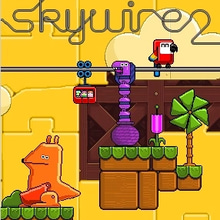
Skywire 2 is built on one of those ideas that sounds harmless until the first obstacle swings into view and suddenly your entire body starts reacting like the little cable car is your legal responsibility. On Kiz10, the game is presented very simply: move your passengers through the cable line, avoid all obstacles, and get them safely to the end. It also supports one or two players, which already tells you a lot about the kind of chaos it wants to create.
That simple setup is exactly why it works. Skywire 2 does not waste time on complexity it does not need. You are in a suspended little vehicle, the track is set, danger is everywhere, and your job is to keep moving without turning the ride into a public disaster. The whole thing feels like a joke about transportation safety written by somebody who really enjoys panic, because the route is never just a calm scenic ride. It is a gauntlet. A weird, floating obstacle course where progress feels suspiciously fragile and every second demands attention.
And that is the hook. Good arcade games often start with one clear action and then squeeze as much tension as possible out of it. Skywire 2 absolutely belongs to that family. The ride itself is easy to understand, but what surrounds it is not forgiving. Obstacles force you to slow down, speed up, wait, commit, and constantly question whether your instincts are actually helping or simply making things more dramatic than necessary. Usually a bit of both.
⚙️ The controls are simple, which is exactly why the pressure feels so personal
One of the smartest things about Skywire 2 is that it does not hide behind complicated inputs. The core interaction is straightforward: guide the cable car and protect the passengers while the path tries to ruin your day. Because the action is so readable, every mistake feels clean and immediate. When you mess up, you know why. When you survive a rough section, you know you earned it. That clarity is part of what makes the game so addictive. Kiz10 lists it as an HTML5 browser game playable on desktop, mobile, and tablet, which fits perfectly with this kind of immediate arcade structure.
There is a very specific pleasure in games where the rules are simple but the execution keeps your nerves busy. At first, Skywire 2 can look almost gentle. Cute, even. A cable ride, a little movement, a destination ahead. Then the obstacles start showing their personality. Suddenly you are not taking a ride. You are negotiating with moving hazards, bad timing, and the awful realization that your passengers are trusting you far more than they should.
That is why the tension lands so well. The game gives you no place to hide. It is only you, the track, and whatever airborne nonsense the level throws in your path. That directness makes every close call feel louder. A tiny adjustment matters. A brief pause matters. Overconfidence matters most of all, because this is exactly the kind of game that punishes the thought “I’ve got this” with immediate comedic violence.
🎢 It feels like a carnival ride designed by a lunatic engineer
The route in Skywire 2 is where the real personality lives. A cable car game is nothing without obstacles, and this one clearly understands that the best hazards are not just barriers, but interruptions to your rhythm. They force hesitation. They bait bad timing. They make movement feel heavier than it should. Kiz10’s description emphasizes that you must be careful with all the obstacles and get everyone safely to their destination, and that destination suddenly feels very far away once the track starts fighting back.
That is what turns the ride into something memorable. You are never just holding forward and waiting for a finish line. You are reading movement patterns, deciding when to stop, and learning how the level breathes. A strong section of Skywire 2 feels almost musical. Pause, move, commit, recover, wait again. When you find the rhythm, the whole thing starts flowing beautifully. When you lose it, the game becomes a small airborne argument between your confidence and basic cause-and-effect.
There is also something wonderfully silly about how much emotion the cable car ends up carrying. It is such a small vehicle, such a simple objective, and yet after a few dangerous sequences it starts feeling like the most fragile thing in the world. You stop looking at it as transport and start looking at it as a tiny metal promise: if you stay calm, maybe everyone survives this ridiculous trip. Maybe.
👥 The two-player angle makes the whole thing even better
Kiz10 specifically notes that Skywire 2 can be played by one or two players, and that detail matters more than it first appears. Games like this are already funny alone, but the moment you add another person, the tension changes shape. Suddenly every decision has an audience. Every mistake becomes a shared event. Every near miss feels louder because someone else is right there to witness how close the whole operation came to turning into cable-car embarrassment.
Two-player arcade games have a special kind of energy. They create that blend of cooperation, blame, laughter, and terrible confidence that only local challenge games manage properly. A difficult obstacle is fun on your own. With another player nearby, it becomes a story. Somebody moved too early. Somebody panicked. Somebody definitely claimed they knew the timing and absolutely did not. That extra layer makes Skywire 2 feel even more alive.
And even in solo play, you can sense that party-game DNA. The game is structured around readable danger and immediate consequences, which is exactly what makes a simple browser game memorable across repeated attempts. It is easy to jump into, but it keeps producing those tiny dramatic moments players remember. The pause before a hazard. The accidental commitment. The weirdly satisfying recovery. That is arcade gold.
🧠 What looks cute is actually a reflex game with manners issues
Skywire 2 has that classic deceptive arcade look. It seems friendly. It seems manageable. It seems like the sort of game you could casually handle while half-distracted. Then it teaches you, very politely at first and then not politely at all, that the real challenge is sustained attention. This is a reflex game disguised as a quirky ride. You must watch patterns, maintain composure, and resist the urge to rush just because the end looks close.
That kind of design is why the game stays sticky. It never asks for giant systems or heavy rules. It just asks whether you can stay in sync with the track longer than your nerves can sabotage you. A lot of modern games bury that kind of tension under extra mechanics. Skywire 2 keeps it right on the surface. That makes every run feel immediate and honest.
And because the core premise is so unusual, the tension never feels generic. This is not another platform jump or another car race. It is a suspended-route survival game where your progress depends on respecting movement and accepting that every obstacle has excellent comedic timing. That identity is part of the charm. It makes the game easy to remember and even easier to recommend.
🌤️ Why Skywire 2 still feels so easy to like
Skywire 2 works because it understands the value of one strong idea executed cleanly. Kiz10 categorizes it under adventure, puzzle, and 2 players, and that mix makes sense: it has the forward momentum of an adventure game, the timing logic of a puzzle, and the shared tension of a great local challenge. It is a browser game with old-school instincts in the best possible way. Quick to load, clear to read, difficult to master, and constantly flirting with disaster.
So expect a lot of close calls. Expect tiny decisions to matter much more than they should. Expect a few beautiful runs where your little cable car glides through danger like a miracle of public transport, followed by a few others where one bad judgment turns the whole ride into a lesson in humility. That is exactly the right texture for a game like this.
On Kiz10, Skywire 2 stands out as a tense, funny, and surprisingly sharp arcade ride because it turns a tiny cable journey into a full reflex challenge. Sometimes that is all a browser game needs: one great vehicle, a path full of nonsense, and enough dangers to make every safe arrival feel heroic.



 4.4 (13 votes)
 Share
Share
 Embed
Embed