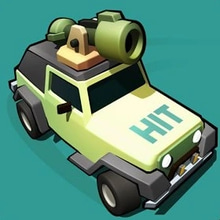
The Hit Car is not the kind of driving game that cares about clean lap times or elegant little racing lines. It has bigger problems. The world is under attack, the road is packed with threats, and your vehicle is less “transportation” and more “metal answer to everything.” Public descriptions of the game frame it as a car driving and invasion-preventing action game where Earth is overrun by aliens, zombies, and robots, and your job is to smash, shoot, and carve through anything in your path while collecting coins for upgrades.
That setup already tells you what kind of mood this game lives in. No politeness. No calm. No gentle road trip under a pretty sky. This is a weaponized highway tantrum. You drive because standing still would be a terrible idea, and you attack because literally everything around you seems to deserve it. That makes The Hit Car feel wonderfully raw right from the start. It is part driving game, part survival brawler, part rolling disaster with upgrades. And honestly, that combination has a very specific kind of arcade charm. It does not ask you to be noble. It asks you to survive loudly.
🚗💣 A Car Built for Very Bad Days
The real fantasy here is not speed alone. It is power. According to public game descriptions, you collect coins to improve your vehicle and unlock stronger weapons, which means your car slowly transforms from a desperate survival machine into something far nastier. That progression matters because games like this are at their best when the vehicle feels like a character in its own right. Not just a car. A weaponized partner in chaos.
And that changes the emotional rhythm of the whole experience. Early on, every obstacle feels personal. Every enemy in front of you looks like trouble. You are reacting, improvising, swerving, trying not to blow up before the level gives you room to breathe. Then the upgrades start coming in. Better firepower. Better survivability. Better ways to turn panic into offense. Suddenly the road feels different. You stop looking at enemies as walls and start looking at them as things that are about to have a very bad afternoon.
That shift is satisfying because it feels earned. You are not simply handed power. You build toward it through destruction, through coin collection, through repeated runs where the road teaches you just how aggressive you are allowed to become.
☣️🛞 Zombies, Robots, and Everything Else That Should Not Be in the Lane
One of the strangest and most entertaining things about The Hit Car is the enemy mix. Public descriptions do not settle for one threat type. They mention zombies, aliens, and robots all causing trouble at once. That gives the game a gleefully overstuffed action vibe, like it looked at one apocalypse and decided that clearly was not enough. Why choose between undead chaos and sci-fi invasion when you can drive through both?
That variety helps the game feel less predictable. It is not just “avoid obstacle, repeat.” It becomes a road war against a world that has completely lost interest in behaving normally. There is always something in your path, something trying to stop your progress, something begging to be flattened or blasted apart. The result is a game that feels busy in the right way. Pressured. Restless. A little ridiculous, yes, but deliberately ridiculous.
And that is good. The Hit Car should feel oversized. It should feel like your vehicle is forcing its way through a collapsing world at full throttle while every second threatens a new mess. That kind of excess is part of the appeal. You are not playing this for restraint. You are playing it because smashing through a zombie while dodging robot nonsense with an armed car sounds objectively more fun than a normal commute.
🔧💥 Upgrades Make the Road Meaner and Better
The upgrade loop is probably the strongest thing in the whole concept. Collect coins, buy improvements, hit harder, survive longer, and push deeper into the chaos. Multiple public descriptions repeat that same structure, which usually means it sits at the core of the experience. And it makes sense. Without upgrades, a game like this would be a quick burst of action. With upgrades, it becomes a progression story.
That progression gives each run purpose. Even a messy failure can still feel useful if you earned enough coins to improve your machine. Maybe your weapons get stronger. Maybe your car lasts longer under pressure. Maybe the next stretch of road feels just a little less cruel because now your build matches the madness better. That is the sweet spot for arcade vehicle games. Short-term chaos, long-term growth.
There is also something deeply entertaining about the emotional journey these systems create. At first, you drive like prey. Later, you drive like a problem. And the road responds accordingly.
🧨⚡ Not Quite a Racer, Not Just a Shooter
What gives The Hit Car its identity is that it does not sit neatly in one genre box. It is not a traditional racing game because beating a rival to the finish line is not really the soul of it. It is not a pure shooter either, because movement and vehicular control are too important. It lives in that messy, energetic space between driving action and combat survival. You are steering, smashing, firing, collecting, upgrading, and improvising all at once.
That hybrid structure usually creates great arcade tension because the player is never only doing one thing. You are looking at the road, at enemies, at pickups, at danger, at your own ability to keep the vehicle alive. One bad choice can cost you momentum. Another bad choice can cost you the whole run. So the game keeps you alert in a very physical way. It is not abstract pressure. It is road pressure. Impact pressure. “Please do not explode in front of the checkpoint” pressure.
And yes, that kind of gameplay tends to be replayable for a reason. Every failed attempt feels close to being fixable. Every good run feels like proof that your upgrades and reflexes are finally syncing up. Then the game throws another wave of nonsense at you and everything becomes messy again. Perfect.
🛣️🔥 Why It Fits Kiz10 So Well
The Hit Car has the exact kind of energy that works on Kiz10: immediate action, easy-to-understand stakes, loud gameplay, and a core loop that rewards repeat runs. It is the sort of browser-friendly concept that gets to the point fast. Armed car. Invading monsters. Coins. Upgrades. Survive. Destroy. Move. Public descriptions consistently describe that same formula, and it is easy to see why it works.
What makes it memorable is not realism. It is momentum mixed with aggression. The car keeps moving, the enemies keep coming, and the upgrade loop keeps whispering that the next run might finally be the one where you stop feeling hunted and start feeling unstoppable. That is the hook. You begin by trying not to die. Then you begin trying to dominate. Then, without really noticing, you are treating the whole road like your personal demolition project.
So The Hit Car is not about graceful driving. It is about surviving a world that has gone completely off the rails and answering it with horsepower, steel, and a steadily improving arsenal. It is chaotic, violent, and just a little ridiculous in the best possible way. Exactly the kind of road rage fantasy that turns one quick session into a much longer one because now you need better upgrades, a better run, and at least one more chance to hit something that really had it coming.





 4 (12 votes)
 Share
Share
 Embed
Embed