🌪️ You are the storm now
Most games ask you to save the city. Tornado: Fury of the Elements politely slides that idea into the nearest dumpster, sets it on fire, and hands you the wind itself. You’re not a hero. You’re not even human. You’re a tornado lord, a moving column of pure nope spiraling through streets, plazas and suburbs that were having a perfectly ordinary day until you arrived. Buildings shake when you pass. Trees bend like they suddenly regret growing here. Cars do that little jittery dance that means they’re about to become airborne decoration. Your “character” is a spinning tower of air with one job: ruin urban planning.
🏙️ A city built to be unbuilt
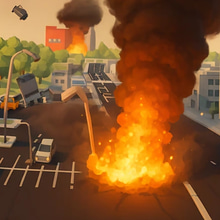
The map lies politely at first. Neatly stacked high-rises, cozy suburbs, streetlights lined up like soldiers, highways pinstriping the horizon. It’s all so organized, so proud of its infrastructure, so ready to pretend natural disasters are something that happen on the news to other people. Then you roll in. Glass shatters under your pressure. Roofs peel like stickers. Small houses vanish first, then billboards and light poles, then heavier structures once your power climbs. The city isn’t just a background, it’s a buffet. Every block offers something different to chew on: industrial yards full of crates, tight alleyways that focus your wind, open plazas you can cross like a bulldozer made of sky.
🕹️ Controls that feel like flying a monster
The game keeps the inputs simple so you can focus on mayhem, not finger knots. On PC, W moves your tornado forward, A drags it left, S pulls it back, D slides right. It’s classic WASD, but instead of controlling legs or wheels you’re steering a spinning column that doesn’t stop just because you let go. On mobile, a virtual joystick handles the same dance: push toward your target, tilt to weave between obstacles, pull away when defenses start to sting. Because the controls are so intuitive, you quickly stop thinking about keys and start thinking like the storm itself. “I want that tower gone,” and your hands handle the rest.
⚡ Power, precision, and the art of not crashing
You may be a force of nature, but you’re not invincible. The city fights back with defenses and hazards that don’t care about your ego. Anti-storm installations, reinforced structures, weirdly sturdy obstacles—they all serve one purpose: to break your rhythm. You can’t just slam straight into everything and expect victory. Angle matters. Approach matters. Hitting a high-value target from the right side at the right speed can rip it apart cleanly; hitting it wrong can stall your movement, scatter your debris cloud and give defenses time to chip away at your energy. The fun lives in that thin line between reckless and surgical.
💥 Whirlwinds as weapons
You’re not just drifting around like a big windy tourist. You actively generate powerful whirlwinds and direct them like fists. As your control improves, you’ll learn to “hook” smaller objects into your vortex—cars, trees, signs—and drag them into bigger structures for extra damage. It’s one thing to knock over a building with raw wind; it’s another to launch three cars and half a billboard through its glass front and watch the whole thing collapse in pieces. Add in the way debris swirls around your core, and you start to feel less like a simple storm and more like a mobile blender full of regrets.
📈 Upgrades that turn chaos into craft
Tornado: Fury of the Elements isn’t just mindless destruction. It’s destruction with progression. The more damage you do, the more points and resources you earn. Those go straight into upgrades: stronger pull force, faster movement, bigger radius, tougher “armor” against defenses, sharper control over the tornado’s path. Early on your twister feels wild and a bit clumsy—fun, but easy to pin down with sturdy structures. After upgrades, you stop bouncing off buildings and start slicing through districts like you’re editing the skyline. That curve from clumsy gale to precision catastrophe is where the game really sinks its hooks in.
🚧 Defenses that treat you like a boss fight
The city is not impressed by your vibe, so it builds things specifically to ruin your day. Sturdy bunkers and reinforced towers resist your base-level power, forcing you to circle, weaken surrounding structures, and come back later when you’ve leveled up. Certain defensive installations act like traps: hit them head-on and your tornado stutters, loses energy, or gets momentarily stunned. The result is a surprising amount of strategy. You start planning routes: approach weak zones first, avoid certain choke points until you’re strong enough, flank heavy defenses with a belly full of debris. The more dangerous the city becomes, the more your path feels like a plan rather than a random rampage.
🎯 High score destruction and stylish runs
Sure, you can roam around and smash whatever looks breakable. But the game quietly nudges you toward efficiency. How much of the city can you level before your energy runs low. How fast can you erase an entire neighborhood without touching a single defensive installation. How many combo chains can you create by snapping through clusters of destructible objects in one smooth pass. You’ll start replaying districts not just to cause damage, but to cause smarter damage: optimized paths, perfect spins, tactical retreats followed by glorious returns. Suddenly you’re not just a tornado—you’re a speedrunner made of weather.
🌪️ Physics, debris, and accidental comedy
The best moments are often the unplanned ones. You clip a billboard, it hangs in your vortex for a second, then rockets into a water tower you weren’t even targeting. You smash through a supermarket roof and watch a rain of boxes, shelves and signs whirl around you like confetti. You misjudge a corner, bounce off a warehouse, and accidentally send a cluster of parked cars flying into a neighboring apartment block. The physics lean into cartoon exaggeration just enough to make every impact feel punchy, without losing the sense that you’re wrestling something heavy and dangerous.
📱💻 Same storm on any screen
On PC, keyboard controls and a wide view give you a tactical vantage point: you can see entire districts, plan routes across multiple blocks, and treat the city like a puzzle made of breakable parts. On mobile, the joystick makes it easy to dive into short bouts of chaos—a quick session on a bus ride where you flatten a neighborhood, grab some upgrades, and hop out. The action scales well either way. Whether you’re playing full-screen or in your hand, the core feeling is the same: you are the thing on the weather radar nobody wants to see.
🧠 Tiny tips from one tornado to another
Don’t charge the toughest structures first; warm up on weaker neighborhoods to grow your power and build a nice debris cloud. Avoid colliding head-on with visible defenses until you’ve tested how much they hurt; circle them, nip at the edges, and only commit when you’re sure. Use sudden direction changes to “shake” stuck debris loose toward new targets. If you feel your movement bogging down, pull away, rebuild speed in a less fortified area, then swing back in like a spinning hammer. And above all, remember you’re not racing a timer—you’re racing the map. Pick your battles.
🌩️ Why being the bad weather feels so good
There’s something oddly cathartic about a game where your job description is “disassemble this city using atmospheric rage.” But Tornado: Fury of the Elements sells more than raw destruction. It gives you the joy of mastery—of going from clumsy windstorm to calculated elemental surgeon, from bouncing off office blocks to carving clean paths through whole districts. You start because it’s funny to knock over buildings. You keep playing because each upgrade, each new route, each carefully avoided defense makes your runs feel sharper and more intentional. It’s chaos with a learning curve, and that’s a dangerous combination… in the best way.





 Share
Share
 Embed
Embed


