🛡️ The coast is beautiful until the raiders arrive
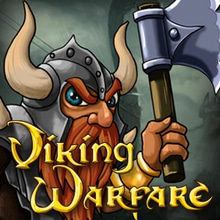
Viking Warfare is the kind of strategy game that does not need a long speech to explain itself. Kiz10’s own page says it plainly: this is a tower defense game with a Viking and Celtic backdrop where, beyond building towers, you also need to manage archer boats to survive the assault. Other public listings of the same game repeat that exact idea, adding that you defend your treasure from incoming raiders, unlock stronger tower levels, and buy upgrades with stars earned by beating stages.
That setup is already strong. It tells you this is not a lazy defense game where you place one turret and hope for the best. No, this one wants more from you. It wants proper battlefield control. Land pressure, water pressure, enemy routes, defense timing, upgrade choices, and that wonderful little feeling that your kingdom is one bad decision away from becoming somebody else’s loot. That is exactly why Viking Warfare works so well. It turns a familiar tower defense structure into something more alive by forcing you to think about multiple layers at once.
⚔️ Towers alone are not enough here
The most interesting thing about Viking Warfare is that the game is not satisfied with ordinary tower placement. Kiz10 and Kongregate both highlight the same mechanic: in addition to building towers, you must build and manage archers boats. That one detail changes the entire rhythm of the game. Suddenly the battlefield is not only a line of fixed defenses. It becomes a mixed defense system where static structures and mobile ranged support need to work together.
That matters because good tower defense games live on variety. If every level is solved by stacking more of the same tower in the same places, the strategy becomes lazy very quickly. Viking Warfare avoids that problem by introducing a second layer of control. Boats give the game movement. They create the feeling that your defense is not only anchored in stone, but still reacting to the shape of the invasion. That makes the action more dynamic and the planning much more satisfying.
And honestly, it also fits the Viking theme perfectly. Of course there are boats. Of course coastal defense matters. Of course the battle should feel like part fortress management, part desperate shoreline warfare. The setting is doing real work here, not just hanging around in the background wearing fur and pretending to matter.
🏹 Every wave is a small argument about priority
The best tower defense games are really about one thing: deciding what matters most, one bad second before it becomes a real problem. Viking Warfare sounds built around exactly that pressure. Do you spend on a new tower now, or save for an upgrade that makes the next wave easier to handle? Do you reinforce the obvious weak lane, or prepare for the path that looks quiet now but could collapse later? Do you rely on your boats for temporary control, or lock down the route properly with stronger fixed defenses? The game’s public descriptions do not spell out every tactical detail, but they consistently emphasize building towers, managing archers boats, and upgrading as you progress, which makes the strategic loop very clear.
That is where the fun sharpens. Because no matter how pretty a defense layout looks, the waves are always there to test whether it actually works. One lane can hold beautifully until the wrong enemy type appears. One section can feel secure until the pressure shifts just enough to expose the flaw you ignored. Tower defense players know this feeling well. A plan can look brilliant right up until the enemy politely demonstrates that it was built on hope and misplaced confidence.
Great. That means the next run matters more.
🌊 Boats make the battlefield feel alive
This is really the feature that gives Viking Warfare its own identity. The boats are not just decoration. Kiz10’s page specifically says you need to build and manage archers boats to win, and other listings repeat that almost word for word. That makes the sea part of the battle, not a painted background. And that is smart.
Why? Because mobile support changes how a player thinks. A tower is commitment. A boat feels like intervention. Towers represent structure and long-term planning. Boats suggest reaction, reinforcement, and emergency control. Put both together and you get a strategy game with more texture than a standard lane defense title. You are not only preparing for battle. You are actively shaping how the defense breathes once battle starts.
There is also something wonderfully cinematic about that. A line of towers holding the coast while archer boats help stop raiders before they crash through your defenses? That has real energy. It gives the game a harsher, more dramatic mood than a generic fantasy defense map. The world feels coastal, contested, and vulnerable in a way that supports every tactical decision you make.
⭐ Progression makes every win mean more
Kiz10 says you can unlock new tower levels as you advance and buy upgrades with stars granted by completing levels. That progression loop is important because it gives the game momentum beyond the individual wave. A good defense game needs that. You do not only want the satisfaction of surviving one stage. You want the feeling that survival opens stronger options for the next one.
That is what turns Viking Warfare from a one-off level challenge into a proper browser strategy game. Win, earn stars, improve your defenses, come back stronger. Simple. Effective. Slightly dangerous for your free time. Because once a defense game starts offering progression with meaningful upgrades, every failure becomes easier to justify. You were close. One more improvement and the next map should go better. One more run and the stronger tower becomes available. One more level and maybe the whole defense line stops collapsing in that embarrassing section near the shore.
That is exactly the sort of loop Kiz10 players respond to. Short sessions, visible growth, and strategic decisions that feel better the more you understand the systems.
🪓 Vikings, Celts, and the pleasure of defending something worth stealing
The theme helps more than people think. Kiz10 and the mirrored listings all describe the game as having a Viking and Celtic background. That gives the whole experience a rougher, older, more grounded fantasy than the usual magical crystal defense nonsense. You are not protecting some glowing orb in a generic forest. You are defending treasure from raiders in a harsh coastal world where boats, archers, and fortifications all make intuitive sense.
That clarity is good for the player and good for SEO. Viking Warfare naturally fits strong search terms like Viking tower defense game, medieval strategy game, coastal defense game, archer tower game, and browser war strategy game. The title is direct, the mechanic is distinct, and the setting makes the whole thing memorable.
🔥 Final thoughts from someone who definitely upgraded the wrong tower once
Viking Warfare works because it adds one smart wrinkle to a proven genre and builds its whole identity around it. The public descriptions are consistent: build towers, manage archer boats, defend your treasure, and use stars to unlock stronger upgrades as the levels get harder. That combination is enough to make the game feel more active and more strategic than a plain tower defense clone.
If you enjoy browser strategy games where planning matters, where the defenses line can break in ugly and educational ways, and where one extra mechanic is enough to make the whole battlefield feel richer, Viking Warfare is a great fit for Kiz10. It is tense, smart, and very easy to replay when your coast gets humbled.






 4.5 (108 votes)
 Share
Share
 Embed
Embed


