⌨️🌀 A tiny question that turns into a sprint
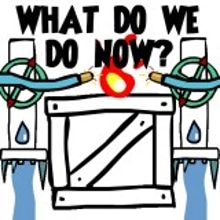
What Do We Do Now? begins like a joke you don’t fully get yet. A simple title, a simple setup, and then the game hits you with the real twist: you’re not here to learn one set of rules, you’re here to survive a constant rotation of them. On Kiz10, it plays like a quick decision minigame collection dressed up as a puzzle challenge, where each moment is basically the same problem in a new disguise: figure out what the game wants, do it immediately, and don’t freeze.
It’s the kind of game that turns your brain into a live performance. There’s no time for elegant thinking. You don’t plan five moves ahead. You react, you adjust, you guess correctly under pressure, and sometimes you guess wrong and feel personally attacked by a letter on the screen. Yes, a letter. Welcome to the era of being outplayed by typography. 😅
⚡🧠 Rules that change before your confidence finishes loading
The heartbeat of What Do We Do Now? is urgency. The game loves that moment right before you understand it. It wants you right there, in the fog, still decoding what’s happening, because that’s where the tension lives. You’ll get a prompt, you’ll interpret it, you’ll press a key, and then the game flips the situation again. It’s not cruel in a “gotcha” way, it’s more like a mischievous test of adaptability.
You start to realize the skill isn’t raw speed alone. It’s recognition. It’s pattern catching. It’s making your hands obey the new rule while your head is still saying, “Wait, the rule changed again?” There’s a weird satisfaction when you nail a sequence and feel your reactions tightening into something sharp. You stop being a confused player and become a human shortcut: stimulus, decision, input, done. 😈⌨️
🧩🔁 Micro-challenges with big “try again” energy
Each minigame is short, but the emotional stakes feel higher than they should because everything happens so fast. You don’t lose ten minutes of progress when you mess up, you lose a streak, a rhythm, a run that was starting to feel clean. And that’s exactly why it’s addictive. You’re not angry because you lost time, you’re annoyed because you were almost in the zone.
And the zone in this game is a real place. You’ll feel it. Your hands become lighter. Your mind gets quieter. Your reaction timing becomes smooth instead of frantic. Then one weird prompt appears, you hesitate for half a heartbeat, and suddenly you’re back to being a normal human again, blinking at the screen like it’s speaking a language you used to know. 😂
🕹️😵 The vibe: minimal visuals, maximal panic
What Do We Do Now? doesn’t need flashy graphics to feel intense. The minimal presentation is part of the trick. With fewer distractions, you focus harder on the rule itself, and the rule becomes the monster. The simplicity makes everything feel sharper: the timing, the decision, the consequence. It’s like the game is saying, “I removed all the excuses. It’s just you and the prompt.” Which is brave of the game, because you will absolutely still blame it anyway. 😭
The minimalist style also helps the chaos land cleanly. You’re not trying to parse a complicated scene. You’re parsing intent. What does the prompt mean right now? What is it asking you to do this second? What is it going to ask next? That tension between clarity and surprise is the whole flavor.
🎯🧠 It’s secretly training your brain, but don’t tell it
There’s something sneaky about games like this: you finish a run and realize you were practicing quick thinking, memory, and adaptation without ever sitting through a boring tutorial. You learn to stop overthinking. You learn to commit. You learn to recover from mistakes instantly because the next prompt doesn’t care that you’re embarrassed.
It also rewards calm under pressure. People think the best strategy is pure speed, but speed without accuracy is just loud failure. The strong runs come from controlled reactions, from reading the prompt first, then acting, instead of slamming keys like you’re trying to intimidate the keyboard. When you manage that balance, the game feels smooth, almost elegant, even while it’s being chaotic. 😎
⏱️🔥 The moment-by-moment drama of being slightly late
The funniest part is how the game makes small delays feel huge. A half-second hesitation becomes a disaster. You’ll see yourself hesitate and you’ll know it’s over before it’s over. That’s a special kind of tension, almost cinematic in a tiny way: your mind notices the mistake in slow motion, but your hands can’t rewind time. It’s dramatic, and it’s silly, and it makes you laugh at yourself because you’re losing to the concept of “decide faster.”
And when you finally get a clean sequence, it feels like you’re doing magic. You’re pressing the right keys at the right times with barely any conscious thought. That’s when What Do We Do Now? hits its peak on Kiz10: you’re not learning anymore, you’re executing. You’re surfing the rule changes instead of getting crushed by them.
🎮🧷 Why it works so well as a quick browser game
This game is built for short, intense sessions. You can play it for a few minutes and still get that satisfying “I improved” feeling because each run is a measurable attempt. You either adapted well or you didn’t. You either panicked or you stayed sharp. The feedback loop is instant. That makes it perfect for the Kiz10 style of play: click in, get challenged, chase a better run, and suddenly you’re five tries deep because your last attempt ended on a mistake you refuse to accept as your final legacy.
If you love puzzle games that aren’t slow, minigames that don’t waste time, and reflex challenges that reward fast thinking, What Do We Do Now? is a compact little storm. It’s simple, tense, weirdly funny, and brutally honest about one thing: you either adapt, or you don’t. So… what do we do now? We press the right key. Immediately. 😅⚡



 3.7 (35 votes)
 Share
Share
 Embed
Embed