🧟♂️🧪 The zombie isn’t your enemy this time
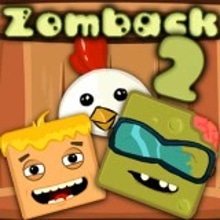
Zomback 2 flips the usual zombie logic on its head and basically says: what if the undead is the victim… and you’re the rescue team with a mouse cursor and a suspicious amount of responsibility? Instead of shooting hordes or swinging axes, you’re solving physics puzzles to help a goofy, boxy little zombie reach the medicine before it’s too late. It’s simple, bright, and oddly tense, because the zombie moves like it has one brain cell left and it’s currently thinking about walking into the worst possible direction.
On Kiz10, it plays like a “remove the right object” puzzle challenge where every click is a decision with consequences. You don’t build a route from scratch. The route is already there, messy and stacked and full of obstacles. Your job is to remove pieces of it so gravity, momentum, and timing do the rest. When it works, the zombie rolls or slides neatly toward the cure like it finally listened. When it doesn’t, it flops into a dead zone and you stare at the screen like, okay… so that was not the block I should have deleted.
🧱🖱️ Click to remove, then watch physics judge you
The core mechanic is clean: click objects to remove them. Platforms fall, boxes drop, slopes open, and your zombie begins to move through the level based on whatever structure you left behind. That simplicity is exactly why the game is addictive. The only thing you control is what stays and what disappears. You’re basically editing the level in real time, trying to create a safe path without overdoing it.
Because overdoing it is the fastest way to fail. Remove too much and the zombie falls into nothing. Remove too little and it gets stuck, inches from the cure, mocking you with its tiny helpless face. Zomback 2 rewards players who can look at a level like a small machine and ask one question: what is the minimum I need to change for the outcome to flip in my favor?
🎯😅 The cure is the goal, but the real goal is elegance
Most levels aren’t hard because they’re complicated. They’re hard because they’re tempting. You’ll see the zombie far from the medicine and think you need to clear a bunch of blocks. Then you try that, and the whole structure collapses in the worst way. After a couple attempts, you start noticing something: the game is quietly asking you to do less. One good click can beat five frantic clicks.
That’s where the “puzzle satisfaction” lives. You begin to chase clean solutions. Not just a win, but a nice win. A win where the zombie moves smoothly. A win where you don’t spam deletions. A win where the whole level collapses in a controlled way instead of an accidental disaster. And the moment you get a perfect chain reaction and the zombie reaches the cure like it was always meant to, you’ll feel weirdly proud… for saving a zombie with geometry.
🧠⚖️ Balance, weight, and tiny moments of patience
A lot of the puzzle feel comes from understanding balance. Some objects are support beams. Some are just filler. Some blocks are only there to trick you into wasting a click. You’ll learn to identify load-bearing pieces fast. If there’s a stack holding a platform in place, removing the wrong block can send the whole stack crashing early. If there’s a slope, removing a barrier at the wrong time can launch the zombie too fast and overshoot the cure.
Timing matters too, even when it’s not obvious. Sometimes you should wait a beat before deleting the next object, letting the zombie settle into position so the next movement goes the right way. That little pause is where players either win cleanly or fail hilariously. The game is teaching patience without ever saying the word.
🧟♀️💊 The zombie’s movement is part comedy, part challenge
Let’s be honest: the zombie is not graceful. It’s not a precision athlete. It moves like a box on a mission, and that’s what gives the game personality. You’ll watch it wobble, slide, bump edges, and sometimes get stuck on a corner you didn’t even notice. Those little “oops” moments are part of the fun because they make success feel earned. You’re not guiding a perfect character. You’re guiding a stubborn physics object with feelings.
That also means your solutions have to be forgiving. A super tight, perfect path might fail if the zombie bumps one pixel wrong. Better solutions are smooth and stable: wide slopes, safe landings, gentle drops, and clean approaches to the medicine. You’re basically designing a path that can survive the zombie being a little dumb. That’s the real design challenge.
🧩🏚️ Each level is a mini contraption you have to “unbuild”
Zomback 2 levels often feel like small contraptions made of crates, platforms, and oddly placed supports. The puzzle is not building it, it’s dismantling it correctly. That’s a fun twist because it turns the game into controlled demolition without explosions. You remove the right piece and the whole structure reconfigures itself. Remove the wrong piece and you break the machine completely.
Some stages want you to create a rolling path. Others want you to drop the zombie onto a ledge, then open a side route. Others want you to remove a blocker so the zombie can slide into the cure instead of falling below it. The variety comes from the layouts, not from new mechanics, and that’s why the game stays easy to understand while still offering levels that make you stop and think.
😈⏱️ The “I can fix this in one click” addiction
This is the kind of Kiz10 puzzle game that makes you replay instantly because failures feel close. You’ll lose and immediately see the mistake. “I removed that too early.” “I should have kept that support.” “I clicked the wrong side.” That clarity is dangerous. It makes every level feel solvable in the next attempt, and the next attempt is always just one click away.
You’ll also start doing that classic puzzle-gamer thing: blaming yourself in a funny way. The zombie falls off a platform and you’re like, buddy, I’m trying. Then you restart because you’re not leaving the zombie uncured. Not today. Not on your watch.
🧊✨ Tips that make the puzzles feel smoother
If you want cleaner wins, start by scanning the level before clicking anything. Look for the cure and imagine the simplest path to it. Then find what blocks that path. Remove only what truly blocks it. If you’re unsure, remove the smallest blocker first, not the biggest support. Big supports usually create big chaos.
Also, think about where the zombie will land after each change. If you drop it onto a slope, make sure the slope actually leads somewhere safe. If you open a hole, make sure the hole leads toward the cure and not into a useless pit. And when a level seems impossible, try doing less. Seriously. Zomback 2 loves minimal solutions.
Zomback 2 on Kiz10 is a smart, lightweight physics puzzle game with a funny twist: you’re saving the zombie instead of destroying it. It’s all about careful deletions, clean chain reactions, and that satisfying moment when the cure is finally reached because you respected gravity instead of fighting it.





 4.6 (7 votes)
 Share
Share
 Embed
Embed