🏝️⏳ Fifty-five days to build something that actually survives
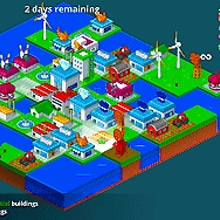
55 Days is the kind of strategy game with a very rude clock. It does not just ask you to build, expand, and improve things at your own comfortable pace. It gives you a limit right in the title and quietly reminds you that time is the real enemy. Public descriptions of the game consistently frame it around one core idea: you have 55 days to keep your citizens happy by building facilities and upgrades while your island evolves day by day.
That is a strong setup because it turns a simple building game into something more tense than it first appears. A lot of city-building or island-management games let you settle in. You place things, optimize later, and slowly drift toward success while pretending your first bad layout decisions never happened. 55 Days does not sound like that kind of game. A countdown changes everything. Suddenly every structure is not just a decoration or a long-term investment. It is a decision with pressure attached. Is this the right upgrade now? Is this helping happiness fast enough? Am I building momentum, or just building things because I like seeing little islands grow?
That pressure is exactly what makes the concept so good. A civilization game becomes much more interesting when the question is not “how large can you grow eventually?” but “how well can you shape this place before time runs out?” It creates urgency without needing war, explosions, or giant disasters raining from the sky. The disaster is quieter than that. The disaster is inefficiency. The disaster is wasting Day 12 on something Day 12 absolutely did not need.
And that is a great kind of strategy tension. A mean kind. But great.
🧱🌴 An island builder with a clock breathing on your neck
What makes 55 Days feel different from a normal management game is the relationship between growth and happiness. According to the public game description, your job is not merely to stack structures randomly and admire the skyline. You are building upgrades and facilities specifically to generate happiness while the island changes across those 55 days. That gives the whole game a clearer emotional center.
Because happiness is a much more interesting target than raw expansion. It means your civilization cannot just look bigger. It has to function better. It has to feel livable. You are not building a monument to bad urban planning. You are trying to create a place people can actually stand living in before the timer ends. That gives each choice a different flavor. A new facility is not only a piece of progress. It is a promise that this island is moving in the right direction.
And island settings always help these games. An island is naturally tidy as a strategy space. Bounded. Visible. Contained. Everything matters because there is only so much room, so many opportunities, so much time. You can almost feel the terrain pushing back against sloppy thinking. Place things badly and the whole island starts carrying your mistakes around like luggage. Place things well and suddenly the space feels smarter, cleaner, more alive. A good island-builder is basically a conversation between your plan and the land. A timed one turns that conversation into an argument.
There is also something charming about watching an island evolve day by day. That detail from the public description matters more than it sounds. It suggests a game rhythm where progress is visible, not abstract. The island changes because of what you do. The civilization takes shape in front of you. That visible evolution makes the countdown more dramatic. You are not only racing time, you are watching the results of your choices accumulate in a way that feels tangible.
📈😵 Small mistakes become huge problems later
This is where games like 55 Days usually get their hooks in. Early mistakes do not always hurt immediately. Sometimes they sit there quietly. A misplaced building. A weak opening sequence. A delayed upgrade. Everything still looks fine for a while, so you keep going, maybe a little too confident. Then later the timer gets tighter, the demands start feeling heavier, and suddenly you realize that Day 8 version of you was a complete idiot.
That delayed pain is one of the best parts of time-limited strategy. It makes learning feel real. You are not losing because the game decided to be unfair. You are losing because your priorities were wrong. Or your layout was inefficient. Or you chased growth when you should have chased stability. The lesson becomes clear because the clock forces consequences to arrive before you can hide from them.
And then the next run gets more interesting.
You start to think differently. Faster. Sharper. You do not treat the early days like warm-up anymore. You treat them like foundations. That is when strategy games become addictive: when the player starts seeing structure where before they only saw options. Maybe this building needs to come earlier. Maybe that upgrade is bait. Maybe happiness spikes better if you secure one chain before branching outward. The game does not need ten thousand systems for that kind of satisfaction. It just needs enough pressure that better decisions feel meaningful.
55 Days sounds built for exactly that loop. Quick understanding, gradual mastery, repeated attempts that each feel a little smarter than the last. It is the sort of management game that can quietly turn you into someone who cares deeply about optimization without ever asking permission.
🏗️⚡ A strategy game that rewards urgency, not comfort
There is a funny thing about relaxed-looking island builders. They often lure people into playing too comfortably. The bright setting, the tiny buildings, the civilization theme, all of it suggests patience. But 55 Days, by design, should punish comfort. The whole concept points toward urgency. Not panic in the sense of frantic clicking, but urgency in the sense of directed thought. Every day should matter. Every build order should whisper some larger intention.
That makes the game feel closer to a strategy puzzle than a sandbox. You are not simply decorating. You are solving. The island is the board, the buildings are your moves, and happiness is the score that decides whether your plan deserves to survive. That is a much sharper fantasy than open-ended construction alone.
And honestly, the 55-day limit is such a good piece of title design because it constantly reminds the player what the game is about. Not forever. Not someday. Fifty-five days. There is something clean and almost brutal about that number. Specific enough to feel real. Long enough to build something meaningful. Short enough that you know waste will hurt.
It also gives the game replay value naturally. A time limit invites self-comparison. Can I do better next run? Can I optimize that first stretch? Can I reach a stronger happiness curve earlier? Timed strategy games often create that lovely internal rivalry where you are not only playing against the game anymore, you are playing against your own previous incompetence. Very motivating. Slightly insulting. Perfect.
🌅🧠 Why the concept still works so well
What makes 55 Days appealing is not just that it is about building. It is that it is about building under pressure for a purpose people instantly understand. Keep the citizens happy. Shape the island well. Do it before the clock wins. Public descriptions support exactly that loop. That clarity is powerful. Good browser strategy games often live or die on whether they can communicate their fantasy in one sentence. This one absolutely can.
I could not verify a dedicated live Kiz10 page for 55 Days in current search results, so this long description is an original interpretation based on public gameplay descriptions rather than a Kiz10 page-specific rewrite. The similar games below were chosen from confirmed live Kiz10 pages in the closest strategy/management lane I could verify.
So what is 55 Days, really? It is a time-limited island strategy game about building a place worth living in before the calendar turns against you. It is civilization management stripped down to pressure, priorities, and visible growth. A small island. A short deadline. A lot of decisions that look harmless until they are not. Which is exactly the kinds of strategy tension that sticks.


















 4.3 (58 votes)
 Share
Share
 Embed
Embed


