💥 Loud missions, bad odds, no patience
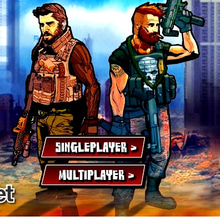
Action Bros feels like the kind of game that throws subtlety out of a helicopter before the first level even starts. This is not a quiet platformer where you tiptoe through danger and politely consider your options. It is a side-scrolling action shooter built around missions, enemies, weapons, stars, and upgrades, with outside descriptions consistently framing it as a fast action shooter platformer packed with multiple objectives and stronger guns over time.
That gives the whole game exactly the right kind of energy. You are not just running because the level scrolls that way. You are running because staying still in a game called Action Bros sounds like a deeply irresponsible lifestyle choice. A proper run-and-gun game should feel like motion under pressure, and this one absolutely has that shape. Enemies everywhere, bullets crossing the screen, objectives demanding attention, and you in the middle of it all trying to look competent while the mission steadily gets louder.
What makes that setup so addictive is how direct it is. There is no confusion about what the fantasy is here. Grab a weapon, push through the level, complete the mission, survive the mess, and spend your rewards to become more dangerous next time. That is a very clean arcade loop. You feel the danger quickly, you understand the improvement path quickly, and before long the game has turned you into the kind of player who starts replaying a mission not because it was impossible, but because you know you can clear it faster and with fewer embarrassing mistakes.
🔫 Every level feels like a moving firefight
The best thing about a side-scrolling action shooter is how little time it gives you to be comfortable. Action Bros is repeatedly described as a mission-based shooter where each stage has a different task, enemies everywhere, and stars earned according to performance. That structure is excellent because it means the game is not just asking whether you can shoot. It is asking whether you can shoot while adapting. One mission wants survival. Another wants aggressive clearing. Another may push you toward a specific goal while bullets and enemy positions keep trying to distract you.
That mission variety matters. It stops the action from turning flat. A lot of shooters can feel repetitive when every stage asks the same question in the same tone. Action Bros seems more interested in keeping the player alert. Different objectives mean different rhythms. Sometimes you play carefully. Sometimes you push hard. Sometimes you take risks because the level basically dares you to. That shifting pace makes the whole thing more memorable than a simple endless spray of bullets.
And because it is a platform shooter rather than a static firing range, the movement matters almost as much as the gunplay. Every jump is tactical. Every ledge is either cover or a trap. Every bad landing is one of those mistakes that looks tiny in the moment and then becomes a full-screen crisis immediately after. That is where the game gets its bite. You are not only aiming. You are controlling space. Surviving a platform route while the whole level keeps objecting with gunfire. Lovely, really.
🧠 Guns help, but rhythm wins
People love to talk about weapons in games like this, and yes, weapons matter. A lot. Better firepower changes the mood instantly. But what really separates a clean run from a messy one is rhythm. Action Bros is described by multiple sources as a game where stars can be spent on upgrades like health and speed, or on new and stronger weapons. That means progression is important, but progression only pays off if your movement and timing can keep up with it.
That is the hidden beauty of run-and-gun design. A stronger gun feels great, sure, but it does not solve everything. You still need to enter rooms properly. You still need to handle incoming fire. You still need to stop making those little reckless pushes that looked heroic in your head and absolutely ridiculous one second later. The game becomes much more satisfying once you stop thinking only about damage and start thinking about flow. Move, fire, clear, reposition, continue. That is the language.
And once you find that rhythm, the whole experience changes. The screen stops looking like random hostility and starts looking readable. You know which enemy needs to go first. You know which jump can wait a fraction longer. You know when to keep pressure on and when to stop acting like the stage owes you mercy. That transition from panic to control is where action platformers become genuinely addictive. You can feel yourself getting better, and games like this make visible improvement feel incredibly rewarding.
⭐ Stars, upgrades, and the dangerous rise of confidence
One of the strongest hooks in Action Bros is the reward loop. Missions award stars based on performance, and those stars go back into your character and weapons. That is such a useful system because it turns every level into more than a simple yes-or-no challenge. Even a rough mission can still contribute to progress. Even a failed-feeling run can make the next one stronger. That keeps the pace positive without removing the difficulty.
Of course, the funny thing about upgrades is that they usually create confidence, and confidence in a shooter is both a blessing and a lovely source of terrible decisions. You improve your health, speed, or weapon loadout, and suddenly the level that used to scare you looks manageable. Then you push too far, eat half the screen’s damage in one stupid moment, and the game reminds you that upgrades are not a personality replacement. Great system. Very educational.
Still, that growth matters a lot. It gives the game a reason to stay in your head between missions. You are not only remembering the firefight. You are thinking about what to improve for the next one. More health for survival? More speed for cleaner movement? More firepower for faster clears? That planning layer gives the whole game more stickiness than a straight arcade shooter. The action stays immediate, but the progression gives it a stronger spine.
🚁 Why run-and-gun games always feel personal
There is something uniquely personal about 2D action shooters. In a giant modern shooter, failure can feel distant or messy. In a side-scrolling run-and-gun, it feels immediate. You know the exact jump you mistimed. You know the exact enemy you left alive too long. You know the exact moment your plan changed from “clean mission” to “chaotic nonsense.” That clarity is a huge part of the appeal.
Action Bros seems built for that kind of honesty. Mission-based structure, stars tied to performance, upgrades that reward persistence, stronger guns that turn earlier pain into later confidence. All of it feeds into the same satisfying loop: act, fail, learn, improve, return louder. That is exactly what players want from a browser action game. Not confusion. Not padded complexity. Clear pressure and visible growth.
And the “bros” part of the title helps too. It gives the game that rough, pulpy action attitude. Explosions, hard pushes, ridiculous confidence, plenty of bullets. It sounds like a game where the answer to most problems is forward momentum and a weapon upgrade, and honestly, that is a very respectable identity for a side-scrolling action title.
🔥 Why this one sticks
In the end, Action Bros works because it combines three things that are very hard to resist when they are done well: mission-based action, constant pressure, and clear progression. External descriptions consistently present it as an action shooter platformer with many missions, performance stars, character upgrades, and stronger weapons. That is a strong formula. It gives players something to do right now and something to build toward afterward.
For anyone who enjoys run-and-gun games, platform shooters, mission-based action, and browser games that reward both reflexes and persistence, this kind of title lands beautifully. It is fast, readable, and just messy enough to stay exciting. You jump in for the firefights, stay for the upgrades, and keep replaying because the next clear always feels likes it could be the clean one.





 4.4 (14 votes)
 Share
Share
 Embed
Embed