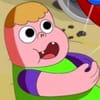
🧤🏐 The sky drops trouble, your arms say “not today”
Arm Shirt Juggle starts like a harmless joke. You’re standing there, looking up, and the first ball falls as if the universe is politely testing your reflexes. Tap it back up, easy. Then another one drops. Then the tempo tightens. Then the “harmless” joke turns into a full-on juggling crisis where your only job is to keep the ball in the air while random objects try to bonk you out of existence. It’s a Cartoon-style arcade skill game on Kiz10 that lives on timing and panic management, the kind that makes you go from relaxed to locked-in in about five seconds. One clean hit feels satisfying. A streak feels addictive. A single miss feels personal, like the ball didn’t fall… it betrayed you.
The fun is that it’s not complicated on paper. You’re basically doing one thing: keep juggling. But the game doesn’t let that one thing stay simple. It adds pressure by changing the rhythm, the height, the spacing, the speed, the kind of objects falling, and the way your brain starts hallucinating danger because you’re trying to watch everything at once. That’s what makes it so replayable. The rules are clear, but the situation is always a little messy, and mess is where skill games become sticky.
🎯🧠 Timing is your real superpower
If you play Arm Shirt Juggle like a frantic clicker, it will chew you up. The ball doesn’t want constant taps. It wants the right tap at the right moment. There’s a sweet spot where the hit sends the ball high enough to buy you time, but not so high that you lose control of its return. When you find that sweet spot, everything feels smoother. Your eyes stop darting. Your hands calm down. You stop reacting late and start anticipating. It becomes less “save the ball” and more “conduct the ball,” like you’re guiding a tiny orbit.
And then the game tries to break your rhythm on purpose. That’s the point. It’s testing whether your timing is stable or just lucky. A good run isn’t the one where you never face chaos. A good run is the one where chaos shows up and you still keep the ball up, using tiny adjustments instead of dramatic flailing.
🪂⚡ The ball isn’t the only thing falling
Here’s where the game gets mean in a funny way: it doesn’t only drop the ball. It drops distractions. It drops heavy objects that can smack you and end the run, and it drops them in exactly the kind of timing that makes your brain hesitate. Because hesitation is death in juggling games. You’ll see something dangerous and your instinct will be “move away,” but moving away can also put you out of position for the next hit. So you start doing this little mental math on the fly: can I take one more juggle and then dodge, or do I dodge now and risk the ball falling? That tension is the real gameplay. It turns a simple keep-up mechanic into a decision loop where you’re balancing survival against streak.
You’ll have moments where you feel like a genius because you threaded it perfectly. Hit the ball, slide away from a falling object, return just in time, hit again, keep the rhythm alive. Then you’ll have moments where you try the same move and get clipped, because the timing was half a beat different. That’s what keeps it alive. It’s predictable enough to learn, chaotic enough to stay exciting.
😵💫🕹️ Your brain will do the classic “too much, too fast” thing
The most common way to lose isn’t a hard section. It’s overreaction. You hit the ball, it goes slightly off-center, and instead of calmly repositioning, you panic-correct. Panic-correction creates bigger mistakes. Bigger mistakes turn into desperate hits. Desperate hits launch the ball into a weird angle, and now you’re not juggling anymore, you’re chasing consequences you created. The game is quietly teaching you a skill-game truth: small corrections beat big ones.
That’s also why it feels so satisfying when you finally get a clean rhythm. You stop chasing. You start controlling. The ball stays near your ideal zone, your timing stays consistent, and you suddenly feel like you could juggle forever. That feeling is a trap, obviously, because the moment you get comfortable, the game drops a nasty object right where you’re standing. Still, that false confidence is part of the fun. It’s the peak that makes you restart when you fall.
🎬😄 Cartoon chaos, but the challenge is real
Arm Shirt Juggle has that bright, silly energy where the character and vibe feel playful, but the mechanics are genuinely skill-based. That contrast is exactly why it works. You’re laughing at the absurdity while your hands are doing serious timing work. It’s like the game is smiling while it tests you. When you get hit, it doesn’t feel cruel. It feels like slapstick. When you drop the ball, it doesn’t feel unfair. It feels like a clean mistake you can fix next run.
And that “next run” happens instantly on Kiz10, which is dangerous. Because the failure doesn’t end the fun. It invites a rematch. You’ll tell yourself you’re just doing one more attempt, then you’ll get a better streak, then you’ll want to beat that streak, and suddenly your brain is treating a juggling ball like a rival you must defeat.
🧩🏐 The hidden strategy is positioning, not speed
There’s a subtle layer that good players pick up: where you stand matters almost as much as when you hit. If you keep the ball in a consistent lane above you, you control the pace. If you let it drift toward edges, you lose options, and dodging obstacles becomes harder because you’re already stretched. So you start playing with a goal that isn’t visible on the UI: keep the ball “centered.” That mental target makes everything easier. Your hits become cleaner. Your dodges become smaller. Your recovery becomes faster.
The game rewards that discipline. It’s not flashy, but it produces long streaks, and long streaks are the real trophy here. If you can keep the ball in a stable zone, the whole run feels like a rhythm game. If you can’t, it feels like a crisis simulator. The difference is one habit.
🔥🏆 The streak chase is the real villain
Once you have a decent run, your mind changes. You stop playing to survive and start playing to protect your streak. And protecting a streak makes you tense. Tension makes you make conservative hits. Conservative hits can lower the ball too much. Low ball means less reaction time. Less reaction time means panic. Panic means miss. That’s the spiral. It’s hilarious and painful because you can feel it happening. You’ll literally think “don’t mess up” and that thought alone will make you mess up.
The best way out is to treat every hit like its own moment, not part of a fragile masterpiece. Keep the rhythm, breathe, accept that the game will try to distract you, and focus on clean contact. When you do that, the streak grows naturally, and it feels less like a fragile tower and more like momentum.
🧊🧠 Small tips that make you last longer without trying too hard
Aim for consistent height, not maximum height. Maximum height feels safe but it can mess with timing and make you wait too long, which is where distractions land. Use smaller repositioning instead of big moves. Big moves look dramatic but they cost control. When dangerous objects fall, don’t abandon the ball’s lane completely; dodge just enough, then re-center. And if you feel yourself speeding up, slow down your inputs for one beat. One calm beat can reset the entire run.
Arm Shirt Juggle is one of those classic Kiz10 arcade skill games that stays fun because it’s honest. It doesn’t need complicated systems. It needs one ball, one rhythm, and one player who keeps insisting they can go longer this time. And you can. Until you can’t. Then you restart, because the ball is still up there, and it’s still acting like it owns the sky. 🧤🏐😈









 2.5 (75 votes)
 Share
Share
 Embed
Embed