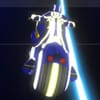
Blur Racing feels like somebody took a normal racing game, stripped out the polite parts, dipped the whole thing in neon, and then whispered, “Now survive.” It is fast in that very specific arcade way where the road does not really feel like a road anymore. It becomes a glowing line, a pulse, a narrow promise that says if you keep your nerve for just a few more seconds, maybe you will make it. Maybe. On Kiz10, the game throws you onto a futuristic bike, pushes you toward 200 km/h, and asks you to do three things at once: collect coins, hit time accelerators, and avoid red hazards that chew through your speed and your remaining time. That mix turns a simple driving game into something twitchy, urgent, and weirdly hypnotic.
🏍️🌌 Neon Panic With a Stopwatch
The first thing Blur Racing gets right is pressure. Not the fake kind. Real arcade pressure. The kind where the clock is not sitting quietly in the corner like a decorative suggestion. No, the timer here feels personal. Every second matters, and the track keeps daring you to make tiny mistakes that suddenly become giant problems. A missed accelerator pad? Pain. A sloppy move into a red trap? Also pain. Going wide because you got greedy chasing coins? Congratulations, now the finish line feels twice as far away.
That is what makes the game more interesting than a basic futuristic racer. You are not only trying to stay fast. You are trying to stay alive inside the run. Time is your real opponent, and the track is full of little tricks designed to bleed it away. That changes how you play. You stop thinking like a calm driver and start thinking like somebody sprinting through a collapsing hallway with headlights. Every safe line becomes precious. Every good decision feels smarter than it probably was. And every lucky recovery feels heroic, even when it was mostly panic and stubbornness 😅
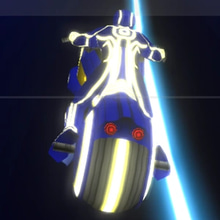
There is also a very satisfying visual fantasy at work here. The Tron-style atmosphere is not just decoration. It shapes the mood. The glowing paths, the sharp color contrast, the feeling of racing through a digital tunnel of speed and danger… it all helps Blur Racing feel more intense than its controls might suggest. It is not realism. It is electricity pretending to be a highway.
⚡🪙 Coins, Traps, and That One Bad Choice
At a glance, the objective sounds simple enough. Move fast, collect coins, reach the goal before time runs out. But of course it gets messy, because games like this always get messy. The coins tempt you into riskier lines. The red traps punish impatience. The time accelerators look like gifts from the gods, right until you realize you still have to reach them cleanly without clipping something stupid on the way.
That constant push and pull is the heart of the game. Blur Racing keeps asking, how brave are you really? Are you going to cut across for that coin trail and risk drifting into danger? Are you going to stay conservative and lose precious seconds by playing too safe? Are you going to hit that accelerator cleanly, or are you about to embarrass yourself by overcorrecting at the exact wrong moment? These are the small dramatic decisions that keep each run alive.
And honestly, that is where the fun starts to become strangely human. Because you begin every attempt with a plan. You tell yourself you will stay calm, follow the clean line, ignore greedy little detours. Then ten seconds later your brain sees a string of coins, your hands betray you, and suddenly you are improvising like a man trying to steer through a laser disco. Blur Racing has that nice arcade talent for exposing the gap between what players intend to do and what they actually do under pressure. That gap is comedy. It is also where retries are born.
🛣️💥 Speed Is the Easy Part, Control Is the Real Game
A lot of futuristic racing games love the fantasy of pure speed. Blur Racing understands that speed without control is just a louder way to fail. Yes, your bike moves fast. Yes, that feels great. But the real skill is in keeping that speed useful. The track is not there to admire your confidence. It is there to punish lazy movement.
The handling creates a nice balance. It is accessible enough that you can jump in and understand the basics quickly, but the challenge comes from maintaining rhythm. Smooth movement matters. Oversteering hurts. Hesitation hurts too. You want a clean, deliberate style, the kind of driving that feels almost musical once you lock into it. Then, naturally, a red trap appears where you did not want it, and the whole rhythm explodes for a second. That little break in flow is brutal, because this game lives on momentum.
What makes it satisfying is that improvement feels visible. You can tell when you are getting better. At first, everything feels too fast, too bright, too twitchy. Then your eyes adjust. Your reactions sharpen. You start spotting trap patterns earlier. You begin treating coins as choices instead of irresistible candy. And then, suddenly, you are not just surviving the track. You are reading it. That shift is where arcade games earn their replay value.
🌀🚨 The Tron Energy Never Really Lets You Relax
Blur Racing benefits a lot from its atmosphere. Some games would collapse under such a minimal structure, but this one leans into style hard enough to make the experience memorable. There is something about the futuristic visual language that makes every run feel just a bit more dramatic. Even a normal mistake looks expensive in neon. Even a simple straightaway feels like a launch corridor into some digital abyss.
That helps the game create tension without needing a huge pile of systems. It does not need deep customization or giant menus or ten different modes screaming for your attention. The fantasy is clear. You are on a blazing bike in a Tron-style world, and the route ahead is trying to erase your progress one bad move at a time. Clean enough. Sharp enough. Effective enough.
And because the sessions are immediate, the game has that dangerous “one more try” structure. You fail, and the reason is obvious. Not abstract. Not mysterious. You know exactly what happened. You chased the wrong line. You clipped the trap. You missed the accelerator. You got impatient. That clarity matters. It makes the restart button feel less like surrender and more like unfinished business.
🎮🔥 Why Blur Racing Works on Kiz10
This is exactly the kind of browser racing game that makes sense on Kiz10 because it wastes no time. You load it, understand the danger fast, and jump straight into the good part. There is no giant wall of setup between you and the gameplay. The concept is immediate, but not shallow. It gives you enough tension, enough visual style, and enough room for skill growth to keep short sessions from feeling disposable.
It also hits a nice intersection of tags. It is a driving game, a racing game, a 3D game, and even a bit of a reflex survival challenge depending on how you look at it. That hybrid energy helps it stand out. It is not trying to be a realistic bike simulator. It is trying to make your pulse rise while neon flashes under your wheels and the clock threatens to ruin your plans. That is a much more entertaining ambition, frankly.
So yes, Blur Racing is simple. But simple is not the same as forgettable. It is the kind of game that knows exactly what it wants to deliver: velocity, tension, glowing danger, and that tiny arcade miracle where one clean run makes you feel much cooler than you really are. On Kiz10, it turns futuristic bike racing into a nervous little sprint through a digital storm, and the result is hard to resist. You chase the coins, you dodge the red traps, you steal time wherever you can, and for a few seconds the whole track becomes a bright, ridiculous blur with your name on it.



 4.4 (58 votes)
 Share
Share
 Embed
Embed