🏝️🚗 Island roads, loud engines, and a “training” label that lies a little
Extreme Racing 3D Training drops you into the driver’s seat with that classic promise: it’s practice, it’s training, it’s going to be fine. Then you touch the gas and the island immediately starts behaving like a stunt park built by someone who dislikes brakes. This isn’t the type of 3D racing game where you calmly follow lanes and admire scenery. On Kiz10, it feels more like a fast driving playground where the road curves hard, ramps appear out of nowhere, cliffs sit right beside you like they’re waiting, and every coin you pick up whispers the same temptation: go faster, you can handle it, right? 😅
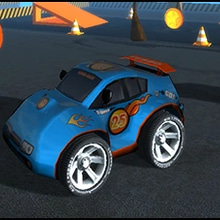
The core fantasy is simple and addictive. You’re driving a sporty car across winding island highways, launching off ramps, threading narrow stretches, collecting coins, and improving the car so the next run feels smoother, quicker, sharper. But it’s not only about speed. It’s about surviving your own confidence. Because the island is full of moments where you’re doing great, you’re cruising, you’re landing cleanly… and then one tiny oversteer sends you flirting with the edge. Extreme Racing 3D Training is basically a game of momentum management disguised as a “training session.”
🛞💨 The car doesn’t glide, it commits
The handling is where the personality lives. You’re not controlling a weightless toy. The car has presence. When you turn, you feel the shift. When you hit a ramp, you feel the consequences. When you land, you learn very quickly that the landing matters more than the jump, because a bad landing doesn’t just look messy, it ruins the next corner and turns your run into damage control. That’s the rhythm of the game: accelerate, set your line, jump, stabilize, collect, repeat.
At first, you’ll probably drive like most people do in stunt racers: full throttle and hope. And the island will punish that instantly, not with a dramatic “game over” lecture, but with the most humiliating outcome possible: you slide just a little too wide, the tires lose grip, and suddenly you’re watching the horizon tilt like your car decided it wants to become a boat. The funny part is that the game teaches you without words. After a couple of these moments, you start driving differently. You brake earlier. You straighten before ramps. You stop steering mid-air like it will help (it won’t). You begin to respect the edges.
🪙✨ Coins are not “collectibles,” they’re speed traps for your brain
Coins are the shiny pressure system. They’re there to reward you, sure, but they also exist to pull you off the safest line. You’ll see a coin string hugging the outside of a curve and your mind will do that fast greedy calculation: I can grab those and still make it. Sometimes you can. Sometimes you can’t. Extreme Racing 3D Training gets its best tension from that choice. Safe racing line versus profitable racing line. Clean control versus risky profit.
And the best part is how the coins connect to progression. Collecting isn’t just for points, it feeds upgrades, and upgrades make the car feel better, which makes you willing to attempt riskier lines, which makes the island more dangerous again. It’s a loop that keeps the game alive. You’re improving the machine, but you’re also raising your own expectations. That’s how “training” turns into obsession.
🧨🛣️ Ramps, airtime, and that silent moment before landing
Ramps are the loudest feature, and also the most dramatic. You line up, you hit the takeoff, and for a split second everything is quiet. No grip, no braking, no correction, just the car flying while your brain does a tiny prayer. The landing is the real test. If you land straight, it feels amazing, like you nailed a stunt in a movie and nobody saw the panic behind your eyes. If you land crooked, the car wobbles, the camera angle starts feeling accusatory, and now you’re trying to recover before the next corner arrives. Recovery is where good players separate themselves. Not “never mess up,” but “mess up and still save it.”
That recovery skill becomes the hidden training. You start learning how to stabilize after a jump, how to ease into steering instead of snapping, how to keep speed without turning the car into a spinning coin magnet that collects nothing and crashes into everything. It’s not a simulator, but it does teach the same truth real driving games teach: smooth is fast, and fast without smooth is just noise.
🌅🧭 The island is a teacher with bad manners
The island layout makes everything feel like a lesson. Long straights invite speed, then punish you with a sharp bend. Wide sections encourage relaxed driving, then suddenly narrow into a bridge-like stretch where a tiny mistake becomes a fall. Some corners are friendly if you approach them from the right line, and absolutely evil if you come in late and try to “fix it” mid-turn. You’ll start to recognize the track’s personality. Not like memorizing a full map, more like learning moods. This area is safe to push. This stretch is where I always oversteer. This ramp needs a straight approach. This cliff edge is basically a hungry mouth.
That’s why it works so well on Kiz10. It gives you that quick arcade satisfaction, but the track has enough character that you naturally want to run it again and do it cleaner. Not necessarily faster, cleaner. Cleaner becomes faster later, and that’s the trick that keeps you playing.
🔧⚡ Upgrades that change the feel, not just the number
Progression is what turns early chaos into later confidence. As you earn coins and upgrade, you feel the car become more cooperative. Acceleration gets punchier. Handling feels less like you’re wrestling. Stability improves so you can land and recover with less drama. But the game doesn’t completely remove risk. Even with upgrades, the island still has cliffs, ramps, and corners that punish careless driving. What upgrades really buy you is margin. More forgiveness. More control when you slightly mess up. More ability to attempt a line that would have destroyed you earlier.
And that’s satisfying because it feels like training in the real sense. You didn’t just get lucky. You built a better run through skill and improvement. The car improves, sure, but your approach improves too. You begin to set up corners earlier. You start thinking one section ahead. You stop chasing every coin like it’s an emergency. You become the driver the island was demanding from the start.
😅🔥 The chaos moments that turn into stories
You’ll remember the run where you nailed three ramps in a row and felt unstoppable. You’ll remember the run where you got greedy for one coin line and paid for it with a perfect slow-motion slide off the edge. You’ll remember the first time you landed badly and still saved the car with a calm correction, like you surprised yourself. Those moments are the real content of Extreme Racing 3D Training. It’s not about a plot. It’s about micro-drama. Every corner is a decision. Every ramp is a gamble. Every landing is a verdict.
If you like 3D driving games with stunts, ramps, coin collection, upgrades, and that satisfying loop of “I can do this cleaner next run,” this is exactly the kind of Kiz10 racer that keeps your hands busy and your prides involved. Just remember: the island doesn’t care that you called it training. It still wants you to earn your speed. 🏁😄





 Share
Share
 Embed
Embed