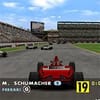
🏁🟦 Old-school Formula speed, zero forgiveness
F-1 World Grand Prix (N64) has that special late-90s racing sim attitude where the car doesn’t care if you’re confident. It cares if you’re precise. The first thing you notice isn’t fireworks or flashy boosts, it’s weight. The car feels like a real object, something with momentum that keeps moving even after your brain has already decided it should stop. On Kiz10.com, this isn’t a “tap gas, win race” arcade rush. It’s the kind of Formula racing where you learn to respect the braking zone like it’s a law of nature, and you start hearing that tiny inner voice after every mistake: “Yeah… that corner was never going to work at that speed.”
What makes it addictive is how honest it is. You go fast, you pay. You go smooth, you’re rewarded. You try to bully the track, the track bullies you back. There’s a satisfying seriousness baked into it, a feeling that the game is quietly daring you to drive like an adult while it tempts you to drive like a maniac. And if you’ve ever wanted that “real racing” vibe in a browser session, this one hits it: manage your pace, keep the car stable, and survive the full run without turning your tires into a sad confession.
🚦🧠 The real opponent is your own impatience
The quickest way to lose in F-1 World Grand Prix (N64) is to treat every lap like a sprint. You’ll dive into a turn too hot, tap the brakes too late, drift wide, and suddenly you’re not racing anymore, you’re recovering. Recovery is expensive. It kills your line, it ruins your exit speed, and exit speed is everything. The game teaches a simple truth in a mean way: the corner isn’t about how late you can brake, it’s about how early you can get back on the power without sliding into chaos.
After a few races, you start changing how you think. You stop hunting the perfect “hero move” and start hunting consistency. You begin to plan corners in pairs, because what you do now sets up what you can do next. You learn that one clean lap often beats one brave lap and five messy ones. This is where the sim part shows up: it rewards drivers who build rhythm, not drivers who spam aggression.
🔧🛠️ Setup choices that actually matter
A lot of older racing sims hide their depth behind menus that look simple. F-1 World Grand Prix (N64) is one of those games where the setup feels like a quiet advantage. Tires, fuel, aero balance, even the way the car behaves in different conditions, it all nudges your experience. You don’t need to obsess like a real engineer, but small changes can turn a car from nervous to stable, or from stable to painfully slow.
The fun part is experimenting without turning it into homework. If the rear keeps stepping out on corner exit, you start thinking about grip and stability. If the car feels heavy and sluggish, you start thinking about responsiveness and speed. If you’re burning through tires or losing control in longer runs, you start realizing the game expects you to drive like the race is longer than your attention span. That’s a compliment and an insult at the same time.
🏎️🌧️ The sim vibe: weather, grip, and “why is the track suddenly evil”
One of the reasons this game got remembered is that it tries to feel like Formula racing, not a cartoon version of it. Weather and grip matter, and the car doesn’t magically stick to the road just because you want it to. When conditions change, the track feels different. Braking distances shift. Corner speed feels less certain. Your “safe” line might suddenly be the line that sends you into a slide. It’s subtle sometimes, but it’s enough to make you stay alert.
That alertness becomes the game. You’re not only driving, you’re interpreting the car’s behavior. You’re noticing small signs: the way it squirms under braking, the way it pushes wide when you ask for too much steering, the way it spins if you treat the throttle like an on/off switch. You start respecting the idea of smooth inputs. Not because it sounds cool, but because it keeps you alive.
🧩⏱️ Modes that keep you busy in different ways
F-1 World Grand Prix (N64) isn’t just “race and finish.” It’s built around multiple ways to test your driving, which is important because a sim like this can feel intense if it only has one rhythm. A full season-style run pushes endurance and consistency. A single exhibition race feels like a pure duel against the track and the pack. Time Trial strips away traffic pressure and exposes you: if you’re slow, it’s you, not the other cars. Challenge-style scenarios (the kind where the game throws a situation at you) force you to adapt instead of repeating your comfort lap.
The best part is how each mode changes what you value. In longer runs, you want stability and fewer mistakes. In time-focused modes, you start chasing cleaner apexes, smoother exits, and tiny gains. In competitive races, you learn that passing is not just “go faster,” it’s “choose a line that doesn’t ruin your next two corners.” You begin to treat overtakes like a calculated risk instead of a desperate lunge.
🎯🧊 Corner craft: where the time actually lives
If you want to get good, you stop thinking about top speed and start thinking about transitions. Brake, turn, settle, accelerate. That’s the loop. The game rewards drivers who brake in a straight line, turn with control, and get back on the throttle in a way that doesn’t snap the rear loose. Sounds obvious, until you’re under pressure, chasing a car, and the corner arrives faster than your courage can handle.
You’ll also learn that “smooth” isn’t slow. Smooth is fast. Smooth lets you carry speed through the corner without drama. Smooth keeps the car stable so you can accelerate earlier. And earlier acceleration is free speed, the kind that adds up across a lap until you suddenly notice you’re catching cars you used to fear.
There’s a weird satisfaction in that improvement. The first time you drive a track, it feels like surviving. The tenth time, it feels like you’re shaping the lap. The track stops being a wall and starts being a route. You still make mistakes, sure, but the mistakes get smaller, and that’s the sign you’re learning.
😅🔥 The emotional loop: calm, confidence, punishment, repeat
This game has a pattern it loves. You drive carefully, you build confidence, you start pushing harder, and then the game punishes you for pushing in the wrong place. Not always with a crash, sometimes with a wide exit, a bad line, a lost second that feels like a theft. Then you calm down again, you tighten up, and you recover. It’s a very human loop. You’ll catch yourself doing the classic racing sim behavior: arguing with yourself mid-lap. “Brake earlier.” “No, not that early.” “Okay, now power.” “Too much power.” It’s ridiculous and also kind of perfect.
That’s why F-1 World Grand Prix (N64) works so well on Kiz10. You can jump in for a quick run, but the game invites you to take it seriously if you want. It rewards you for learning. It doesn’t hand you wins for free. And when you finally nail a lap that feels cleans from start to finish, it doesn’t feel like you got lucky. It feels like you drove it.





 Share
Share
 Embed
Embed