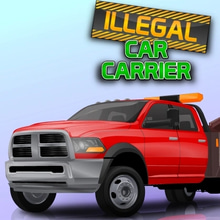
Illegal Car Carrier is the kind of driving game that immediately makes one thing clear: this is not a casual Sunday cruise with a nice playlist and a polite little delivery route. This is heavy transport with attitude. You are not driving a tiny sports car that can slip through mistakes and pretend nothing happened. You are hauling cars on a massive carrier trailer through a city full of bad angles, tight spaces, and the constant feeling that one careless move could turn the whole mission into a metallic public embarrassment. Kiz10 describes it as a game where many parked cars in the city need to be picked up and placed, and you are the one driving the tow truck to do it. It also highlights multiple missions and control over both cars and trucks, which tells you right away that this is not just about reaching a finish line. It is about handling machinery, positioning weight, and surviving the awkward beauty of vehicle transport.
🚛🏙️ A truck this big does not ask for permission
The first thing Illegal Car Carrier gets right is scale. A game like this works because the vehicle feels huge. Not in a cartoon monster-truck way, but in that specific transport-sim way where every road suddenly looks narrower, every turn looks meaner, and every parked object in the city starts feeling like it has personal issues with your trailer. The title already gives the tone away. “Illegal” adds a little bit of mischief, a little suggestion that maybe this is not the most elegant transport operation in the world. Maybe the route is messy. Maybe the situation is suspicious. Maybe your job is less “professional logistics expert” and more “person who somehow accepted a very questionable hauling contract.” Perfect. That gives the whole thing character.
And once you start imagining the actual gameplay, the fun becomes obvious. Transporting cars is already more interesting than normal driving because the vehicle is not just big, it is complicated. You are moving extra weight, dealing with longer turning radius, and trying to keep everything aligned while the streets keep offering exactly the wrong amount of space. A clean run feels satisfying because it should. You are not only steering. You are managing a moving stack of consequences.
🛞🚧 Loading, hauling, and the art of not making a mess
Kiz10’s page points to picking and placing parked cars, plus controlling both cars and trucks. That is a great setup because it gives the game more variety than a simple “drive from A to B” delivery sim. If you are moving cars onto a carrier, then the tension begins before the road even does. You have to think about approach, angle, patience, and that wonderful moment where you are trying to line up a vehicle onto a trailer and suddenly realize the easiest-looking move is somehow the one most likely to ruin your pride.
That is where a game like Illegal Car Carrier gets unexpectedly addictive. The route is one challenge, but the setup is another. Loading a transported vehicle should feel like a little mechanical ritual. You inch forward. You correct. You try again. You tell yourself not to rush. Then, naturally, you rush a bit anyway because confidence is a powerful and deeply unreliable substance.
Once the cars are loaded, the whole mood changes. Now every movement matters more. You are not just driving a truck. You are protecting a cargo stack that makes the vehicle heavier, longer, and a lot less forgiving. The city becomes hostile in a very specific way. Curbs feel closer. Obstacles feel ruder. Even a small overcorrection starts feeling like the beginning of a very expensive story.
💰⏱️ Missions that turn simple roads into stress
Kiz10 explicitly mentions multiple missions, and that matters a lot. A transport game needs structure. It needs different objectives, different placements, different reasons for the player to keep going. With mission-based design, each job becomes its own little drama. Maybe one task is about cleaner parking. Maybe another is about navigating denser streets. Maybe another asks you to load and unload under tighter pressure. The exact format can vary, but the important thing is that the gameplay keeps changing its mood.
That is the secret of truck-based games that stay fun. The vehicle itself already creates tension, so the missions only need to adjust the pressure. A short route can still be difficult if the loading angle is nasty. A long route can feel terrifying if the trailer is slow and the road is full of awkward urban turns. A parking zone that looks generous can become an insult the second you approach it from the wrong side. Suddenly the whole mission is not about transport anymore. It is about recovery. About how quickly you can fix a bad line without turning the entire operation into a comedy.
And honestly, there is something deeply satisfying about games that let giant machinery create small emotional disasters. You do not need explosions. You only need one turn taken too early.
🏗️🔥 Why heavy transport feels more intense than racing
Racing games usually ask one loud question: how fast can you go? Transport games ask a meaner one: how fast can you go without proving that you absolutely should have slowed down? Illegal Car Carrier belongs to that second category, and that is exactly why it has personality. The game is not about elegance for its own sake. It is about handling responsibility under pressure. A strange responsibility, yes, because the title suggests a bit of outlaw flavor, but responsibility all the same.
That makes every successful move feel more earned. A good parking job with a normal car is fine. A good parking job with a long carrier trailer loaded with vehicles feels like solving a giant moving puzzle while the city watches. You start noticing details you would ignore in smaller driving games. The space you need before turning. The way the trailer follows. The angle of approach that saves everything. The angle of approach that ruins your afternoon.
These details create real replay value because improvement is easy to feel. At first, the truck seems awkward and oversized. Then the routes begin to make sense. You start preparing earlier. You stop making dramatic steering corrections. You begin respecting the width of the trailer instead of bargaining with it. And just like that, the impossible-looking job becomes manageable. Not easy, but manageable. That difference matters.
🚦😈 The “illegal” flavor makes it better
There is also something fun about the word “illegal” in the title because it gives the whole experience a slightly rougher mood. This does not sound like a clean official dealership delivery with paperwork and calm music. It sounds like urban transport with bad timing and questionable urgency. That tiny bit of attitude helps the game stand out. A plain carrier simulator can be enjoyable, sure, but adding that little outlaw edge makes the missions feel a bit dirtier, a bit more cinematic, a bit more like you are pushing heavy machinery through a city that would prefer you did not exist.
That tone fits perfectly with Kiz10’s driving catalog, especially since the page tags the game under car games, truck games, car parking games, and HTML5 browser play. It sits nicely between parking challenge, truck control, and transport task management. Not full realism, not pure arcade nonsense either. It is in that satisfying middle lane where the challenge feels mechanical and immediate.
🏁🔩 A transport game with real browser energy
Illegal Car Carrier works because it understands the pleasure of oversized responsibility. You load cars. You move them. You complete missions. You control both the carried vehicles and the hauling truck. That is already a strong loop, and Kiz10’s own description confirms exactly those core ideas. What gives it staying power is the simple fact that big vehicles create memorable mistakes. And memorable mistakes create great retry loops.
On Kiz10, this feels like the kind of game you open because “car carrier trailer” sounds mildly interesting, then keep playing because now you need to prove that yes, you actually can back this ridiculous machine into position without scraping half the city. It is tense, awkward in the right ways, and weirdly satisfying whenever a difficult transport job comes together cleanly. You start by trying to finish one mission. Then you start trying to finish it properly. Then, before long, you are treating every ramp, every parked car, and every narrow turn like a personal challenge. That is when the game really hits. Not with speed. With weight, patience, and the lovely panic of hauling more steel than the road seems willing to forgive.





 Share
Share
 Embed
Embed