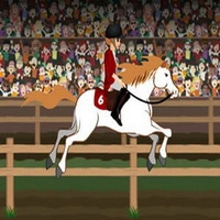
Jenny’s Jockey Adventures starts with a simple idea: get on the horse, stay on the horse, and don’t let the track embarrass you. And then, five seconds later, reality shows up with a grin. The ground tilts, fences appear like they were placed by a mischievous architect, and the horse decides it has opinions about your timing. That’s the vibe on Kiz10: a fast, playful riding adventure that feels like a race, a platform challenge, and a tiny comedy of errors all rolled into one galloping mess 🐎💨
You’re playing as Jenny, a jockey with that “I totally meant to do that” energy, even when you didn’t. The game pushes you into motion quickly—no long speeches, no dramatic training montage, just the track ahead and the quiet pressure of momentum. And momentum is everything here. It’s not just speed. It’s the way your decisions pile up. A late jump becomes a sloppy landing, which becomes a weird angle into the next obstacle, which becomes… well, you already know how that ends 😅
The heart of the gameplay is control under stress. You’ll be steering, timing jumps, managing tiny bursts of acceleration, and trying not to overcorrect like a panicked shopping cart. One second you’re feeling smooth, the next you’re threading between hazards with your brain yelling “WHY IS THIS FENCE HERE” while your hands try to stay calm. That tug-of-war between calm control and chaotic reaction is what makes it addictive. It’s not unfair. It’s just… awake. The track is awake. It’s watching you.
Sometimes the best moments come from the smallest wins. You clear a jump by a hair. You land clean. You hit the perfect line through a tight section and suddenly you’re flying, not just moving. The horse feels lighter, the rhythm clicks, and for a brief, beautiful stretch, you’re not surviving the course—you’re styling on it ✨🐴 And then the game throws a curve. Literally. And you remember you are, in fact, mortal.
There’s a quiet strategy to this kind of riding game, even if it doesn’t look like it at first. You start learning the difference between fast and controlled-fast. You start reading the track ahead instead of staring at the horse like it owes you answers. You begin to recognize patterns in obstacle spacing, the way certain hazards “invite” a jump too early, the way a safe landing spot is sometimes more valuable than raw speed. It becomes less about mashing and more about flow. Which is funny, because the game still feels like a cartoon chase scene half the time 🧠⚡
Jenny’s Jockey Adventures also hits that sweet browser-game loop: short sessions that turn into “one more try.” You fail, but it feels like information, not punishment. You missed a timing window? Now you know it exists. You took a risky line? Now you know the risk has teeth. You get better in tiny, human steps. Not instantly. Not magically. Just… better. And that’s the kind of progress that sticks.
Visually, you want the track to feel readable. In a good riding adventure, obstacles should pop clearly enough for your brain to plan, but still come fast enough to keep your pulse up. That’s where the cinematic side sneaks in. You’re basically directing a small action sequence: approach, commit, lift, land, recover, repeat. Every jump is a mini scene. Every clean run is a short movie where the hero doesn’t trip on the staircase.
And yes, there’s comedy. Because horse games have this special talent for making even skilled play look slightly ridiculous. Your best run might include one tiny bounce that makes you go “uh-oh,” followed by a miraculous recovery that makes you go “I AM A LEGEND.” The emotional range is wide for something that takes place on a track with fences 🤷♂️🎭
If the game includes checkpoints or levels, it naturally becomes about mastering chunks. You’re not conquering the whole adventure at once; you’re conquering moments. That one stretch with the tight jumps. That section where the pace changes and your timing muscle memory betrays you. That nasty little obstacle combo that feels like it was designed by someone who hates happiness. You replay, you adapt, you win. And then you immediately start acting cocky, which the track will correct. Quickly.
If it leans more into racing, you’ll feel the tension of position. You’re not just fighting the course, you’re fighting the idea of being behind. That pressure changes how you play. You take sharper lines. You jump earlier. You push for speed when you should push for safety. Sometimes it pays off. Sometimes you clip a fence and learn a valuable life lesson about patience 😬
If it leans more into platforming, the joy comes from precision. There’s something satisfying about landing cleanly and keeping the rhythm going, like your hands are playing a drum pattern and the horse is the beat. The more precise you get, the more the game opens up. Suddenly sections that felt impossible become “okay, that’s doable,” and then later they become “I can do this consistently.” That shift is the real reward.
And because this is Kiz10, the game fits the browser lifestyle: quick to start, easy to retry, and perfect for that moment when you want action without a commitment. You can dip in for a few minutes, chase a better run, and leave with your pride mostly intact. Mostly 😄
What makes Jenny’s Jockey Adventures memorable isn’t just the theme. It’s the feeling of riding the edge between control and chaos. That tightrope is where good arcade-style action lives. You’re always one clean jump away from feeling unstoppable, and one silly mistake away from becoming a cautionary tale.
So here’s the mindset: don’t fight the speed—shape it. Look ahead. Trust your timing. Don’t panic-correct. And when you finally string together a smooth run where every jump lands like it’s scripted? Enjoy it. That’s the moment the game was waiting to gives you 🏁🔥





 Share
Share
 Embed
Embed


